How-To Guide
How do you know if your social content is working after 30 days?
Compare social content with a business goal, check whether the evidence is usable and choose one next test in a practical 30-day review.
By the Superdirector editorial team. Platform guidance linked below is specific to the named platforms. The worked example uses hypothetical figures, not customer results.
At a glance
How do you know if your social content is working after 30 days?
Use 30 days as a first diagnostic, not a pass-or-fail test. Compare one chosen business goal with a recorded baseline, check supporting content signals, and verify that the posts and downstream actions are actually observable. Then continue, change one element, or gather more data. There is no universal post count or percentage lift that proves success.
- Choose a business action before looking at the results; attention metrics alone do not establish business impact.
- If the baseline, tracking, or sample is weak, label the result inconclusive and improve the measurement before making a strong claim.
Start with a useful 30-day answer
Thirty days can tell you whether your content is producing signs worth investigating. It cannot, by itself, prove durable growth or that social caused a business result. Start with one job for the content—such as prompting a prospective customer to request a booking—and compare evidence for that job with a consistent earlier baseline.
Separate three questions: Did the content reach people? Did anyone take a relevant next step? Can you connect that step to the content with reasonable confidence? A post can earn attention without producing inquiries; an inquiry may also have come through another route. Write down what you know and what you cannot attribute. This is more useful than calling a month successful because one visible metric rose.
The right measures depend on the platform and goal. Buffer’s guide makes the practical point that setting a goal helps you assess performance and decide where to iterate; its examples are not a universal 30-day scoring rule. For platform-specific reporting, YouTube Analytics offers channel and video reports, comparisons, and exports, while noting some data may be limited.
Choose one job for the content
Before opening analytics, finish this sentence: “In this review, social content is meant to help ___ do ___.” Make the second blank observable. Examples include visit a service page, ask a product question, or submit a booking request. Avoid goals such as “get more engagement” unless engagement itself is the outcome you need.
Choose one primary outcome and one supporting signal. A local appointment-based business might count booking inquiries as the outcome and tracked page visits as a supporting signal. Reach or shares may help explain whether content was noticed, but they do not substitute for inquiries. If your goal is awareness rather than a direct action, state that clearly and use an appropriate signal; do not quietly relabel a visibility change as revenue.
Keep the scope narrow enough to compare: one account, a defined group of posts, and the same kind of outcome across the review. If you change platforms, offers, tracking, or the audience during the month, record it. Those changes may explain a difference, but they also make a simple before-and-after comparison less clean.
Set a comparable baseline
A baseline is the reference period you chose before interpreting the new one. Write down its start and end dates, the account, the content included, and how you counted the outcome. Use the same definitions for the next 30 days. If this is your first measurement period, record it as a starting point; you will need a later period before you can say performance improved.
Do not compare unlike windows without saying so. A launch, holiday, promotion, account interruption, or change in how inquiries are recorded can make two periods different for reasons beyond the posts. Note those conditions in the log. A short window can also contain too few observations for a stable conclusion. There is no universal minimum-post rule in the supplied evidence, so report how many posts and outcomes you actually observed instead of applying an invented cutoff.
For YouTube specifically, its guidance warns that click-through rate varies with content, audience, and traffic source; it advises against judging it immediately after upload or without substantial impressions. Treat that as a reason to be cautious with that metric on YouTube, not as a rule for every platform or every outcome.
Track posts and downstream actions
A lightweight spreadsheet is enough to begin. Use one row per post, with its platform, publication date, format, intended job, live-post confirmation, and the measures relevant to that job. Add the date you checked the result so you do not accidentally compare a new post with an older post that has had longer to accumulate attention. Use the platform’s own analytics for platform measures, and note when a value is unavailable.
For website actions, use a consistent tagged destination link when practical. Google Analytics explains that campaign parameters can identify campaigns referring traffic and that the values appear in its Traffic acquisition reporting. For example, an organic social link could identify its source, medium, and campaign consistently. A tagged visit shows a tracked route, not necessarily that the post alone caused a booking; preserve that distinction in your notes.
Check that a post actually went live before treating its numbers as performance. A draft or scheduled item is not evidence of a published post. In Superdirector’s help documentation, a “Posted” row links to a live Instagram post, while Scheduled, Posting, and Not confirmed do not establish that it is live. This is a product-interface description, not a general rule for other tools. Save the live link or platform record in your own log where possible.
Worked example: a local booking goal
Hypothetical example—not customer data. Imagine a neighborhood bicycle-repair shop using one Instagram account. Its goal for the month is to prompt service-booking inquiries. Before the review, the owner defines an inquiry as a request received through the booking form or a message that explicitly asks to book. The owner records tracked visits to the booking page as a supporting signal, and notes that other inquiries may not be attributable to social.
| Measure | Baseline: prior 30 days | Review: 30 days | What it can tell you |
|---|---|---|---|
| Posts confirmed live | 8 | 9 | How much content was actually published |
| Tracked booking-page visits | 18 | 25 | Tracked traffic to the page, not bookings by itself |
| Total recorded booking inquiries | 2 | 3 | Observed inquiries under the stated definition |
| Of these, unattributed inquiries | Not consistently noted | 1 | A reminder that the log is incomplete |
These invented figures do not establish that the content caused the extra inquiry. The tracked visits and recorded inquiries moved in the same direction, which is a reason to inspect the posts and keep the same measurement running—not proof of a reliable lift. The unattributed inquiry is included in the total of three, not additional to it. The baseline did not consistently classify attribution, so the example cannot compare socially attributed inquiry counts across periods.
The owner’s next decision could be: keep the booking goal and tracking method, review which posts clearly explained the service and booking route, and test one change to the call to action. Do not change the audience, offer, posting approach, and tracking method all at once; if several things change, the next review will be harder to interpret. If inquiries are too few to compare, record “not enough evidence yet” rather than declaring the content a success or failure.
When enlarged, scroll horizontally to read the diagram.
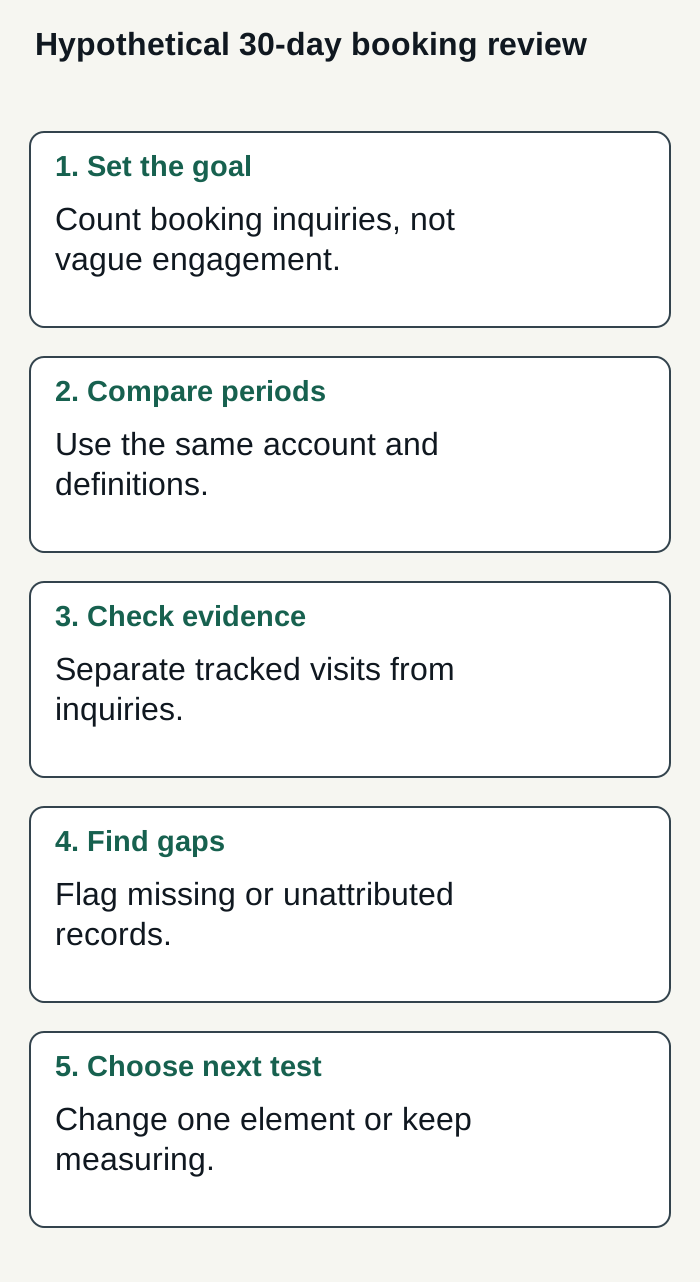
A condensed hypothetical review checklist: select a goal, record observations, note uncertainty and choose a next action. It shows no measured results.
Condensed original editorial illustration. Read the surrounding guidance for qualifications and the complete procedure; any example is fictional and shows no verified customer outcome or product screen.
Illustrative worked example by Superdirector editorial team. Created 2026-11-09.
Read the evidence and choose one next test
Use a short decision worksheet rather than a universal score. For each question, write the evidence and a next move:
- Were the posts live, and did you record the period and content scope? If not, fix the log before judging results.
- Did the chosen business outcome move in the direction you hoped? State the observed count or value, not a vague impression.
- Do supporting signals help explain that outcome? Treat reach, clicks, and interactions as context unless they are the goal itself.
- Is the comparison fair and complete enough to interpret? Note missing records, small samples, and changes between periods.
- What is one next move: continue measuring, test one change, or revisit the goal? Set a date to review it.
A rise in attention with no visible next step suggests examining whether the post makes the intended action clear and whether the destination is usable. A rise in inquiries with little tracked traffic may mean people used another route, or that tracking missed activity; investigate before assigning credit. If both outcomes are unchanged, that is a signal to test or learn more, not a universal verdict that the channel cannot work. If the data is incomplete, improve collection first.
For video creators, YouTube’s CTR guidance is a useful example of why small changes and audience differences complicate quick judgments. Do not transfer its platform-specific advice or thresholds to another channel. The broader lesson is to compare like with like and avoid treating a short-window fluctuation as a dependable result.
Choose a measurement setup you can maintain
You can run the review with native platform analytics and a spreadsheet. If web traffic matters, consistent campaign tags can help separate referrals in Google Analytics. Agree on the outcome definition before the month begins, and keep a record of changes so the next comparison has context. A more complicated dashboard is not automatically more useful if nobody can keep its data consistent.
If you delegate content production or publishing, assess the work separately from its business outcome: record review and correction time, confirm posts went live, and compare your chosen goal with a consistent baseline. For this 30-day review, judge whether delegation makes measurement and follow-through manageable—not whether a short window proves the channel works. You still choose the goal and decide whether observed results justify the cost.
For a business seeking a customizable AI-run channel around $200 a month, current Growth is $199/month for two accounts, with no trial. Publishing is limited to eligible Instagram image carousels and single X text posts, with per-piece approval or enabled account Auto-post; finished video—including TikTok, YouTube, and Reel methods—and full autonomy are upcoming. Account connection and selected source cards define what can publish. Verify the first hand-approved post is live before enabling Auto-post. Measure review effort and your own defined results; neither is guaranteed. See pricing and how publishing works for current scope and controls, including turning Auto-post off to stop unsent posts or pausing the queue.
Make the next review more useful
At the end of the month, save the dates, post count, chosen outcome, supporting signal, and any missing data. Write one sentence explaining what you learned and one change—or decision to keep measuring. Then choose the next review date. Reuse the same definitions unless you deliberately record a change.
If you want more detail on choosing measures, see social media KPIs for founders, how to track follower growth weekly, and what makes a good engagement rate. These can help identify useful signals; none supplies a universal pass mark for a 30-day review.