How-To Guide
How do you A/B test posts on Instagram, TikTok and X?
Separate paid split tests from organic comparisons and use a one-variable workflow without mistaking a directional signal for proof.
By the Superdirector editorial team. Revised using the supplied source dossier on November 9, 2026.
At a glance
How do you A/B test posts on Instagram, TikTok and X?
Start by separating paid experiments from organic comparisons. TikTok Ads Manager documents a split test for ads that shows two versions to two equal audience groups while holding other variables constant. That is not an organic-post feature. For ordinary posts on Instagram, TikTok or X, choose one goal and one element to vary, compare similar posts, and log the conditions. Because organic versions may reach different people at different times, the result is a directional clue—not a clean causal verdict. Repeat the comparison before adopting a rule.
- Paid TikTok ads: the supplied official documentation describes two ad versions and equal audience groups.
- Organic posts: change one element, use a consistent metric and record timing and context.
- Interpret cautiously: different audiences and moments can affect results independently of the change.
First separate paid tests from organic comparisons
You can compare posts on Instagram, TikTok and X, but that does not automatically make the comparison a controlled A/B test. In a controlled split test, comparable audience groups receive different versions under managed conditions. TikTok’s Ads Manager documentation describes that setup for ads: two versions, equal audience groups, and other variables held constant. It is paid-ad documentation, not evidence of an organic-post testing control.
For organic posts, you can still test a practical question—such as whether a question-led opening earns more replies than a direct statement—but each post may be shown to a different audience at a different time. Treat the result as a clue about what to try again, not proof that the opening caused the difference. The supplied sources do not establish current native organic A/B test controls individually for Instagram, TikTok and X.
| Situation | Useful approach | What the result means |
|---|---|---|
| TikTok paid campaign | Use Ads Manager split testing when the campaign fits. | A platform-managed ad comparison, not an organic-post result. |
| Instagram organic posts | Compare similar posts; document the conditions. | A directional signal; no verified general native test control here. |
| TikTok organic videos | Compare similar videos outside the ads test. | Do not call the Ads Manager split test an organic feature. |
| X organic posts | Compare similar posts and log results. | A directional signal; no verified native organic test control here. |
Choose a goal, metric and one variable
Write the question before making versions. “Will a question-led opening bring more replies than a direct opening?” is more useful than “Which post is better?” because it identifies the change and the outcome you care about. Shopify recommends defining a measurable goal before testing and changing only one element at a time. Its examples of possible variables include captions, calls to action, formats, video elements, hashtags and timing; select one rather than mixing several.
Pick a metric that reflects the question. If the goal is conversation, count replies or comments. If the goal is bringing people to a booking page, use link clicks where available. If the goal is attention, choose a consistent view or watch-time measure that the platform makes available for the content type. Record the metric before publishing. Do not switch to whichever number makes a preferred version look good afterward.
Timing itself can be the variable, but it also confounds a creative comparison: a post may attract more attention because more people were online, not because its opening was stronger. Shopify specifically flags that risk. If you are testing the opening, try to keep timing as comparable as practical; if you are testing timing, keep the creative stable. There is no need to test every possible element in one go.
Build comparable versions and record the plan
Make A the version you would normally publish and B the version with one deliberate change. Keep the topic, offer, format, length and call to action as close as practical. If your question is about the opening, change the opening and leave the rest alone. Label each version clearly in your working notes; a short tag such as “booking-hook-question” makes results easier to find later. Socialinsider recommends tagging organic test posts for later comparison, a practical recommendation rather than a platform rule.
Use this small worksheet before posting. It separates what you intended to test from what happened, so a busy week or an unrelated post does not quietly change the meaning of the comparison.
| Worksheet field | Hypothetical example |
|---|---|
| Business goal | Help more people find the appointment-booking page |
| Question | Does a question opening earn more booking-page clicks? |
| Single change | First sentence only: question versus direct statement |
| Hold steady | Same service topic, format, offer and destination link |
| Primary metric | Link clicks recorded for each post |
| Context to log | Account, post time, post age at review, unusual events |
| Decision | Repeat the comparison before changing the usual approach |
This is a hypothetical example, not a customer result or a claim that either opening will perform better. It also does not assume the platforms will distribute the posts equally. The worksheet makes your comparison interpretable: if one post goes out during a promotion or a service interruption, note that context rather than quietly treating the numbers as directly comparable.
Run the comparison without overclaiming
For a paid TikTok campaign, consult the current Ads Manager workflow and choose a goal and test variable that fit the campaign. TikTok’s documentation says split tests compare two versions of ads, split the audience into equal groups, and can test items including creative assets, targeting, placement, bidding and budget strategy. Those details apply to the paid tool described in that documentation; they should not be generalized to organic TikTok posts, Instagram or X.
For organic content, publish the comparable versions on the same account and keep the remaining choices as steady as real publishing allows. If you cannot publish simultaneously, record when each went live. Do not suggest that posting on the same weekday or at the same hour makes audiences identical: it only reduces some avoidable differences. Avoid publishing two versions so close together that your own activity changes the context, and do not alter a post mid-comparison without noting it.
Instagram-specific format matters. The supplied sources do not verify the current availability or exact behavior of an organic Trial Reels test, so this guide does not promise that feature or its metrics. Likewise, the sources do not establish a native organic A/B test for X. For both, use the worksheet approach and make the limits clear to anyone interpreting the outcome.
Review results and decide what to do next
Choose a consistent review point in advance—for example, compare each post after the same elapsed time—and record the metric and post age together. This makes the log easier to read, but does not erase differences in who saw each post, what else was happening or how distribution changed. Socialinsider notes that organic reach does not guarantee comparable audiences between versions. A post-by-post comparison therefore cannot offer the same controlled audience allocation as the documented TikTok paid split test.
Look at the primary metric first, then note other useful observations separately. If A has more clicks but B has more replies, answer the question you set in advance rather than blending both outcomes into an invented overall winner. If a version appears stronger, repeat the test with another relevant piece of content and see whether the pattern returns. Socialinsider recommends repetition rather than trusting one apparent organic winner; its suggested practice is not a guarantee of certainty.
Record a concise conclusion: “Question openings earned more clicks in this comparison; repeat before adopting.” If there is no clear difference, keep the simpler or more practical option and test a different question later. Do not conclude that the creative has no effect merely because one comparison is inconclusive. Small samples, changing audiences and outside events can obscure a real difference or make a random difference look meaningful.
A practical way to keep testing manageable
A repeatable process matters more than a complicated scoring formula. Keep a simple record with the question, versions, primary metric, publish times, review age, results and a note about unusual context. Review several comparisons together rather than allowing one unusually strong post to rewrite your entire approach. This is especially useful for a small business where the same person may create posts, reply to customers and check performance.
If you want a customizable AI-run channel for about $200 a month, assess whether delegation of research, brand context, post creation and eligible publishing helps you run this testing workflow. Your team still needs to choose the test question, check claims and review results against customer-defined goals; measure review effort and useful outcomes rather than assuming either. Superdirector’s current Growth plan is $199 a month for two accounts, with no trial. It supports eligible Instagram image carousels and single X text posts, with per-piece approval or account Auto-post when enabled. See current pricing.
Publishing depends on a connected account and the source cards selected for it. Before enabling Auto-post, the first hand-approved post must be verified live; you can turn Auto-post off to stop unsent posts or pause posting to hold the queue. See the publishing setup and how the workflow works. Finished video and fully autonomous channels are upcoming; video scripts still need your filming and final editing. This workflow can support content publishing, but it is not an A/B testing tool and does not guarantee business results.
When enlarged, scroll horizontally to read the diagram.
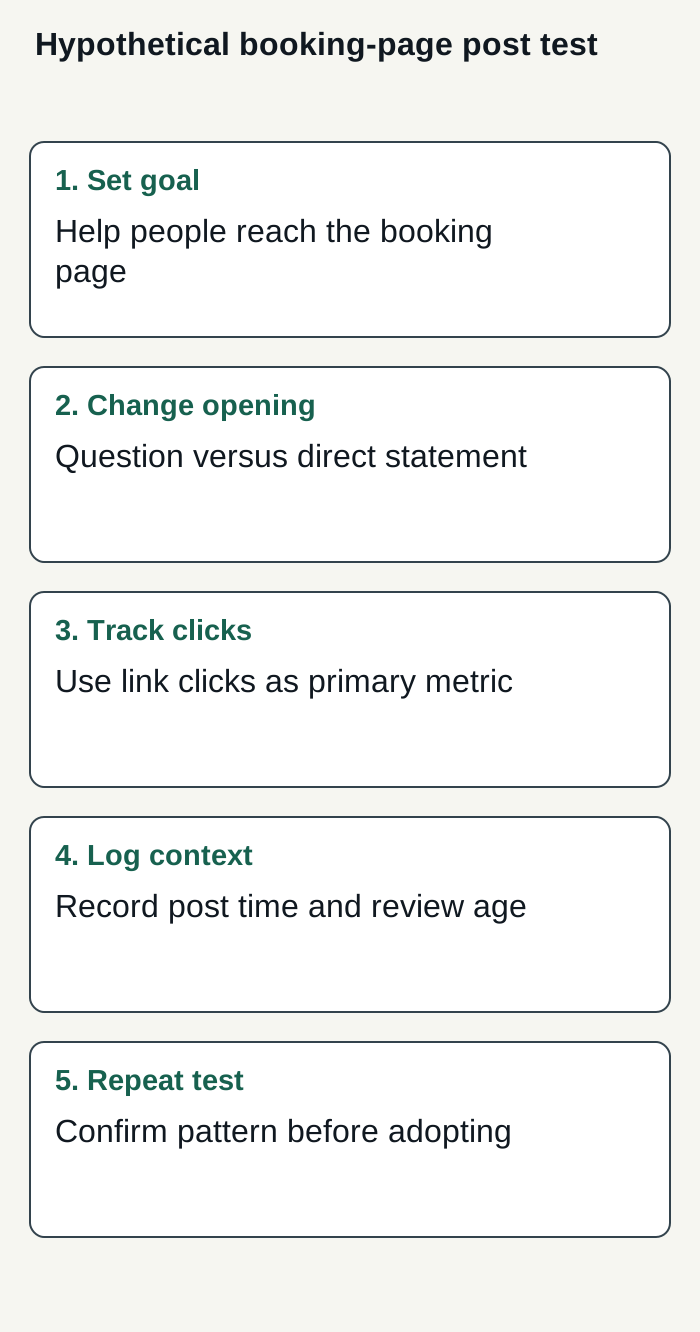
Workflow for a hypothetical booking-page post comparison; no real performance data or result is shown.
Condensed original editorial illustration. Read the surrounding guidance for qualifications and the complete procedure; any example is fictional and shows no verified customer outcome or product screen.
Illustrative worked example by Superdirector editorial team. Created 2026-11-09.