How-To Guide
AI agent or scheduler: what is the difference for a small team?
Compare decision-making, tools, approvals and publishing scope to decide which parts of your social workflow to delegate.
By the Superdirector editorial team. Revised November 10, 2026. The two workflow traces below are hypothetical; no product execution or customer outcome is claimed.
At a glance
AI agent or social media scheduler?
A scheduler executes a plan you set; an agent can use context and tools to choose steps toward a goal. They are not mutually exclusive: an agent may prepare a post while a scheduler handles its approved publication time. For a small team, compare who makes each decision, what actions require your approval, and which channels and formats the product actually publishes.
- Ask what the tool decides and what it only executes.
- Measure review time and workflow fit before delegating public actions.
The difference is who chooses the next step
A scheduler follows a plan you set: you choose or prepare the post and set when it should go out. An AI agent can use information and tools to decide what step to take toward a goal. That might include gathering context, drafting material, or asking a publishing tool to act. Products can combine the two: an agent may make decisions while a scheduler handles the timing.
That distinction is more useful than asking whether a product calls itself an “agent.” Anthropic’s description of agents centers on a model using tools in a loop. A tool is an interface for acting or retrieving information; n8n’s explanation of tools gives examples such as workflows, code, and HTTP requests. Having a tool available does not mean an agent should be allowed to use it without limits.
For a small team, the practical question is how much decision-making you want to delegate—and what evidence you will use to judge whether that delegation helps. No general comparison here establishes that agents outperform schedulers, save a particular amount of time, or produce better business results.
Ask what decisions leave your team
Ask the vendor, or map your own setup, against these questions. Write down the answer for each job rather than accepting a broad promise of “automation.”
- Who starts? Do you load a finished post, ask an assistant for a draft, or give a system a goal or trigger?
- Who chooses the next action? Does software follow a calendar you set, or decide which available action to take?
- What can it do? Can it retrieve information, draft, schedule, publish, or perform some other task? A draft-only tool is not a publishing service.
- Where does a person approve? Find out whether review is required per action, optional, or replaced by a standing rule you enable.
- What happens when something goes wrong? Can the action be stopped, rejected, or corrected? Who sees the failure and decides what to do next?
An AI-assisted scheduler may draft when asked while leaving topic choice and publication to you. A configurable workflow can connect tools and pause for a person to review a particular action. A more agent-like system can select among tools as it works toward a goal. These are useful categories, not guarantees about any product: inspect its actual workflow and permissions. n8n documents one example of a human gate: a tool action can wait for approval, and a denied action is canceled (human review for tools).

Illustrative test conditions. Products can combine both; this is not an observed tool run.
Original visual by Superdirector editorial team. Created 2026-11-10.
Choose the simplest setup that covers the gap
Start with the task that is costing the team attention, not with the most ambitious label. A scheduler is a reasonable first choice when you already know what to publish and mainly need timing and organization. An AI writing feature may help when ideas and direction are clear but drafting is slow. A human-reviewed workflow can connect several repeatable steps while preserving a checkpoint. Consider delegating a broader goal only when you can define acceptable actions, review boundaries, and how you will notice failure.
| What is stuck? | Setup to investigate | What to verify |
|---|---|---|
| Approved posts sit unpublished | Scheduler | Does it publish the channels and formats you need, at the times you set? |
| Drafting takes attention; ideas are clear | Scheduler with AI assistance | Can you edit, reject, and approve drafts before publication? |
| Several predictable steps require handoffs | Connected workflow with a human gate | Which actions pause for review, and what happens after rejection? |
| Choosing topics and carrying out recurring work is the burden | Goal-directed agent or managed service | What information informs decisions, what tools can act, and how much oversight remains? |
| You need replies or coverage on a channel the tool does not support | Separate channel or inbox tool | Does the product actually cover that channel and task today? |
Treat these as starting points, not performance findings. Begin with the least complex option that addresses the identified problem, then test whether broader delegation is useful. For longer-running agents, context matters: Anthropic notes that systems operating over multiple turns need to manage the evolving information available to them, not just rely on an initial prompt. Ask what brand guidance, current information, and prior decisions the system uses—and how outdated or irrelevant context is handled.
Trace the same brief through two kinds of workflow
Reused hypothetical fixture: the two-person bicycle repair shop from our educational carousel exercise wants to explain a changed appointment process on Instagram. Here we reuse only that brief, not its five-slide payload. The comparison below is a proposed decision trace, not a record of either product running. Both candidates receive the same agreed shop facts, audience and publication boundary.
| Decision point | Scheduler-only test: who acts? | Goal-directed test: what must be demonstrated? |
|---|---|---|
| Start the job | A person supplies the finished post and its chosen publishing time. | Give the candidate a bounded goal and allowed inputs; require it to show what job it selected before it acts. |
| Choose the next step | The team decides which content to prepare; the queue does not settle that decision in this test. | Ask for the chosen next step and the supplied facts behind it. A draft alone does not demonstrate an action loop. |
| A booking detail is missing | A person stops preparation and confirms the missing detail. | Require the candidate to expose the gap and ask for the needed fact, rather than invent a booking term. |
| Approve a public action | The owner approves the exact post before it enters the selected publishing route. | Inspect the proposed content and action against the actual authority. A planning goal is not blanket permission to publish. |
| Observe delivery | Check the destination rather than treating a scheduled row as publication. | Require the available status or destination evidence; record an unavailable observation as unknown. |
| Delivery is uncertain | The responsible person investigates before choosing another submission. | Require a named uncertainty and a proposed recovery decision; do not assume an automatic retry is safe. |
| Choose the following job | A person reviews the observations and sets the next task. | Ask the candidate to demonstrate how it uses the permitted observations in its next decision; do not infer business value from one post. |
These columns specify the test conditions; they do not classify every scheduler or agent. A scheduler may have more features, and an agent may need a person to start or approve each action. Leave any unperformed step untested. The question is whether the selected setup takes on the decisions you actually want to delegate.
Use the accompanying blank decision log to record the evidence you observed for each row. Keep customer briefing, review, correction and recovery time separate from operator intervention and waiting. No duration, accepted-output count, publication or business result has been filled in. If the candidate cannot resolve a required decision within its allowed scope, keep that step with the team or choose another setup.
When enlarged, scroll horizontally to read the diagram.
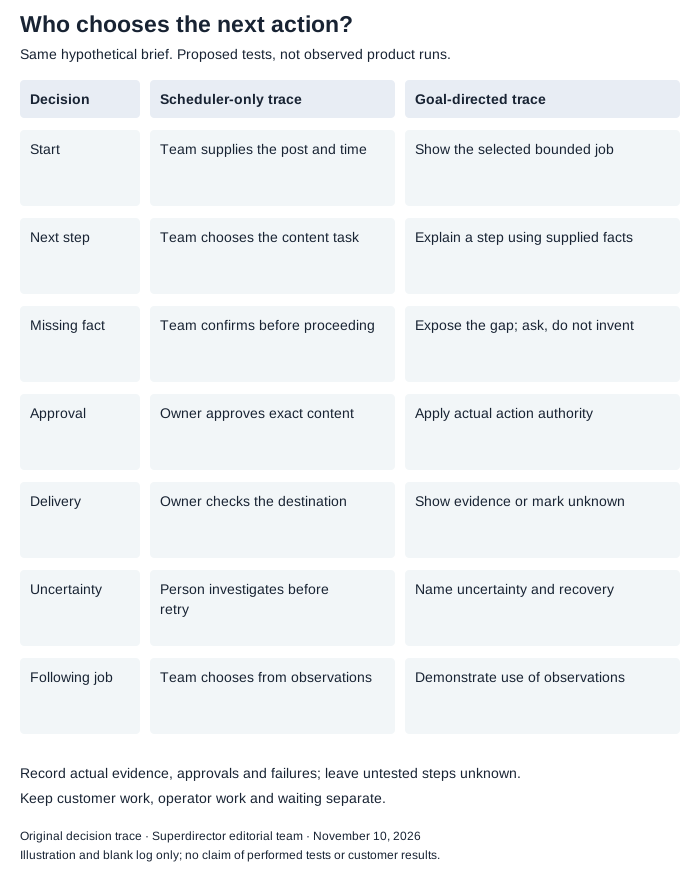
A proposed ownership test using a reused hypothetical brief. These are decisions to demonstrate, not vendor behavior or measured results.
Blank decision log; record evidence and active effort yourself. No formulas, accepted outputs or customer results are supplied.
Illustrative worked example by Superdirector editorial team. Created 2026-11-10.
Set approval boundaries and verify delivery
Before connecting a public account, list actions that must stop for review. For a social post, that may include factual claims, customer information, brand-sensitive language, and the final media and caption. Keep the review specific: a useful approval shows the proposed action and its content, rather than asking someone to sign off on an unspecified “AI plan.” A technical workflow can pause before a tool acts; n8n describes approval and denial as distinct outcomes in its human-review guidance.
If the burden is continuing account decisions and creation, compare that job with Superdirector’s declared primary offer: $199/month for one customizable AI-run social account, in the brand direction you set and within agreed supported scope. Its separate $29/month MCP/manual offer covers directed individual jobs, not native repeated channel operation. Connection slots are a different unit; confirm the one operated account and quote any additional operating scope instead of assuming a second connection buys a second operated account.
The documented publishing route covers eligible Instagram image carousels and single link-free X text posts, with per-piece approval unless an enabled account Auto-post rule covers them. The first manually approved post must be verified live before Auto-post is enabled. Finished AI video and fully autonomous channels remain publicly marked upcoming; do not treat TikTok, YouTube or Reels video publishing as included. Confirm the owned destination, formats and controls in the publishing setup. The public subscription pricing page still describes Growth as including two accounts and extra account capacity. That wording does not establish two operated accounts under the declared $199 one-account service offer. Confirm the operated account, agreed jobs and current service availability separately before paying.
The publishing guide describes Auto-post off as stopping unsent posts and Pause posting as holding the queue. This article does not establish recall of an action already submitted to a provider. In the decision trace, ask who notices that uncertainty and chooses the next action. Before continuing a paid account service, compare delivered work, active customer effort, operator intervention and the customer-defined result; no low-oversight or business-return outcome is demonstrated here.

Conceptual illustration: an approval or submission receipt alone does not prove publication.
Original visual by Superdirector editorial team. Created 2026-11-10.
Run a bounded buying test
Use one account and a defined task. First record how your current process works; then repeat the same kind of task with the tool, without changing your standard of review. A short worksheet can make the comparison concrete:
| Record for each attempt | What to write down |
|---|---|
| Task and goal | What was being made or scheduled, for whom, and why? |
| Decision ownership | Who found the idea, chose the format, drafted, set the time, and approved? |
| Team effort | Time spent preparing, checking, correcting, and resolving publishing issues. |
| Disposition | Published as proposed, edited before publishing, or rejected; note why. |
| Delivery check | Whether it appeared as intended on the selected account and format. |
| Goal measure | Choose a measure relevant to the task; note the observation period and avoid attributing changes to the tool alone. |
Decide in advance what would make the tool worth continuing: for example, acceptable review effort, fewer manual handoffs, or reliable execution of the task you selected. Keep cost and human oversight in the comparison. If the first attempt fails, identify whether the issue was the brief, information, generated work, approval path, or publishing support before changing the process.
A short test can tell you whether a workflow is worth investigating further; it cannot establish durable results from a small number of posts. Keep a scheduler for work it covers well. Add an agent or managed service only where the extra decisions and actions address a real gap—and retain the approval boundaries your team needs.