How-To Guide
What is seeding marketing, and how does a product seeding program work?
Seeding marketing means sending free products to creators with no post required. How a 20-box seeding test works, what the FTC requires, and what to measure.
By the Superdirector editorial team. FTC, eCFR and ASA pages and seeding guides read November 6, 2026.
At a glance
What is seeding marketing, and how does a product seeding program work?
Seeding marketing, or product seeding, is sending your product free to creators or customers without paying them or requiring a post, so that some use it and talk about it. A program runs as a loop: choose about 20 people who already fit, ask before shipping, send one kit with a disclosure line, log posts for four weeks, and offer paid or affiliate work to those whose posts did best. In the US a free product is a material connection, so posts still need a disclosure.
- Seeding asks for nothing; paid posts and ambassador programs ask for defined work.
- The FTC's Endorsement Guides cover free products even when no post is required.
- Score with post rate, cost per post, views per dollar and code redemptions.
What seeding marketing means
Seeding marketing, usually called product seeding, means sending your product free to creators, customers or other people whose audience you want to reach, without paying them or requiring a post, in the hope that some will use it and talk about it. A seeding program runs as a loop: choose a short list of people who already fit, ask before you ship, send one kit, record who posted and what each post got, then offer paid or affiliate work to the people whose posts did well.
Shopify's guide defines it the same way, as free merchandise sent without an explicit request to create content, and notes that brands send to many people expecting a small share to post. Shopify credits seeding for much of olive oil brand Graza's recognition and quotes its brand director, at a conference Shopify presented, calling it '99.5% organic product seeding'.
Seeding, gifting, paid posts and ambassadors compared
The terms overlap and vendors use them differently. Sprout Social treats gifting as a no-strings hello and seeding as a test: if a creator posts and their audience engages, that is a green light for paid work. Status describes seeding as sending products in exchange for word of mouth. The useful line is what you ask for:
| What you give | What you ask for | When it fits | |
|---|---|---|---|
| Gifting | A product, no strings | Nothing | Saying thanks to a customer or creator you like |
| Seeding | A product to a planned list | Nothing required; you watch who posts | Testing which creators and messages work before paying |
| Paid post | A fee, often plus product | A defined post by a date | Creators whose seeded posts already worked |
| Ambassador program | Ongoing product, codes or commission | Repeated posts or referrals over months | Customers and creators who keep posting about you |
Whatever you call it, the disclosure rule is the same, which the next section covers.
A post about a free product still needs a disclosure
Many brands assume that because they did not ask for a post, nothing needs to be disclosed. US rules say otherwise. The FTC's Endorsement Guides (16 CFR 255, revised July 2023) say material connections include 'the provision of free or discounted products ... regardless of whether the advertiser requires an endorsement in return'. The FTC's guide for influencers tells creators to disclose when a brand gave them free products and they mention it, 'even if you weren't asked to mention that product'.
- The brand carries duties too. The Guides say advertisers should guide endorsers on disclosure, monitor their compliance, and act to fix problems, and that an advertiser may be liable even when the endorser is not.
- Plain words work. The FTC says 'Thanks to Acme brand for the free product' is often enough if it is hard to miss, and warns against vague tags like 'spon', 'collab' or a bare 'thanks'.
- Place it where people look. A disclosure only in a bio, at the end of a video or behind 'more' is likely to be missed; in a video it belongs in the video itself, and a platform's own label may not be enough on its own.
- Small gifts count. FTC staff answer that judging whether a small gift matters 'can be difficult. It's always safer to disclose'.
- Outside the US, the UK's ASA applies its 'ad' label to everything from a post about a gifted product to a full brand collaboration, and says labels such as 'Gifted' or 'Thanks to X for making this possible' are unlikely to be clear enough; for a UK audience, ask for an 'Ad' label up front. Check the rules where your audience lives.
When enlarged, scroll horizontally to read the diagram.
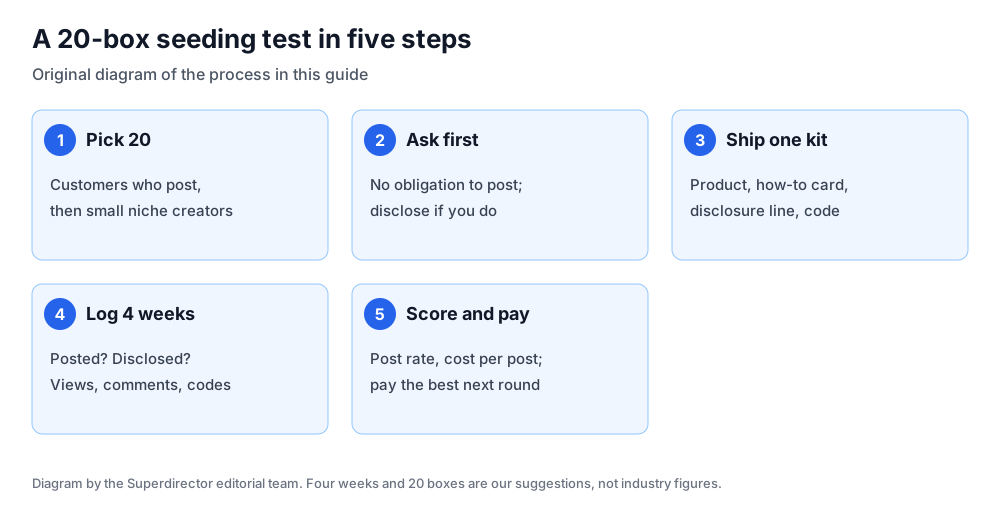
Original diagram of the process in this guide. Twenty boxes and four weeks are our suggestions.
Original visual by Superdirector editorial team. Creation date not recorded.
Pick 20 people who already fit
The people most likely to post about a product are the ones who already buy or cover it. Status notes that seeded creators are often past customers or creators a brand has worked with. Build the list in two halves:
- Ten customers who post. Look through tagged posts, reviews with photos and the people who reply to your stories.
- Ten small creators in your niche. Pick accounts whose last ten posts include your category, whose comments come from real buyers, and whose audience lives where you ship.
Twenty boxes is our suggestion for a first test: enough to see whether any message or creator type works, small enough that the product and postage cost stays modest. Our guide to getting influencers to promote a product for free covers finding and vetting the creator half.
Ask before you ship
Unannounced boxes can go to old addresses, get lost or feel pushy. A short message first gets you a confirmed address and a better chance of a real reaction. Say who you are, what you would like to send and why you thought of them, that there is no obligation to post, and that if they do post you would like them to mention the product was free. Ship only to people who reply yes.
Send one kit with a disclosure card
Send the product customers buy most, not a sampler of everything. Add a card with how to use it and one sentence on disclosure, so the creator has the words ready. If you want to track sales, include a personal discount code or affiliate link; Shopify reports that Three Ships sets creators who post up with affiliate links so they earn commission. Keep the cost of each box (product at your cost plus postage) in the sheet: apart from your time and any discount a code gives away, it is the whole cost of a seeding test.
Log every post for four weeks
Check each person's feed and Stories for four weeks after delivery, our suggested window for a creator to try a product and post. Record whether they posted, whether the disclosure was clear and near the start, the views and comments seven days after posting, and any code redemptions. This log is also how you monitor disclosures, which the FTC's Guides say advertisers should do. If a post lacks a clear disclosure, ask the creator to add one.
Score the test and decide who to pay next
Score the test with your own numbers, not industry averages. The seeding test worksheet has 20 rows and four totals:
| Number | How to work it out | What it tells you |
|---|---|---|
| Post rate | Posts / boxes shipped | Whether your list and message were right |
| Cost per post | (Product cost + postage) / posts | What a seeded post costs you, to compare with a paid one |
| Views per dollar | Day-7 views / total box cost | Reach for the money, across all posts |
| Code redemptions | Sum of uses of each code | Whether posts moved sales, where you used codes |
Then decide person by person. Offer paid or affiliate work to people whose post beat their own recent average and who disclosed clearly; thank and stop with people who said yes and did not post. When Superdirector runs creator campaigns for its own brands, it pays only after a post is live and checked, with nothing upfront; that is our practice, not a market rule.
Where Superdirector fits
Superdirector, which publishes this guide, can build the creator half of your list. Its creator search shows each creator's match score, followers, region and any contact method it found, and saves the research without contacting anyone; outreach and shipping stay with you. It also remakes posts that are working in your niche as carousels and X posts for your own account, which helps when seeded creators are slow to post. AI video and full autopilot are coming soon. See how it works.