How-To Guide
Content creator vs influencer: what is the difference for a brand hiring one?
A content creator sells you files you post; an influencer sells reach on their account. How to price each, who owns the content in the US and what to measure.
By the Superdirector editorial team. US Code title 17, 16 CFR 255, FTC, TikTok help pages and the top-ranking guides read November 6, 2026.
At a glance
Content creator vs influencer: what is the difference for a brand hiring one?
A content creator is paid for content: you receive files and post them on your own account, site or ads, so you pay per usable asset and handle distribution. An influencer is paid for an audience: the post goes out on their account to followers who trust them, so you pay for reach, which we suggest pricing per 1,000 measured views. Many people do both; what the contract buys decides which hire it is. In the US the maker owns the content unless it qualifies as a work made for hire under a signed agreement or a signed written transfer moves it.
- Content creator: price per usable asset, plus your own ad spend to show it.
- Influencer: price per 1,000 views measured on an agreed day.
- Write ownership or the license down and have both sides sign.
The short answer
A content creator is someone you pay for the content itself: you receive the videos or photos and post them on your own account, site or ads, so you pay per usable file and the distribution is your job. An influencer is someone you pay for their audience: the post goes out on their account to people who already trust them, so you pay for reach and credibility, which we suggest pricing per 1,000 views the post actually gets. Plenty of people do both, so the deciding question is what your contract buys: files you control, or a slot in someone else's feed.
Shopify puts it in one line: 'You hire creators for the content they produce, and influencers for the audience they reach.' Billo says the difference between UGC and influencer work 'is contractual and operational', and Popular Pays that it lies in how brands decide to engage the person. Every influencer makes content; not every content creator has an audience.
Content creator vs influencer side by side
| Content creator | Influencer | |
|---|---|---|
| What you buy | Files: videos, photos, scripts | A post (or Story, video) on their account |
| Where it runs | Your account, site, emails and ads | Their feed, to their followers |
| Their audience | Mostly irrelevant; you judge the work | The main thing you are paying for; price it on measured views, not follower count |
| Who owns it by default (US) | The creator, unless the work qualifies as made for hire under a signed agreement or is transferred in signed writing | Typically the creator; you get the use the contract grants |
| How to price it | Cost per usable asset, plus your own ad spend | Cost per 1,000 measured views |
| Creative control | High: you brief and approve | Lower: their voice is the reason it works |
| Disclosure | When they appear as a user in your ad: they must have used it, and a connection viewers would not expect is disclosed | Needed for any payment or free product |
The hire sheet turns both quotes into numbers you can compare, with the decision questions at the bottom.
When enlarged, scroll horizontally to read the diagram.
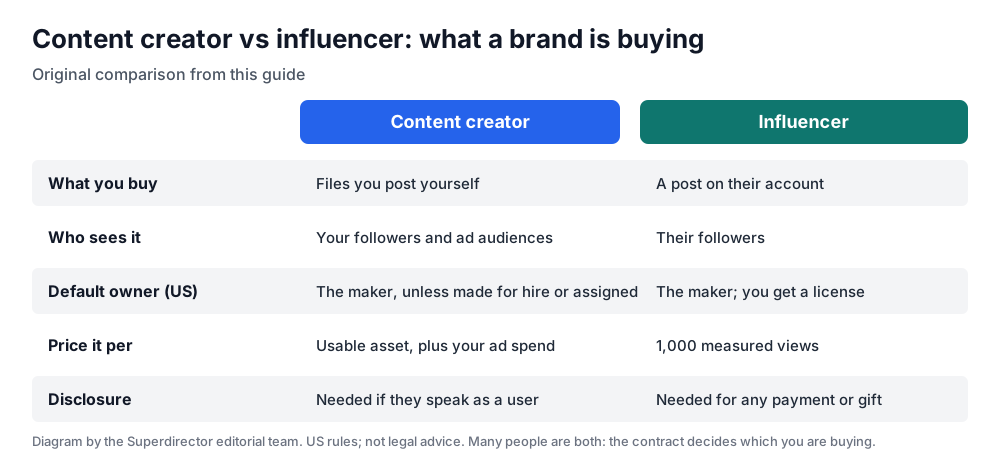
Original comparison from this guide. US rules; not legal advice.
Original visual by Superdirector editorial team. Creation date not recorded.
Write down whether you need files or an audience
Start from the job, not the label. Ask what you will have when the work is done:
- Files you will post again and again, such as product demos for ads, carousels for your own feed or a video for your landing page. That is a content creator hire. Billo notes that 'the creator's own follower count doesn't matter, because the brand is the one distributing the content.'
- Attention from people who have never heard of you, coming from someone they follow. That is an influencer hire. Shopify's own list of drawbacks adds a caution: audience access does not guarantee awareness or sales.
- Both, usually the most expensive version, since you pay for the audience and the usage rights: the influencer posts to their audience and you also license the video to run in your own ads.
Not sure which influencers to pay yet? Seeding a small batch of product first can show who posts and whose audience reacts, before any fee. If you cannot name the post you will run or the audience you want, you are not ready to hire either. Our guide to UGC and influencer marketing covers the related question of whose account content sits on.
Price both hires on the same sheet
The two hires are quoted differently, so compare them on two numbers you work out yourself. Here is a worked example with illustrative figures, not market rates:
| Content creator | Influencer | |
|---|---|---|
| Quote | $600 for 4 short videos | $300 for 1 TikTok post |
| What you get | 3 videos you will actually run | 25,000 views measured on day 7 |
| Basic unit cost | $200 per usable video | $12 per 1,000 views |
| Cost to be seen | Plus $300 of your ads for about 40,000 views | Included: their account distributes it |
| All-in per 1,000 views | ($600 + $300) / 40,000 x 1,000 = $22.50 | $12.00 |
The creator's files look dearer per view in this example, but if your contract gives you ownership or a long enough license, you can run them again next month and the production cost spreads over more views, while the influencer post is spent once its feed moment passes. That is why the sheet asks how many times you will use each file.
For what creators commonly ask per post, see our influencer rate guide.
Put ownership or a license in writing
This is the part most comparisons skip. Under US copyright law the maker owns the work from the start: copyright 'vests initially in the author' (17 U.S.C. 201(a)), and the Copyright Office says a work is protected the moment it is created and fixed in a tangible form. Paying for a video does not change that by itself.
- Work made for hire. A freelancer's video counts as the brand's own work only if it falls in a category the law lists, such as 'a part of a motion picture or other audiovisual work', and the parties 'expressly agree in a written instrument signed by them' that it is a work made for hire (17 U.S.C. 101). Then the brand is treated as the author (201(b)).
- Assignment. Otherwise ownership moves only through a transfer that is 'in writing and signed by the owner of the rights conveyed' (17 U.S.C. 204(a)).
- License. With an influencer you usually do not buy ownership at all. Shopify notes influencers 'typically retain ownership of content'. Write down where you may reuse the post, for how long, and whether you may run it as an ad.
- Ads from their post. TikTok's Spark Ads let a brand run a creator's organic post as an ad 'with their authorization', through a code whose duration is set for the campaign. Agree that duration and the fee for it before you boost.
Rules differ outside the US, and this is not legal advice: have a lawyer check the contract. Our usage rights checklist and the guide to agreeing paid use before boosting a creator's post list the clauses.
Agree how views are counted before the post goes live
Board of Creators, reporting an IAB initiative, says brands, agencies and platforms 'define views differently, negotiate rights from scratch and measure results in their own ways' (report). You cannot fix the industry, but you can fix your own deal. Put four things in writing before an influencer posts:
- The exact post: platform, format and the account it goes on.
- The count you will use: the platform's own view count, not an estimate from a third-party tool.
- The day you read it, such as seven days after posting, so neither side picks a convenient date.
- The proof: a screenshot of the post's insights or an export, sent by the creator.
Also decide in writing what happens if the post falls short: a flat fee you accept either way, a fee per 1,000 views with a cap, or one make-good post. For a content creator, the measure is your own: the views and results the files get on your account and in your ads, read the same way each time.
Disclosure applies to both hires
The FTC's Endorsement Guides (16 CFR 255) define an endorsement as any advertising, marketing or promotional message for a product 'that consumers are likely to believe reflects the opinions, beliefs, findings, or experiences of a party other than the sponsoring advertiser'. A paid influencer post praising your product usually is one. So is a content creator talking as a happy customer in your ad, which is why the Guides add that an endorser shown using a product 'must have been a bona fide user of it at the time the endorsement was given'.
The influencer discloses the payment or free product in the post; the FTC's guide for influencers says to disclose free products 'even if you weren't asked to mention that product'. The brand carries risk too: an advertiser may be liable for a deceptive endorsement even when the endorser is not.
Decide which posts a remake can cover
A lot of commissioned content is a steady run of posts for the brand's own account in formats that are already working in its niche: a five-slide list, a question hook, a before and after. For that kind of post, you may not need to commission each one. You can study what is working for accounts like yours and remake the format, with your own product, words and look.
Two things a remake cannot replace. It cannot borrow someone else's audience, so it is no substitute for an influencer when the goal is reaching new people through someone they trust. And it cannot stand in for a real customer: no remake should present an invented person describing an experience with your product, which the bona fide user rule above exists to prevent.
Where Superdirector fits
Superdirector, which publishes this guide, does the remake side. It watches the accounts, competitors, keywords and hashtags you choose on Instagram, TikTok, YouTube and X, picks the formats that are taking off, and rebuilds them with the same hook and structure as carousels and X posts in your brand. On Growth ($199 a month, two accounts) it posts Instagram carousels and single X text posts after you approve the first one or under a standing Auto-post setting; AI video and full autopilot are coming soon. It can also find and screen creators, but it does not contact or pay them: that stays with you. You remain the publisher and label AI content where a platform requires it. Starter is $29 a month and starts with a 7-day free trial with 100 credits (card required). See how it works.