How-To Guide
Which post formats get replies on X? Worked examples for founders
Try decision posts, focused questions and specific lessons to invite conversation. Compare the formats on your own X account.
By the Superdirector editorial team. Examples labeled hypothetical were written for this guide; they are not customer results.
At a glance
Which X post formats are worth trying?
Try a decision with a real tradeoff, a focused question that draws on readers’ experience, or a specific lesson from work you actually did. A progress update can also invite conversation when it says what changed and leaves room for a useful response. These are practical starting points, not proven reply winners: the supplied sources provide practitioner examples, not a measured comparison of formats.
- Show a real choice, then explain what you are weighing.
- Ask one focused question that your intended reader can answer.
- Compare posts on your own account; do not assume a format guarantees replies.
Start with formats that give people something to answer
If your goal is conversation, try a post that gives readers a clear opening: a real decision, a specific lesson, a progress update with a point, or a focused question. These formats can make it easier to see what a reader might respond to. None guarantees replies, and the sources available for this guide do not establish which format gets the most.
| Format to try | What gives readers an opening | Useful when |
|---|---|---|
| Decision post | A choice and the tradeoff behind it | You can explain what you are weighing |
| Focused audience question | A specific choice readers can answer | Readers may have relevant experience |
| Lesson from work | A real moment and a takeaway | There is something useful to learn |
| Progress update | What changed and what remains unresolved | The update has context beyond an announcement |
These are editorial starting points, not an evidence-backed ladder. Practitioner guides include asks, decisions, progress updates and lessons among their suggested formats. For example, Ravah’s founder post ideas recommend grounding a post in a real moment, angle and takeaway, while Postory’s X playbook describes decisions as a way to invite useful replies. Those are recommendations, not measured proof of results.
A format is only one part of a post. A question asked of the wrong audience, or one that takes research to answer, may not start a conversation. Be specific about what happened, make your point understandable without a long setup, and ask only when you genuinely want to hear the answer.
Work one product decision into three X posts
Here is a hypothetical example, not a customer story or a report of real results. Imagine a small software founder considering whether to simplify onboarding. The founder has noticed that the current flow asks new users to configure several options before they can try the product. They are deciding whether to ask for fewer choices up front.
| Format | Hypothetical draft | Why it may invite a response |
|---|---|---|
| Decision | “We’re considering moving optional setup until after someone tries the product. More guidance up front, or a quicker first step? We’re weighing clarity against getting started sooner.” | Names a tradeoff readers can discuss. |
| Lesson | “I assumed more setup choices would make onboarding clearer. Now I’m questioning whether people need to try the product before making those choices. What has helped you make a first step feel simpler?” | Shares a revisable view and asks from experience. |
| Audience choice | “For a first-time user, which would you rather see first: a short example using the product, or a chance to configure it? What makes that feel easier?” | Offers two clear options and asks for a reason. |
The three drafts draw on the same hypothetical decision but ask for different kinds of replies: reasoning, a lesson from experience, or a preference with context. If the founder has no real basis for the premise, they should not post it as fact. Replace it with a genuine decision, remove any unsupported claim, and make sure the answer is useful to the intended audience.
A progress version could state what has actually changed and ask what remains unclear. A milestone without context may be an announcement rather than an invitation to discuss. A metric post should use real figures the account is willing to share; do not invent numbers to make a draft feel more persuasive. Practitioner guides list progress, decisions, lessons and metric updates as possible themes, but do not establish that any one theme reliably earns replies.
Make the question easy and worthwhile to answer
Before posting, check whether the reader can understand the situation and see what sort of answer would help. A compact question is not automatically a good one: readers still need a reason to care and enough context to respond.
- Give the question a subject. Name the decision, experience or problem rather than ending a vague statement with “thoughts?”
- Ask for something the reader knows. A question based on the audience’s own experience is usually more answerable than one requiring research.
- Keep it to one invitation. Several unrelated questions make it unclear which response you want.
- Make the options honest. If you offer two choices, do not frame one as obviously foolish just to provoke disagreement.
- Reply as a person. When people answer, acknowledge what they said or ask a relevant follow-up. Do not treat their responses as a resource to collect and ignore.
These are recommendations for writing and conversation, not claims about X’s ranking system. Do not infer that asking a question earns more distribution, or that a visible reply count proves a format caused the response.
Compare formats without overreading the results
The supplied sources do not include a controlled comparison of reply rates by format, and they provide no reliable reply benchmark for an account to target. If you want to learn what fits your audience, keep a simple record and make the comparison modest.
- Choose a question you genuinely want answered. Pick two formats that could both address it, such as a decision post and a focused audience-choice question.
- Keep the topic and audience comparable. Record when and how each post was framed, along with the format. Avoid comparing unrelated announcements, audiences and topics as though format were the only difference.
- Log replies from other people. Note useful responses separately from votes, likes and your own replies. You may also note whether the conversation was relevant to your business goal.
- Look for repetition, not a winner from one post. A striking response to one post is a prompt to learn more, not proof that the format caused it. If the posts differ in topic or context, call the result inconclusive.
- Use the finding to write the next draft. Keep the format that best fits the conversation you want, and revise the prompt if replies are off-topic or the question was unclear.
Do not force a fixed posting cadence or declare a statistical winner from a small informal comparison. Your record can help you notice what topics your audience chooses to discuss; it cannot isolate every reason a post received a reply.
Decide what to delegate and what to measure
A tool may help with research, brand memory, creating drafts and publishing. Those tasks are different from participating in a conversation or proving that paying for delegation is worthwhile. Measure whether the work saved, the relevance of drafts and the time you still spend reviewing and responding against your business goal; do not assume a particular result or oversight burden.
For a business seeking a customizable AI-run channel for about $200 a month, Growth is currently $199 monthly for two accounts, with no trial (pricing). Researching ideas and drafting this article’s single X text posts can be delegated; the customer still needs to decide which conversations matter and assess business-defined results, relevance, and time spent reviewing and replying. Compare that effort and those results with the cost rather than assuming minimal oversight or guaranteed growth.
Current publishing is limited to eligible Instagram image carousels and single X text posts, by approval of each post or an enabled account Auto-post rule; polls, TikTok, YouTube, Reels, and finished video are outside that publishing scope. The account connection and selected source cards determine what can publish. Before enabling Auto-post, verify that the account’s first manually approved post is live. You can stop unsent work by turning Auto-post off or pausing posting; see the publishing setup for the controls. Finished video and fully autonomous channels are upcoming, not current capabilities.
When enlarged, scroll horizontally to read the diagram.
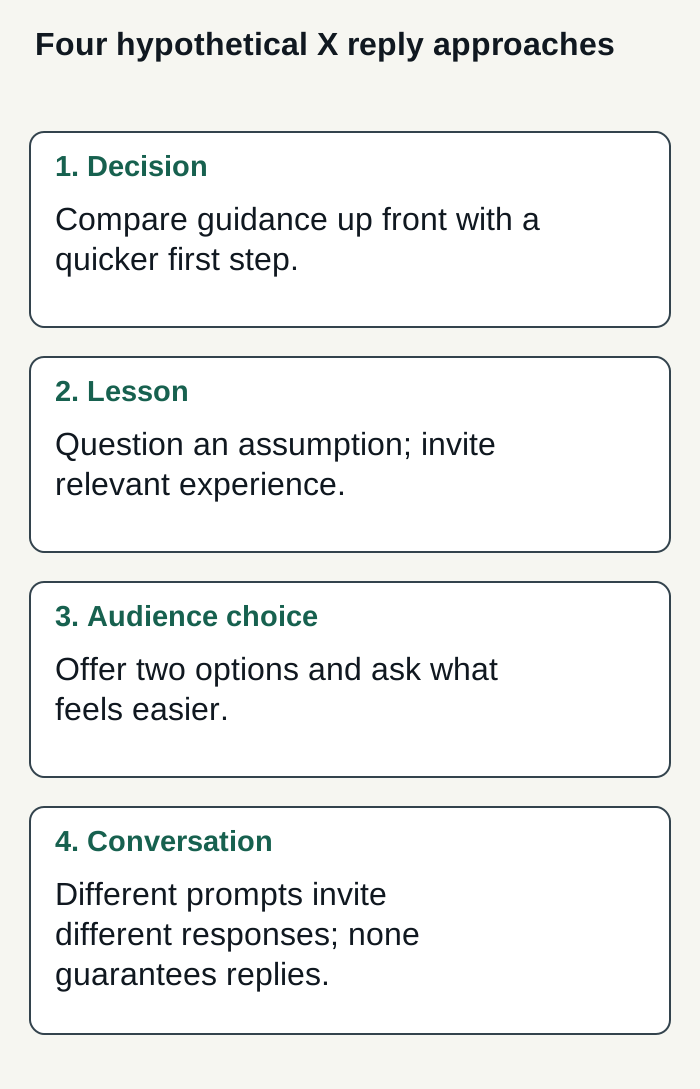
Editorial diagram using hypothetical onboarding examples, not customer results.
Condensed original editorial illustration. Read the surrounding guidance for qualifications and the complete procedure; any example is fictional and shows no verified customer outcome or product screen.
Illustrative worked example by Superdirector editorial team. Created 2026-11-09.