How-To Guide
How do you find the highest-performing posts on X in your niche and learn from them?
Build a focused sample of niche X posts, compare performance in context and test one original adaptation against your account's baseline.
By the Superdirector editorial team. This revision uses the supplied source dossier and references read on November 9, 2026. The hypothetical worked example is invented for illustration, not a report of observed account results.
At a glance
How do you find the highest-performing posts on X in your niche and learn from them?
Define the audience and goal first. Gather recent posts from a consistent set of relevant accounts or searches, record the signals you can inspect, and compare posts in context rather than sorting only by likes. Annotate recurring choices in the idea, opening, format, and evidence. Then test one original adaptation and compare its results with your own baseline. Treat the sample as directional: no supplied evidence shows a complete ranking of niche posts or guarantees that a pattern will work for another account.
- Use one clear business or audience question to decide which posts belong in your sample.
- Separate raw counts from relative performance and from outcomes that matter to your goal.
- Adapt an idea or structure in your own words; do not assume imitation reproduces results.
The short answer: compare a focused sample, not a viral leaderboard
To learn from high-performing posts on X, start with a specific audience and goal, collect a consistent sample of relevant posts, and compare their signals in context. Then look for creative choices that recur across authors and test one original adaptation on your own account. A like count is a useful clue, not a universal definition of success: the right measure depends on whether you want discussion, profile interest, link visits, or another outcome.
There is no supported recipe here for ranking every post in a niche. X's repository README describes components of recommendation services, including candidate sourcing and ranking, but it does not provide a complete public method for finding niche leaders. Treat a search or tool's results as a sample, not the whole conversation.
- Decide what audience and business question the research should serve.
- Gather recent posts using a consistent set of relevant accounts, phrases, or listening tools.
- Compare a chosen signal with context, then annotate the posts for patterns.
- Test one adaptation and judge it against your own baseline.
Start with a question and a comparable sample
“Find viral posts” is too broad to guide a useful review. Make the question concrete: for example, “Which kinds of posts explain a booking process clearly enough to prompt relevant questions?” That narrows both the search and the criteria for learning from it. Choose a recent observation window that fits your research task, and write down when it begins and ends so the next review is comparable.
- Audience: who do you want to reach, and what do they need to understand?
- Sources: list relevant public accounts, organizations, practitioners, or phrases to search. Include more than one author so one person’s style does not define the result.
- Inclusion rule: decide what makes a post relevant before collecting it, such as discussing the chosen question directly.
- Goal: name the response you care about, such as thoughtful replies or visits to a booking page.
Use X search for discovery, an account list for a focused review, and native post analytics where available for metrics on your own account. Third-party listening or analytics tools may broaden collection or reporting, but access, coverage, and definitions can differ. The supplied references do not verify present-day access requirements or that any tool captures every niche post. Note the source and date of your sample rather than implying it is exhaustive.
Collect candidates and choose a useful signal
Keep the capture sheet simple enough to use consistently. For each relevant post, record its link, author, date, topic, visible engagement signals, and the source where you found it. Add impressions, profile visits, or link clicks only when you can actually inspect them. Do not fill missing values with guesses.
| Field | What to record | Why it helps |
|---|---|---|
| Post and author | Link, account, and date | Lets you revisit the example and see whose work it is |
| Context | Topic, audience question, and discovery source | Shows why the post entered the sample |
| Available signals | Visible replies, reposts, likes, or inspectable analytics | Keeps observation separate from interpretation |
| Creative choices | Opening, format, evidence, and requested action | Makes comparison about more than a count |
Choose one primary signal that fits the question, and keep other signals as context. Likes and reposts can indicate different kinds of response; impressions indicate how often a post was shown, not whether it met a business goal. For your own posts, X analytics information summarized in Sprout Social's guide describes measures such as impressions, engagements, profile visits, and link clicks, while noting that availability can depend on account features and region. Treat that guide as practitioner documentation, not a guarantee of current access.
Compare posts in context
Hypothetical example: A small booking business wants to learn which posts help people understand how to book a consultation. The team finds three relevant posts from different public accounts. It can see like counts, but not comparable impressions or account-wide analytics for those authors. It therefore avoids calling the post with the most likes the winner and uses the counts only as a starting point.
| Post | Visible likes | What the post does | Careful interpretation |
|---|---|---|---|
| A | 180 | Explains what happens after someone requests a booking | Potentially useful explanation; no evidence here about clicks or bookings |
| B | 420 | Shares a short checklist of details to have ready | Highest visible count in this tiny sample; not necessarily the best fit |
| C | 95 | Answers a recurring question with a clear next step | Lower count, but directly addresses the team's research question |
These invented counts are not measurements from real accounts. The sample is too small, and its missing reach data makes the counts hard to compare. The team records a useful observation instead: two posts make the next step explicit, while the checklist anticipates reader uncertainty. It can test an original post that answers one genuine booking question and states the next step plainly. It should then review the responses and, if available, relevant profile or link activity against its own usual posts. The exercise produces a testable idea, not a claim that one format caused the observed likes or will bring bookings.
For a larger review, compare posts within similar time windows and, when possible, against the author's typical posts. A practitioner guide from Sprout Social recommends looking for recurring themes in top posts. That is a useful observation practice, but repetition alone does not establish causation or predict results for another account.
Look for patterns, then test one adaptation
Review the sample and label a few observable choices: the question or claim in the opening, the kind of evidence, whether it is a single post or thread, and what response it invites. Count how many different authors use a choice. If it appears in one author’s posts only, it may be that author’s signature rather than a broad niche pattern.
Turn a promising pattern into a small, reversible test. State the hypothesis before publishing: “A direct answer to a common booking question may make this post more useful to prospective customers.” Change one main creative choice while keeping the topic and audience reasonably consistent. Use your own experience and verified business information; do not lift another writer’s wording, story, or distinctive presentation.
- Write down the idea you observed and why it could matter to your audience.
- Create an original post using your own facts, voice, and useful next step.
- Choose one primary outcome and a review window before posting.
- Compare with a relevant set of your own posts, not another account’s raw counts.
- Keep, revise, or drop the idea based on what you observe; do not infer a guaranteed cause from one result.
A founder strategy guide recommends reviewing measures including engagement and profile visits. This is practitioner advice rather than independently established performance evidence. Select measures that make sense for your own question, and pay attention to whether responses are relevant—not just numerous.
When a managed channel could help
A customizable AI-run channel for about $200 a month is the buying goal: delegate research, brand-aware drafting, and eligible publishing toward useful results—not assume full autonomy or guaranteed growth. For this X research task, it could help gather and remake ideas, but you still need to judge whether examples fit your audience and measure review effort and customer-defined outcomes against your baseline.
Current Growth is $199/month for two accounts, with no trial (pricing). Publishing is limited to eligible Instagram image carousels and single X text posts, either approved per piece or covered by an enabled account Auto-post rule; connected accounts and selected source cards define what can publish. Before enabling Auto-post, the implementation requires the account’s first hand-approved post to be verified live. You can stop unsent work by turning Auto-post off or pause posting; see the publishing guide for the workflow. Finished video—including TikTok, YouTube, and Reel methods—and fully autonomous channels are upcoming, not current publishing capabilities.
When enlarged, scroll horizontally to read the diagram.
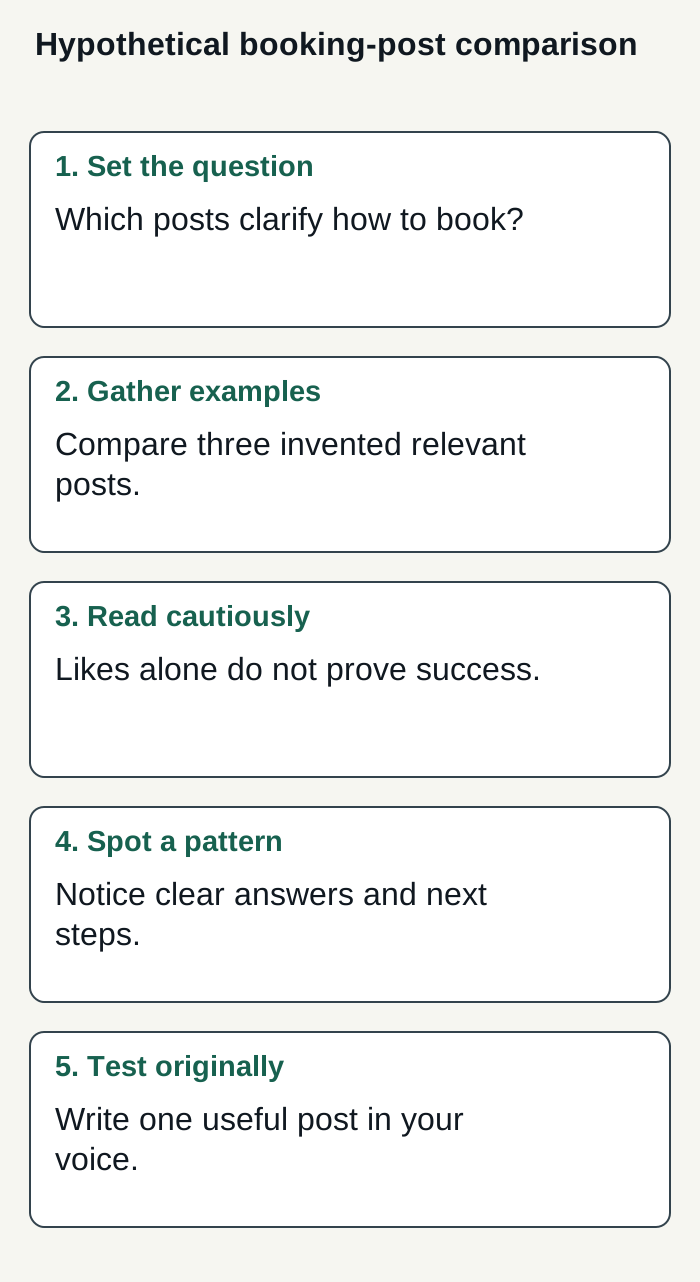
A condensed hypothetical process for comparing visible posts and choosing a useful original direction. It shows no measured counts or outcomes.
Condensed original editorial illustration. Read the surrounding guidance for qualifications and the complete procedure; any example is fictional and shows no verified customer outcome or product screen.
Illustrative worked example by Superdirector editorial team. Created 2026-11-09.