How-To Guide
Should a puzzle brand target hobbyists or gift shoppers, and how do you test both on a small budget?
Test a puzzle's hobbyist hook against its gift hook on about $200: what each buyer needs to see, how to split the budget, and how to read a small result.
By the Superdirector editorial team. Platform help pages read November 6, 2026.
At a glance
Should a puzzle brand target hobbyists or gift shoppers, and how do you test both on a small budget?
Test both before you choose. Run the same puzzle, shots, price and offer to each buyer and change only the hook: piece count, cut and image for the hobbyist; who it suits, the occasion and delivery for the gift shopper. Pick one deciding number, such as add-to-carts per dollar, before you spend. On TikTok's minimums $200 lasts four to five days, so treat the result as a direction, and a no-winner result as a sign the gap is small.
- Change one variable: the hook. Keep the product shots, price and offer identical.
- TikTok: each ad group above $20 a day, and a campaign budget, if you set one, above $50, so $200 lasts four to five days.
- No winner on $200 is a finding: keep both hooks and fix the landing page next.
Test both, with one hook each
Do not pick an audience on instinct. Run the same puzzle, the same product shots and the same offer to both buyers, and change only the hook: one ad speaks to the person who will do the puzzle (piece count, cut, image, difficulty), the other to the person buying it for someone else (who it suits, the occasion, ready to give). Decide before you start which single number picks the winner. On $200 the result is a direction, not proof, and a test that names no winner is still an answer: the gap between the two buyers is smaller than this budget can see.
This page is a method, not a forecast. It gives no puzzle conversion rates or gift-season figures, because none of the sources we read publish them. Platform rules quoted below were read on the platforms' help pages on November 6, 2026.
What each buyer needs to see
The two buyers ask different questions of the same box. Write each hook to answer its buyer's question in the first seconds, and keep everything else identical so the hook is the only thing you are testing.
| Hobbyist arm | Gift arm | |
|---|---|---|
| Question in their head | Will I enjoy doing this one? | Will they like it, and will it arrive in time? |
| Opening line idea | "1,000 pieces, and the sky is not one flat blue." | "For the friend who already owns every board game." |
| Proof to show | Close-up of the cut pieces and a corner of the finished image | The closed box, the finished image, and the box being wrapped |
| Landing page promise | Piece count, finished size, cut and image detail first | Who it suits, gift note or wrap option, delivery dates first |
| Stays the same in both | Price, offer, product shots, the page layout below the headline | Price, offer, product shots, the page layout below the headline |
If you only have one landing page, change the headline and first image only, and use a separate tagged link for each arm so the visits are counted apart. Our UTM guide for creator campaigns shows the tagging.
When enlarged, scroll horizontally to read the diagram.
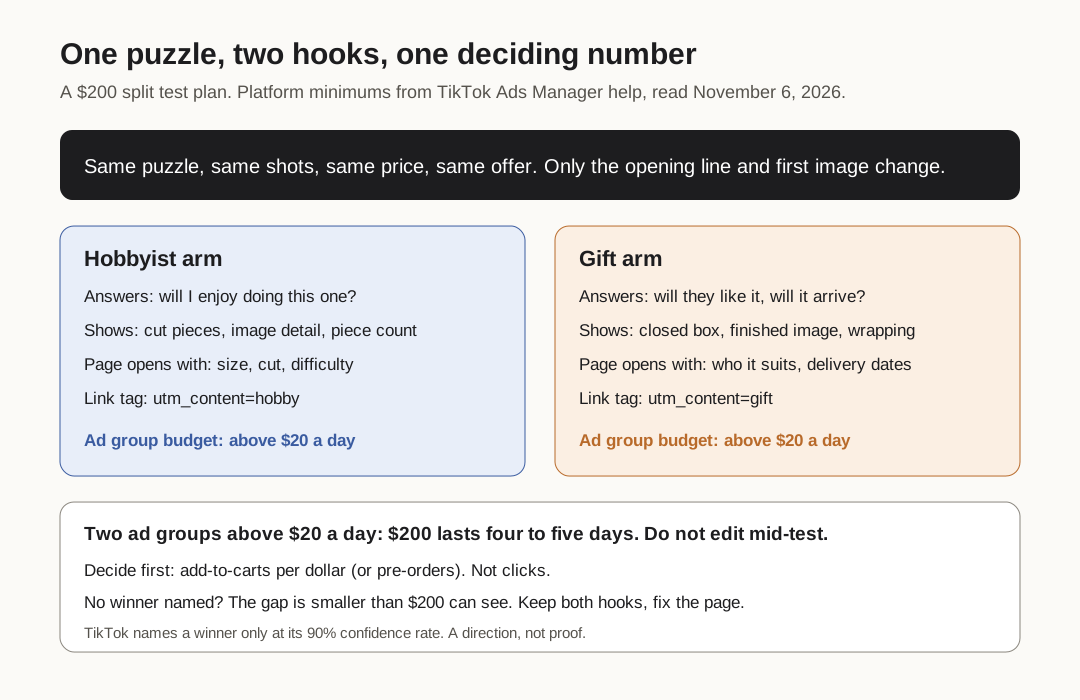
Original test plan. Budget minimums from TikTok Ads Manager help, read November 6, 2026; no puzzle performance figures are implied.
Original visual by Superdirector editorial team. Creation date not recorded.
Write the question and the number first
Google's own advice for Ads experiments fits any small test: tie the hypothesis to a business goal, test one variable at a time, and pick one or two metrics before the test begins. For a puzzle brand the question is usually: which hook gets more add-to-carts (or email sign-ups, if you are pre-selling) per dollar?
- Write the hypothesis in one line: "The gift hook will get more add-to-carts per dollar than the hobbyist hook."
- Pick one deciding number. Clicks are cheap and easy to win with a clever line; add-to-carts or pre-orders are closer to money.
- Write down the result that would change what you do next, before you see any data. If both arms land within a few carts of each other, you will treat it as a tie.
- Keep a record of the test, as Google suggests, so the next test starts from it.
Split $200 across the two arms
Platform minimums decide how long $200 lasts. TikTok Ads Manager says a daily budget must exceed $50 at campaign level and $20 at ad group level. Its split test divides the audience into two equal groups, and each group sees only one ad group, so the two hooks never compete for the same people.
- Make two ad groups with the same targeting, placement and budget. Put the hobbyist video in one and the gift video in the other.
- Set a daily budget just above the minimums. By our arithmetic, two ad groups at a little over $20 each spend about $40 a day, so $200 runs for about five days; a campaign budget, which must exceed $50, shortens that to just under four. A lifetime budget uses the same floor per day: TikTok's example says an ad group running 31 days needs at least $20 x 31 = $620, so keep the test short.
- Do not touch the budget mid-test. TikTok advises against changing it more often than every two days, and you cannot switch between daily and lifetime budgets once the ad group is live.
- On Google, the same $200 spread over a month is an average daily budget of about $6.58, because Google's monthly spending limit is 30.4 times the average daily budget for most campaigns. Some days spend more than that and some less.
- Stop on the planned day, then read the one number you chose.
Our two-arm test plan is a sheet with both arms filled in: hook, proof shot, link tag, budget and the deciding number.
Tests that cost no ad money
Spend some of the effort before the $200. The SBA lists surveys, questionnaires, focus groups and in-depth interviews as direct research, and warns that it can be time consuming and expensive. For a puzzle brand it can be cheap:
- Ask puzzlers directly. The USA Jigsaw Puzzle Association, founded in 2020, hosts free casual speed contests at its monthly Puzzle Club events and works with puzzle companies on giveaways. Hobbyist groups like this tell you what puzzlers check before buying.
- Ask ten recent buyers who it was for. If most bought for themselves, the hobbyist hook is your default.
- Post both hooks organically on the same day and compare saves and link taps. It is a weaker signal, but it costs nothing.
- Pre-sell a limited batch, which LLC Register lists as a low-cost demand test before full production. One way: send each hook to half of your email list.
Read a small result honestly
TikTok says its split test uses a 90% confidence rate and only names a winning ad group when the result is statistically significant. On four or five days and $200, expect that it may name none. Google, for its video experiments, recommends at least 4 to 6 weeks when a result is still undecided.
Practitioner rules of thumb point the same way. Surfside PPC suggests at least 100 data points before reading the outcome, and 50 conversions per variant for conversion-based Smart Bidding. A $200 test of a puzzle will rarely reach 50 sales per arm, which is why you should read it as a direction:
- One arm clearly ahead on your deciding number: brief your next creator or ad round for that buyer, and test a second hook inside it.
- Close result: keep both. Use the hobbyist hook all year and add the gift hook in the weeks before the dates your buyers named.
- Clicks high but carts flat on one arm: the hook works and the page does not answer that buyer's question. Fix the page before spending again.
For more on what one small test can and cannot tell you, see what a small creator test can teach and what one creator post test can conclude. If creators will make the two videos, the hook test request guide shows how to ask for both versions.