How-To Guide
What should a brand check in an influencer marketing proposal?
Review an influencer marketing proposal with a short editable example covering goals, work, costs, timing, evidence, owners, exclusions and open questions.
By the Superdirector editorial team.
At a glance
What should a brand check in an influencer marketing proposal?
Identify who is proposing what and the decision requested. Check the actual creator/account, deliverables, quote currency and basis, timing, responsibilities, source-defined reports, usage scope and exclusions. Compare the same work across options, then return specific questions or use the real acceptance process for the actual offer. A polished template or historical case study does not establish booked creators or promised results.
- Separate proposed names, confirmed participation, delivered files and published creator posts.
- Make the quote currency, basis, term, included work and optional costs explicit; the fictional sample contains no invented fee.
- Keep the current proposal version and the exact answers needed for the next decision.
Identify the proposal’s decision and author
An influencer marketing proposal should let the brand understand the recommended work, what it would cost, who must do what and how the result would be evaluated. Ask what decision the sender wants now: discussion of a campaign idea, comparison of a priced service, approval of a specific scope or acceptance of actual terms.
This guide is for the brand reviewing an agency or creator offer. It includes an original short example and editable review sheet, not a seller’s sales script. The creator brief template supplies production instructions; the agreement guide handles the terms to resolve. Neither task is replaced by a polished proposal.
The sources use the word differently. MightyScout describes a provider’s service recommendation to a prospective client. Meltwater also discusses an internal stakeholder recommendation for a campaign. OneSuite includes scope, reporting and budget but extends into signature. Read the actual requested action. A document’s heading alone does not decide what accepting it would mean.
| First question | Look for | If it is missing |
|---|---|---|
| Who is proposing the work? | Named sender, actual role, company/contact and version/date | Ask who owns the offer and which creator or service provider it represents |
| What decision is requested? | A specific discussion, priced option or acceptance step | Ask the sender to state the intended next action |
| Who has agreed so far? | A proposed creator list distinguished from confirmed participation | Keep suggested names separate from booked work |
| Which version is under review? | One identifiable document with linked supporting evidence | Return questions against the named version so later changes are visible |
Treat an actual signature, checkout, deposit request or acceptance message as consequential. This editorial outline does not determine the legal status of a real offer, replace the accepted agreement or authorize a purchase. Its job is to make the decision understandable before you commit.
Make the scope and cost lines comparable
Translate every package name into outputs and responsibilities. “Full creator campaign” might mean discovery and a recommendation only, or it might include contracting, product delivery, a public post and reporting. Those are different offers even when the slide deck has the same title.
| Line to inspect | Ask for the concrete unit | Keep separate |
|---|---|---|
| Creator participation | Named or to-be-confirmed people, platform and exact posting account | Profiles discovered, people invited and people who accepted |
| Published work | Post format, number, intended window and any agreed live period | A submitted file or draft approval |
| Delivered assets | File count, specification and included edits | Publication and the license for each intended use |
| Management | Who selects, briefs, follows up, consolidates feedback and handles exceptions | An unstaffed list of activities in the proposal |
| Reporting | The report, fields, source, window and owner | The source data and the story interpreting it |
| Optional distribution/use | The actual media, account permissions and licensed reuse requested | A creator post, a file license and paid amplification |
Then ask for the quote in one stated currency with its basis and term. Separate the agency/service fee, creator compensation, product and fulfilment, third-party fees, optional usage and any media budget. Identify included amounts, allowances, estimates and items still to be quoted. Do not add the same funded creator money again when it is later spent, or mistake a recurring commitment’s monthly equivalent for cash due now.
A platform can change the route. For example, Collabstr’s order guide describes upfront payment held pending content approval and says usage rights are not always included in a package. That is its documented order model, not a universal payment rule. Check the actual package, checkout, rights and parties rather than assuming every proposal uses that route.
For two competing offers, hold the required job constant. If one includes one creator-account video and the other only produces files for your account, there is no like-for-like price comparison yet. Ask each sender to show the included and excluded work before choosing a lower number. Price the actual job; this guide supplies no market-rate benchmark.
Read the schedule, evidence and responsibility gaps
A useful schedule shows dependencies as well as dates: current product facts, product arrival, creator availability, draft delivery, the brand’s feedback and the intended publication window. Ask who must act next and what changes if an input is late. A confident launch date is not a substitute for confirmed readiness.
- Name one brand feedback owner and the creator or agency contact who receives that response. Describe what is reviewed and how an expanded brief is handled.
- Require the product owner’s actual source material for claims, current specifications and the intended customer action. Keep facts to demonstrate separate from the creator’s honest opinion.
- Ask what audience and past-work evidence supports the recommendation. Keep the actual post/report link, date, metric definition and missing scope beside the claim.
- Specify the report owner, reporting dates and information the brand can actually access. Views, unique viewers, visits, orders and earned commissions are different measures.
- Write exclusions plainly: paid media, particular rights or raw files, extra concepts, more revisions, shipping exceptions or work not included in the quoted scope.
FTC staff guidance for endorsements affecting U.S. consumers says creators cannot describe experience with an untried product or invent claims requiring proof the advertiser lacks. It also describes disclosure with the endorsement, including within video, and warns against assuming the platform tool alone is sufficient. A proposal should assign that work without presenting a checkbox as a complete legal determination.
If a proposal requests YouTube brand partner access for “reporting,” read the actual capability: YouTube’s guide describes metrics sharing and the ability to boost the video. Usage agreements remain separate. Ask for the intended access, account, paid-use scope and owner; a reporting convenience must not quietly become an unexplained ad permission.
For an audience or case-study claim, open the evidence appropriate to it. A historical success is evidence about that described campaign, not a result promised for yours. Use the media-kit verification guide for supplied creator evidence and the metric guide to retain definitions and windows. A missing report stays missing.
Use the short proposal review example
The following is an original fictional draft a brand might receive for a pocket sketchbook. It deliberately retains unanswered fields so the review has something concrete to do. No agency, creator, quote, acceptance or past result is real. Aim to keep a working summary readable in one or two pages, with detailed evidence and the actual agreement linked separately; page count depends on layout and edits.
| Proposal field | Illustrative content to review |
|---|---|
| Author, version and requested decision | [Agency or creator contact], version [date/revision]. Request: discuss this scope and obtain the missing quote details; not a request in this teaching example to sign or pay. |
| Buyer question and goal | Help travel-sketching viewers understand the sketchbook’s verified paper format and how a removable page is used. No sales target or performance promise is supplied. |
| Suggested work | One creator-delivered integration on the agreed YouTube channel, plus two original product stills delivered as files. Creator identity/channel and final file specifications remain to be confirmed. |
| Message and evidence | Brand supplies current product specifications and an actual product. Creator demonstrates the real format and describes only their actual experience. |
| Timing and responsibilities | Product arrival first; draft and publication dates proposed after availability is confirmed. One named brand contact consolidates feedback; inclusion and scope of revisions remain to be agreed. |
| Quote and commercial questions | [Amount, currency, basis and term]. Separate creator work, management, product/fulfilment, taxes or third-party charges where applicable. State cash due and optional items. No amount has been invented. |
| Requested use and exclusions | Describe the intended organic use of the two stills and request its actual license term. Paid amplification and raw footage are outside this sample request unless later separately scoped. |
| Report and open evidence | Ask for the source-defined video report, selected window, capture date and owner. The final reporting access and audience evidence are still open. |
Use the editable short proposal review or its blank CSV. The HTML separates a filled teaching example from blank review fields. It is a manual local aid, with no signature, checkout, provider connection or automatic saving.
| Issue in the example | Question to return | Who should answer |
|---|---|---|
| Creator and exact scope are not settled | Which creator/channel is proposed, is participation confirmed, and what are the file/output specifications? | The agency or creator proposing the work |
| Price is still a placeholder | What is the quote, currency, basis, term and actual cash due for that exact scope? | The commercial owner of the offer |
| Use and reporting are incomplete | What precise file-use scope is included and what dated report can the named owner actually provide? | The rights and reporting owners |
| Timing is provisional | Which input confirms the draft/publication dates, and who communicates a change? | The project contacts on both sides |
The useful review response is to request those clarifications, not to mark a fictional plan complete. The same approach works when a real proposal is otherwise strong: keep the useful recommendation and identify the exact unanswered fact that prevents an informed decision.
When enlarged, scroll horizontally to read the diagram.
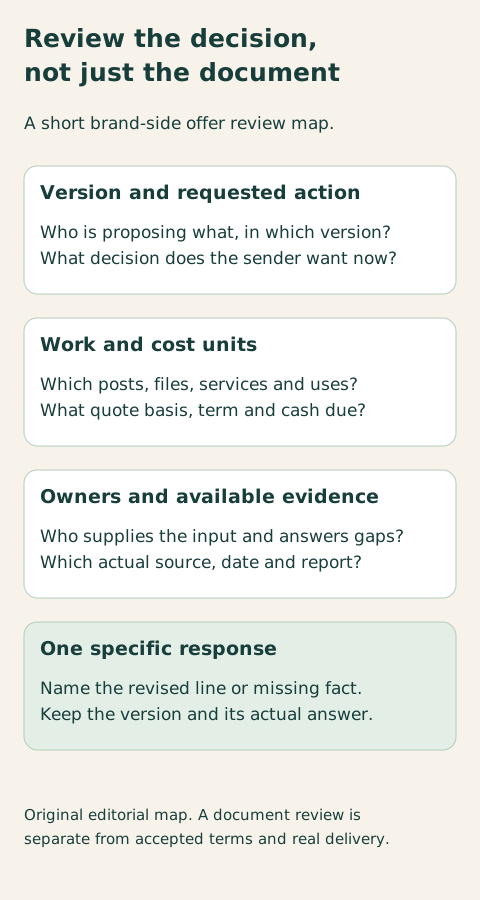
Original editorial review map. A favorable document review is separate from actual accepted terms, booked participation, publication and campaign results.
Original visual by Superdirector editorial team. Creation date not recorded.
Return one concrete decision and keep the version
Reply against the version you read. State the parts that fit the brand’s goal, the mismatches and the specific answers or revised lines needed. A vague “please add more detail” creates another attractive document without making the purchase clearer.
| Your assessment | Useful response | What to retain |
|---|---|---|
| The proposed work fits; commercial or evidence fields remain open | Request the named clarification from its owner | The relevant version, open question and reply |
| The strategy fits but the output differs from what you need | Request a revised scope and corresponding quote | Which units changed and why |
| The work does not address the goal or a material condition cannot be met | Decline that scope with a factual reason | The actual mismatch, without inventing a general verdict on the provider |
| The information supports the next real decision | Use the actual agreement/purchase process appropriate to the offer | The accepted scope, authority and conditions, not merely a favorable review note |
Before sending an actual acceptance, ensure the people responsible for scope, claims, rights and money understand the current record. The proposal may lead to an agreement or include operative terms itself; do not rely on its title or this blank worksheet to decide legal effect. The agreement guide and usage-rights checklist support those detailed questions.
Keep later changes visible. Replacing a creator, adding a file, changing the destination, expanding paid use or moving a provisional date can change the quote and responsibilities. Ask for the corresponding revised terms instead of silently carrying an earlier review forward.
Sources, method and limits
We read the complete OneSuite, MightyScout and Meltwater proposal pages on November 5, 2026, alongside primary FTC, Meta, YouTube, Collabstr and Shopify documentation. The three proposal guides supplied broad component and decision structures. We did not adopt claims that a template guarantees approval, predicts campaign results or determines whether every signature creates an enforceable agreement.
Only public sources support this guide. The short sample, comparison questions, diagram and worksheet are original editorial instruction; no proposal was sent or accepted and no creator campaign or software checkout was tested. Source text and HTML structure were studied, not source images, viewport layouts or private accounts.