How-To Guide
How does a B2B company get leads from X without spamming?
Identify buyer questions, contribute useful public answers, follow up when invited and measure qualified conversations rather than impressions.
By the original author; substantively revised by a separate editor on 2026-11-09.
At a glance
How does a B2B company get leads from X without spamming?
Build a useful presence around a specific buyer problem: listen for relevant questions, answer in public with practical information, and follow up privately only when someone invites it. Make posts valuable without a pitch, and measure qualified conversations and inquiries rather than treating reach as a lead.
- Choose a buyer problem your team can genuinely help explain.
- Answer relevant posts manually and specifically; do not copy-paste pitches.
- Follow up privately only when invited, then log the outcome.
The short answer: be useful before asking for a lead
A useful approach is to start with a narrow buyer problem, contribute practical answers where buyers are already discussing it, and give interested people a clear, low-pressure way to continue. A like, follow, or impression is not permission to sell to someone.
Think of X as a place to demonstrate how you understand a buyer’s work—not a list of people to message. The Neil Patel B2B social guide emphasizes educational content and describes X as a conversation venue. The Highspot social-selling guide likewise describes relevant engagement and personalized interaction. These are practitioner recommendations, not proof that a particular routine will produce leads.
Choose a buyer and check that they use X
Start with one role and one job-related problem. “B2B software buyers” is too broad; “operations leaders at growing software companies comparing appointment-booking tools” gives you something specific to listen for. Write down the question they ask, the decision they are making, and what you can credibly contribute.
- Buyer: operations manager who coordinates customer implementation calls.
- Problem: finding a booking process that reduces back-and-forth.
- Useful contribution: a short checklist for deciding what a booking workflow needs.
- Possible next step: offer the checklist if someone asks for it.
These are hypothetical planning prompts, not a real company’s campaign or results. Before committing, search for relevant job titles, company accounts, and topic phrases. Look for actual questions and substantive discussion, not just follower counts. If the buyers you want rarely participate, prioritize a channel where they do.
Find questions you can answer usefully
Make a small listening list of relevant people and topic phrases. Check it when you have time to respond thoughtfully. Choose a post only if you can answer the point it raises, add a useful distinction, or share a practical next step. If your only contribution is “we sell this,” skip it.
| Buyer’s question | Promotional reply | More useful reply |
|---|---|---|
| “How do you stop people missing a booking link?” | “Our booking product solves this—book a demo!” | “Make the confirmation message say what happens next and how to change the time. That avoids making the invite carry every instruction.” |
| “What should we compare in scheduling tools?” | “We’re the best option for teams like yours.” | “Compare how each tool handles time zones, rescheduling, and who gets the confirmation. Those are separate needs, so test each one.” |
Hypothetical examples: these are editorial illustrations, not actual X posts or customer outcomes. The useful answers stand alone; they do not require a click or a meeting to be worthwhile. If a person asks for more, offer one relevant resource rather than attaching a pitch to every reply.
Publish expertise buyers can use
Use repeated buyer questions as prompts for original posts. Explain one practical choice, common misunderstanding, or step in a process. Give enough context for the post to help someone who never clicks through. A relevant question at the end can invite discussion, but do not manufacture controversy or ask a broad engagement-bait question.
A simple draft pattern is: name the situation, explain one useful point, then invite a specific response. For example, a hypothetical booking-software team might post: “If customers keep asking whether a meeting is confirmed, inspect the confirmation message before adding another reminder. Does yours explain how to reschedule?” The example makes no performance claim and does not imply a real customer result.
Use links when the destination is genuinely the next step—for example, when someone asks for a checklist. A practitioner guide to X for B2B recommends using links when the click itself is the goal (Kurums); treat that as advice, not a platform guarantee. Do not invent statistics, customer results, or opinions for a named colleague. If a post represents an individual, make sure it reflects that person’s actual view.
Follow up only when invited
A public reply is not an automatic invitation to a sales conversation. If someone asks for a resource, requests details, or explicitly suggests continuing privately, respond to that request with one relevant next step. Otherwise, keep contributing publicly or leave the conversation there.
- Refer to the specific point they raised.
- Send only the information they requested, if you have it.
- Ask one relevant question, or give them room to stop.
- Do not turn a single interaction into repeated follow-ups.
For instance, in the hypothetical booking example, if a reader asks for the checklist, send only that requested checklist. Discuss their workflow privately only if they also invite that conversation. Do not treat a like, a follow, or a keyword match as consent to receive a private pitch. If they do not respond, do not keep nudging them.
Review conversations and business signals
Keep a lightweight record of the work and its outcomes. Note the buyer problem, the public exchange, whether the person requested follow-up, and whether it led to a meaningful inquiry or meeting. Record impressions or clicks separately as context. Do not call every reaction a lead.
| Record | What it helps you assess |
|---|---|
| Relevant replies and questions | Whether the topic is reaching people who fit your intended audience. |
| Requests for a resource or conversation | Whether public interest is turning into an explicit next step. |
| Qualified inquiries and meetings | Whether the activity is contributing to a business conversation. |
| Time spent and follow-up | Whether the process is worth continuing for your team. |
Review the log regularly. Keep topics that prompt useful exchanges, revise posts that attract the wrong audience, and stop tactics that feel repetitive or intrusive. This is a decision process, not a forecast: the supplied sources establish no X lead conversion rate or guaranteed outcome. For a useful measurement distinction, Kurums recommends looking beyond impressions toward relevant conversations and business outcomes; treat that as practitioner guidance rather than causal evidence.
Where Superdirector fits—and where it does not
For a business considering a customizable AI-run channel around $200 a month, Growth is $199/month for two accounts, with no trial. It can delegate research and creation toward this article’s task—useful X content from buyer questions—and publish eligible Instagram image carousels and single X text posts, either with per-piece approval or an enabled account Auto-post rule. AI credit use varies by task. Finished video and fully autonomous channels are upcoming, not current; TikTok, YouTube and Reels finished-video publishing are outside today’s scope. See pricing and publishing. Current publishing is limited to connected accounts and selected source cards. Before enabling Auto-post, verify the account’s first hand-approved post is live; you can stop unsent work by turning Auto-post off or pause posting. Replies and private follow-up remain part of the team’s work. Assess review effort and customer-defined results, such as qualified conversations, to decide whether the delegation is worthwhile; neither low oversight nor leads are guaranteed.
When enlarged, scroll horizontally to read the diagram.
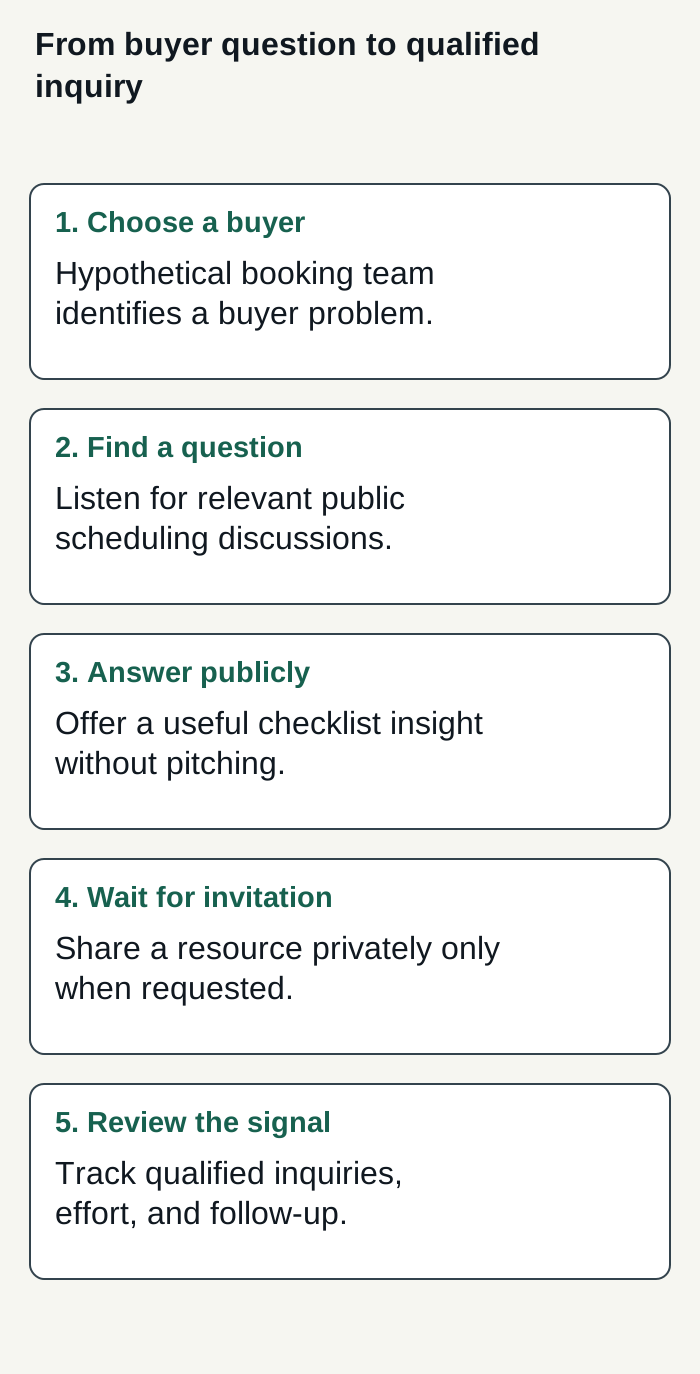
Original editorial flow using a hypothetical booking-workflow example; follow-up happens only when invited.
Condensed original editorial illustration. Read the surrounding guidance for qualifications and the complete procedure; any example is fictional and shows no verified customer outcome or product screen.
Illustrative worked example by Superdirector editorial team. Created 2026-11-09.