How-To Guide
How do you grow an account on X as a founder or small brand in 2026?
Clarify your audience, share useful X posts, join relevant conversations and review results without assuming any tactic guarantees growth.
By the Superdirector editorial team. This revision retains the original author's provenance; the orchestrator records the revising editor separately.
At a glance
How do you grow an account on X as a founder or small brand in 2026?
Start with one audience and one business-relevant goal. Make your profile explain what you do, publish useful posts based on real customer questions, and take part in conversations your intended audience already has. Then review your own results and refine the approach. Treat growth tactics as experiments: the supplied sources do not establish that any one tactic reliably increases followers, reach, or leads.
- Make your profile useful to someone deciding whether to follow.
- Share a complete idea before asking readers to click elsewhere.
- Measure activity and business-relevant outcomes separately; neither proves the other.
Start with a clear audience and a useful profile
The practical answer is to give a specific audience a reason to pay attention, make it easy to understand who you are, and learn from what people actually do. For a founder, that means choosing one business-relevant goal, publishing useful ideas in a recognizable area, joining conversations, and reviewing results. There is no reliable formula in the supplied evidence that guarantees follower growth, reach, leads, or sales.
Begin with the profile a prospective follower will see after a post catches their attention. Check that the account name and image are recognizable, the bio says who you help and what you do, and a visitor can find a relevant next step. Consider pinning a post that demonstrates the kind of useful material the account shares. Buffer’s profile-audit guide similarly recommends making profile details inviting and clear before focusing on follower growth. Treat its suggestions as practical advice, not a measured guarantee.
Next, write down the audience in ordinary language: for example, “owners of small service businesses who handle their own customer bookings.” Choose one outcome to learn about, such as whether more of the right people visit the profile, reply with relevant questions, or follow. Those are signals to examine, not interchangeable proof of revenue. A useful goal keeps the work focused; Later’s business strategy guide, updated in 2021, also recommends defining an account goal and intended audience, while citing some platform context from 2020.
Build posts from real customer questions
A founder does not need to invent a new content persona. Start with questions customers genuinely ask, a misconception you regularly clarify, or a decision you can explain from experience. Turn one question into a complete post: state the useful point, add a concrete explanation, and invite a relevant response only if a real discussion would help.
Use X as a place to communicate, not only to announce. A native text post can deliver the main idea without requiring a click; use a thread when the explanation genuinely needs steps or context. If you share a link, tell readers what they will find and include enough substance that the post still helps on its own. Buffer’s link-post analysis compared 18.8 million posts from 71,000 accounts and reported weaker engagement for link posts in its dataset. That is an observational result from Buffer’s analysis, not proof of what will happen on every account or a verified current X rule.
Keep the voice recognizable and the claim supportable. Avoid manufacturing controversy, making exaggerated promises, or posing a question solely to provoke replies. Buffer’s 2022 consistency advice favors a regular schedule, but it is historical practitioner guidance rather than evidence for a required 2026 posting frequency. A pace you can maintain while still serving customers is a more useful starting point than a volume target copied from someone else.
Worked example: turn one booking question into a test
The following is a plainly hypothetical example, not a customer result. Imagine a founder of a small appointment-booking service who often hears: “What should I include in a booking reminder?” The founder wants to learn whether practical posts attract replies from independent service businesses—not to assume that a post will produce customers.
| Piece of the test | Hypothetical draft or action | What to observe |
|---|---|---|
| Audience and goal | Independent service businesses; learn whether practical booking advice prompts relevant conversations. | Relevant replies and profile visits; note that these are not sales. |
| Native text post | “A booking reminder should answer three things: when the appointment is, how to change it, and what to prepare. Which detail do your customers ask about most?” | Replies that identify a real customer question; profile visits after the post. |
| Follow-up thread | If readers ask for examples, explain one reminder detail per post and finish with a short sample message. | Whether people continue the discussion or share a useful wording suggestion. |
| Conversation | Reply to a relevant small-business discussion with a specific reminder tip, not a sales pitch. | Whether the reply starts a useful exchange and reaches the intended audience. |
| Review decision | Compare this test with other posts made under similar conditions; record the format, topic, and response. | Repeat, revise, or drop the idea based on the account’s own pattern. |
The example works because it begins with a real kind of customer question and makes a complete, practical post before asking anything. It does not depend on an unverified claim about how X ranks content. Change the question to one your own customers ask, and do not use the hypothetical wording as a testimonial or reported result.
When enlarged, scroll horizontally to read the diagram.
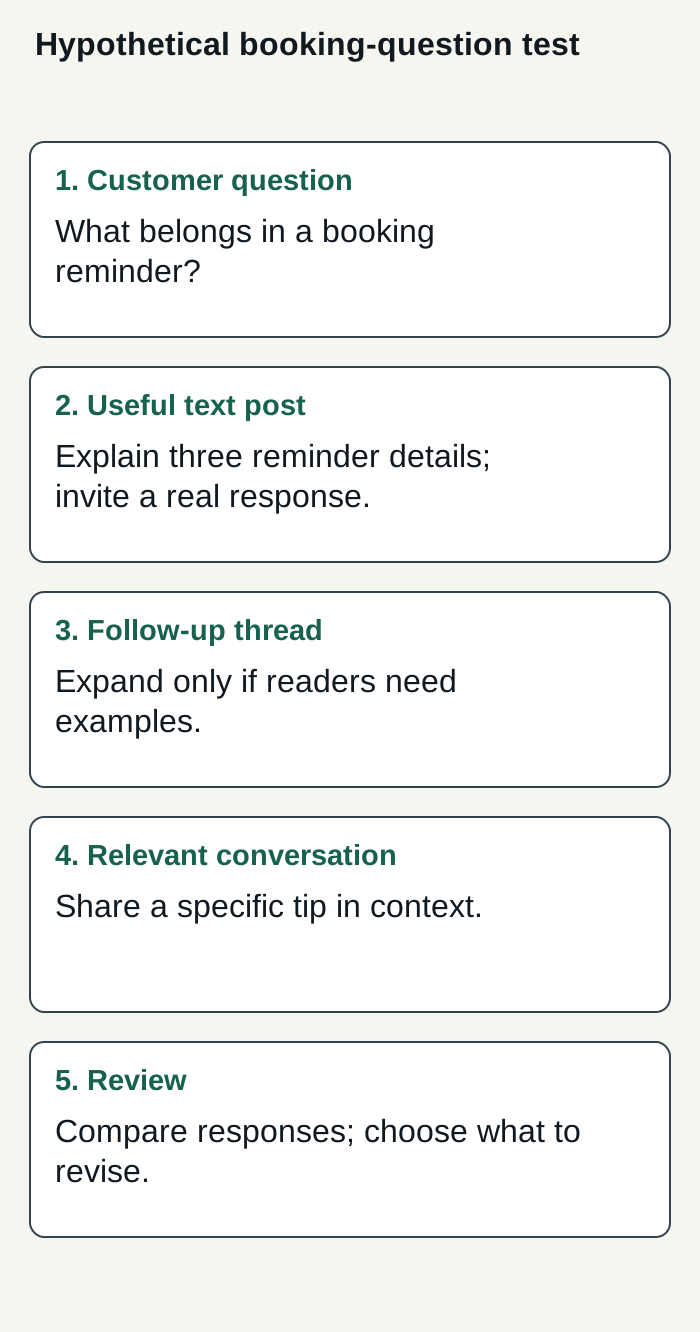
Hypothetical booking-service workflow; no real account or results shown.
Condensed original editorial illustration. Read the surrounding guidance for qualifications and the complete procedure; any example is fictional and shows no verified customer outcome or product screen.
Illustrative worked example by Superdirector editorial team. Created 2026-11-09.
Join relevant conversations thoughtfully
Posting and leaving gives you little information about how people understand your work. Set aside a manageable opportunity to read posts from customers, peers, and organizations relevant to your audience. Reply when you can add a useful answer, a specific perspective, or a sincere follow-up question. Respond to people who engage with your own posts when you have something worthwhile to say.
Do not treat other people’s replies as a growth hack or assume that a conversation will be shown to a particular audience. The supplied sources include practitioner recommendations to engage with others, but no independent evidence that a particular reply routine reliably grows a founder’s account. Avoid copying another person’s post or dropping promotional replies into unrelated discussions. Use replies to be helpful and to learn what your audience cares about.
Choose a sustainable publishing routine
A simple routine can help you show up without turning X into a second full-time job. For example, collect customer questions as they arise, draft a few ideas in one sitting, publish when you can participate in the resulting discussion, and leave room to respond. This is a suggested workflow, not a promised cadence. If that plan crowds out customer work or makes the posts less useful, scale it back.
Use a native text post for a self-contained point and a thread when readers benefit from an ordered explanation. Images may suit an original diagram or example, but do not add media just to satisfy a supposed ranking preference. Buffer’s 2026 algorithm explainer describes its interpretation of recommendation mechanics while also noting that the system changes. The supplied dossier contains no current primary X documentation verifying ranking weights, a post’s useful lifetime, or a guaranteed advantage for any format. Focus on clarity and audience relevance rather than presenting those claims as settled rules.
A quick profile review can be part of the routine too. If a post attracts attention but the profile does not explain the business, a visitor may not know why to follow. Keep the bio, pinned post, and next step consistent with what you actually offer. For more founder-focused planning, see marketing as a solo founder and planning a week of content.
Review a small test and decide what to change
Choose a review period before publishing, and compare posts at a consistent age rather than comparing a fresh post with an older one. Look at the measures that relate to your goal: replies and profile visits may help you understand interest, while new followers are a separate outcome. If the business goal is leads, track that through an appropriate business process too; engagement alone does not establish that a post generated a lead.
Make a small record for each post: topic, format, whether it included a link, and the responses you care about. Compare with your own recent posts and note unusual circumstances. Buffer’s analytics guide recommends relating follower changes to posts and campaigns. That is a sensible way to investigate patterns, but a change after a post does not prove the post caused it. Avoid adopting a performance threshold as if X or an independent study had validated it for your account.
At the end of the review, make one decision: repeat a useful topic in a different way, clarify a post that confused readers, or stop spending effort on a format that is not serving your goal. Keep the test simple enough to interpret. The competitor-content guide can help you observe how others explain ideas, but use their work for inspiration and analysis—not as copy to reproduce.
Decide whether a publishing tool fits
For a business seeking a customizable AI-run channel for about $200 a month, Superdirector’s current Growth plan is $199/month for two accounts, with no trial. For this X growth workflow, AI can help research ideas, use saved brand context, and prepare single text posts; publishing is limited to eligible Instagram image carousels and single X text posts. Each post needs approval unless Auto-post is enabled for its account. Finished video—including TikTok, YouTube, and Reels videos—and fully autonomous channels are upcoming, not current publishing capabilities. Assess whether delegated work fits your business goal and measure customer-defined results rather than assuming growth or a guaranteed outcome.
Connect the account and select the source cards that may feed its publishing workflow. Before enabling Auto-post, verify that the first hand-approved post is live; you can stop unsent work by turning Auto-post off or pause the queue. See the publishing setup for details and current pricing. Measure review effort and the results you define for your business to decide whether the service is worthwhile.