How-To Guide
What should a brand post on X each week? A repeatable weekly mix
Build a flexible X content week around useful ideas, conversation, proof and selective promotion, with an example and review worksheet.
By the Superdirector editorial team. Recommendations are editorial guidance, not a proven universal formula.
At a glance
What should a brand post on X each week? A repeatable weekly mix
Plan a manageable mix of original insight, conversation, proof or human context, and selective promotion. Give each post one clear purpose, then review audience responses and business-relevant signals before changing the plan. Treat the mix as a starting hypothesis, not a proven formula.
- Begin with a small, sustainable set of posts rather than adopting a fixed posting quota.
- Make posts useful on X itself: explain an idea, invite a relevant response, or share credible proof.
- Assess each post against its purpose and adjust one element at a time.
Start with four jobs, not a magic ratio
A useful weekly plan gives people reasons to read, respond, and understand what your business does. Start with four jobs: share practical insight, join or invite a relevant conversation, show credible proof or human context, and make an occasional offer. These are planning categories, not a claim about the best-performing mix.
The available advice does not establish an ideal posting frequency or content ratio for every brand on X. Sprout Social recommends recurring weekday themes as a planning aid and suggests educational posts, questions, and product or customer features. Hootsuite presents both an 80-20 approach and a rule of thirds. Those are practitioner frameworks, not comparative evidence that one split works best for your audience. The useful common ground is variety, consistency, and reviewing what your own audience responds to.
Make the plan fit your real capacity. Three thoughtful posts can be a more workable starting point than a packed calendar that leaves no time to respond. If you have room for more, add posts because they serve a clear purpose—not because a template says every weekday needs a theme. Keep the first post understandable on its own, and make any link or call to action relevant rather than automatic.
Choose a realistic weekly size
Before filling a calendar, answer three questions: What business goal should X support? What question or need does the intended audience bring to the platform? How much time can the team reliably spend creating and responding? If the goal is to help prospects understand a service, practical explanations may be central. If you need to learn what customers find confusing, questions and responsive conversation may deserve more room.
Write down a modest starting commitment: for example, three posts this week, each with a different job. That number is an example, not a benchmark. Reserve time for genuine replies if conversation matters to your goal. If there is no credible proof ready, do not manufacture a testimonial or a result to fill the proof category; explain a process, show a permitted product view, or leave that slot out.
- Goal: What should the post help someone understand, decide, or do?
- Audience: Whose question or problem is this about?
- Evidence: What can we support with a real example or source?
- Capacity: Can we publish and respond without overloading the team?
Build a mix around four post jobs
Here is a plainly hypothetical example for a small company that offers appointment-booking software to independent tutors. It is a planning exercise, not a customer story or a claim about results. This manageable three-post week covers three of the four jobs: practical insight, conversation, and an offer. Rotate in a proof or human-context post when you have something credible to share, replacing or complementing a slot as capacity allows; the jobs need not all appear every week. Shift the days to suit your team.
| Example slot | Job | Hypothetical draft direction | What to check |
|---|---|---|---|
| Monday | Practical insight | Explain one detail tutors can include in a booking confirmation, such as what a student should prepare. | Is it clear and useful without requiring a click? |
| Wednesday | Conversation | Ask tutors which booking detail students most often miss, and invite a specific example. | Can the team respond thoughtfully to answers? |
| Friday | Offer with context | Describe the booking tool's relevant feature, who it is for, and where to learn more. | Are feature and pricing claims current and accurate? |
This schedule deliberately avoids invented customer proof. If the business has permission to share a verified customer example, that could replace or complement one slot. Without it, a behind-the-scenes explanation—such as how the team decides which booking questions to answer first—can add human context without pretending to demonstrate customer outcomes.
Use a small planning worksheet for each draft: audience question; post job; one main point; evidence or source; desired next step; reviewer; and a note about the response after publishing. If a draft cannot answer those prompts, sharpen its purpose or remove it. A post's format can vary, but avoid assuming that a particular format or weekday will perform best for every account.
Draft and check a hypothetical week
For an insight post, lead with the useful point and explain it plainly. For a question, ask something the audience can answer from experience rather than a vague request to “engage.” For an offer, state what is offered and who it may suit; do not make unsupported promises. On X, the post should make sense in the feed even when it points to a longer resource. Hootsuite's guide describes self-contained posts as one practitioner recommendation, not a guarantee of reach.
Before publishing, check names, numbers, product details, permissions, and links. If a post comments on another account's material, add your own relevant perspective rather than copying its wording. AI can help brainstorm angles or organize a draft, but Sprout Social cautions against treating it as a replacement for original ideas. A person who knows the business should check voice and factual accuracy.
Choose a reasonable observation window and assess each post only after it has had that full period from publication. Record each post's job, the intended audience response, replies worth following up, and any goal-related action you can actually observe. Compare like with like where possible—for instance, insight posts with earlier insight posts—rather than declaring one category successful from a single post. There is no supplied evidence establishing a universal review window or threshold.
Then change one decision: revise the opening, make the question narrower, add clearer context, or use fewer promotional posts. Note what changed so the next review is informative. If the evidence is mixed or there are very few observations, keep the conclusion modest and continue learning instead of presenting a hunch as a rule.
When enlarged, scroll horizontally to read the diagram.
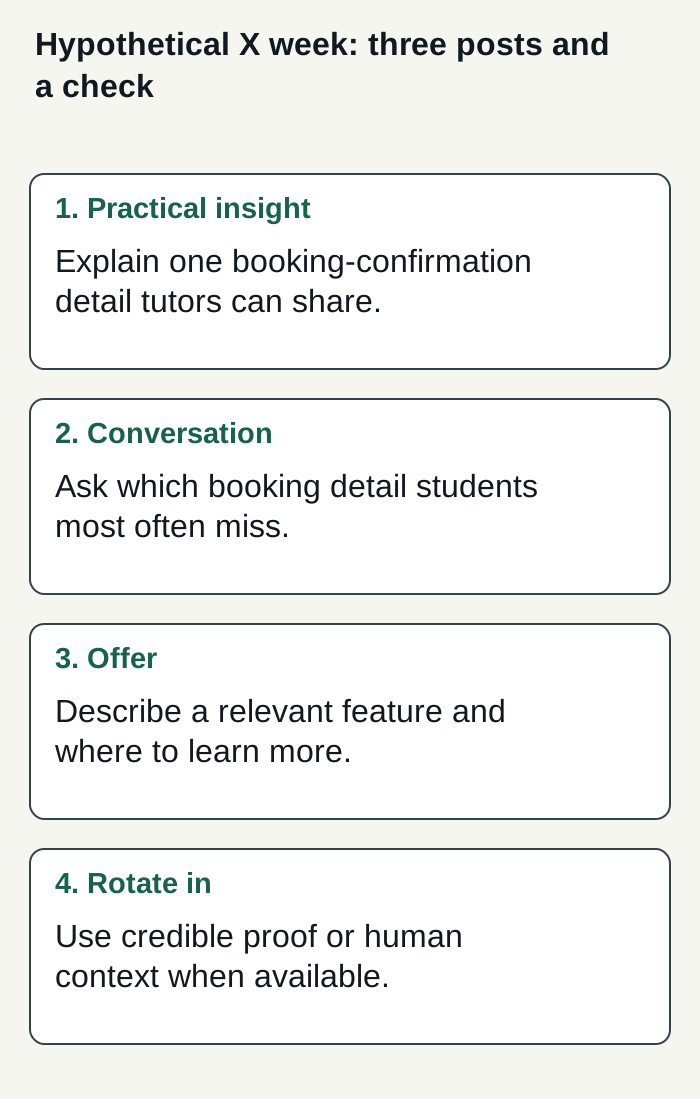
Hypothetical tutor-booking examples cover three post jobs; rotate in credible proof or human context when it fits.
Condensed original editorial illustration. Read the surrounding guidance for qualifications and the complete procedure; any example is fictional and shows no verified customer outcome or product screen.
Illustrative worked example by Superdirector editorial team. Created 2026-11-09.
Decide what to delegate
A customizable AI-run channel around $200 a month is a buying goal for delegating research, drafting, and eligible publishing—not a claim that a channel already runs fully autonomously or guarantees results with minimal oversight. Decide what useful results mean for your business, then measure those results alongside the time spent reviewing, correcting, and responding. Your own observations can show whether delegation is worthwhile.
Growth currently costs $199 per month, includes two accounts, and has no trial. Current publishing is limited to eligible Instagram image carousels and single X text posts, with per-piece approval or Auto-post enabled for an account; finished video and full autonomy are upcoming. Account connection and selected source cards define what can publish. Before enabling Auto-post, verify that the account’s first hand-approved post is live. To stop unsent work, turn Auto-post off or pause posting. See Growth pricing and the publishing guide for setup details. Video scripts and methods for TikTok, YouTube, or Reels do not mean finished videos can currently be published. Assess fit by what you still need to review and the results you define—not assumed savings or guaranteed outcomes.