How-To Guide
Which influencer collaboration type should a brand choose?
Choose gifting, paid posts, ambassador work, affiliate compensation or co-creation by the result, obligations, benefits, permissions and evidence needed.
By the Superdirector editorial team.
At a glance
Which influencer collaboration type should a brand choose?
Start with the actual result required. An unconditional gift requires no content; a paid post specifies creator-account work; an ambassador role defines an ongoing relationship; affiliate compensation follows its qualifying-event rules; co-creation defines creative contributions and uses. Combine those parts only when the actual work, compensation, permissions and evidence are explicit. No label guarantees reach, sales, rights or disclosure compliance.
- A product-for-post exchange has required work; it is different from an unconditional gift.
- Ambassador describes a relationship and co-creation describes participation; either can include paid posts or affiliate compensation.
- Match fulfilment, publication, earned commission and content-use evidence to the actual promise.
Name the result before choosing a label
Choose an influencer collaboration by stating the work you need, what the creator receives and what evidence would count as delivery. A gift, a paid audience post, a recurring ambassador role, affiliate compensation and co-created work can serve different needs. They can also overlap, so a label alone is not a complete offer.
This guide helps a brand choose the arrangement. It is not another outreach script, hiring sequence or contract template. The UGC versus influencer marketing guide handles the basic distinction between buying content files and buying creator-account distribution; the gifting-versus-paid guide helps state the actual offer.
| Your requirement | The question to settle first |
|---|---|
| A particular creator post must go live | What exact work and compensation will the creator knowingly agree to? |
| You want the creator to consider the product with no promised content | Is the gift genuinely free of a content obligation? |
| You need a continuing representative | What work, term, compensation and review points define that continuing role? |
| You want a commission relationship | What events qualify, how are they tracked and adjusted, and is any content separately required? |
| You want the creator involved in developing the work | What will each party contribute, deliver, approve and be entitled to use? |
Original fictional situation: a brand sells a clip-on book light and wants viewers to understand how it attaches to a book. Product features and safe-use instructions must come from the actual product owner. None of the arrangements below represents a real offer, creator, product test or result.
Compare five ways to work with creators
Shopify’s partnership guide describes paid posts, longer ambassador relationships and gifting among its examples. We use those distinctions alongside documented affiliate mechanics and an original co-creation planning category. This is a practical choice framework, not an official exhaustive taxonomy or a ranking of conversion performance.
| Arrangement | When it fits | What the work and compensation must say | What not to assume |
|---|---|---|---|
| Unconditional gift | You can accept that no content may result | The product offered, permission to send it and that no post is required when true | A parcel received is not a booked post or a promise of praise |
| Paid creator post | A defined account publication is needed | The format/account, scope, timing, fee or agreed benefit, disclosure and any other deliverables | The posting fee buys every future use, or the creator must invent a positive opinion |
| Ambassador relationship | The intended role continues across an agreed period | The actual recurring work, term, compensation, availability, representation and review/change arrangements | The title supplies unlimited posts, permanent exclusivity or automatic renewal |
| Affiliate arrangement | Compensation depends on defined qualifying referrals or sales | The rate/basis, tracking and qualifying rules, returns/adjustments, payment route and any separately required work | Joining a program guarantees publication, sales or a fee independent of the actual terms |
| Co-created work | The creator’s creative contribution is part of developing the output | Contributions, deliverables, decision owners, payment/benefit and each intended use | A shared idea or file automatically settles ownership, permissions or account distribution |
A product-for-post exchange belongs in the defined-work lane even if the compensation contains no cash. Do not call it an unconditional gift and reveal the required Reel after delivery. Conversely, if you really offer a gift without required work, plan for no coverage. Shopify’s gifting discussion explicitly says coverage or a favorable mention is not guaranteed.
An ambassador is a relationship description. It can include paid posts, gifts, affiliate compensation or collaborative creation, but those parts still need their own actual terms. A co-created concept is likewise not a payment model: it may be paid, gifted or combined with another agreed benefit. Ask what changes in the work, not which label sounds most impressive.
For affiliate work, Shopify’s creator payment guide provides one documented example: an active merchant partnership can supply a link or code, qualifying purchases can earn commission, and refunds/cancellations can adjust it. Read the actual program’s rules. Do not apply Shopify’s route to every affiliate scheme or describe an attributed sale as guaranteed incremental revenue.
Combine the parts without counting them twice
For the fictional book light, a brand might request one paid Reel showing attachment, offer an affiliate code, and later discuss a continuing role if both parties want it. These are not three separate published posts. They are a defined output, an additional compensation arrangement and a possible future relationship.
| Part of this fictional offer | Record it as | Keep separate |
|---|---|---|
| One agreed creator-account Reel | One publication obligation with its actual fee/benefit and timing | The product parcel, a submitted file and an optional future post |
| A creator-specific affiliate code | A tracking/compensation route with its actual rules | The paid Reel fee and causal proof of sales |
| Creative input into the attachment demonstration | The agreed contribution and review responsibility | An automatic grant of every use right |
| A possible continuing role | A conversation about future work until actual terms are agreed | Already-booked future publications |
Keep cash fees, the product and fulfilment, earned commission and any optional use/media payments in separate cost lines. Do not count the affiliate’s attributed sales as the brand’s commission expense. Use actual currency, quantities and records; this guide supplies no rate or spending rule.
A native Instagram Collab invitation is a separate platform task. If that is the problem, use the Instagram Collab delivery guide. A co-author invitation does not explain whether the underlying business arrangement was gifting, paid work, an affiliate relationship or something else.
Use the collaboration choice card or blank CSV to write the required result, relationship, compensation and creative roles separately. They are manual local aids with no account connection, contract signature, automatic saving or payment function.
When enlarged, scroll horizontally to read the diagram.
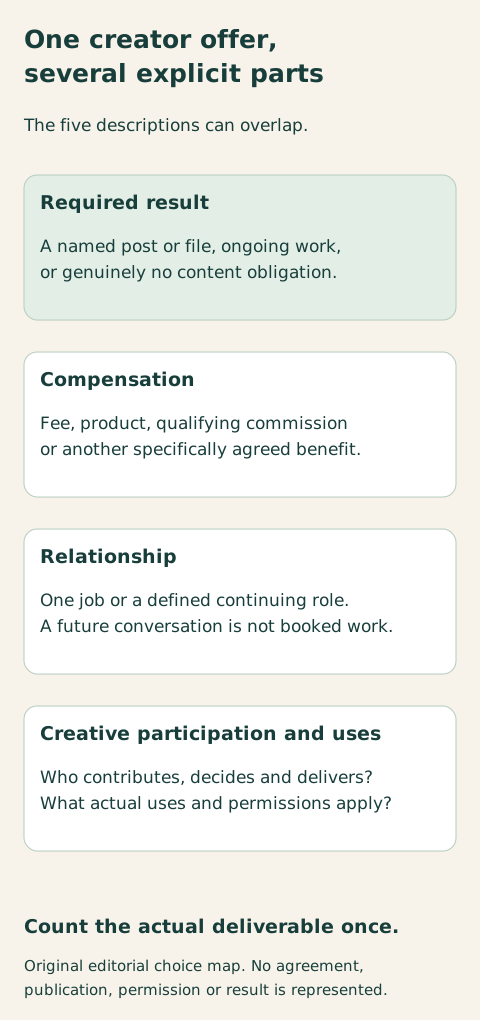
Original editorial choice map. The five collaboration descriptions overlap; they are not an exhaustive platform taxonomy or a performance ranking.
Original visual by Superdirector editorial team. Creation date not recorded.
Set the checks that change with the arrangement
Do not copy one generic checklist into all five offers. Choose the material questions the arrangement actually creates. The agreement guide and usage-rights checklist hold the detailed scope questions once you have chosen the intended work.
- Gift: confirm whether any work is expected, obtain permission for fulfilment and keep a possible later endorsement distinct from a promised post.
- Paid publication: identify the actual creator account, output, dates, review responsibility and payment terms; verify the published work separately from a delivered file.
- Ambassador: name the ongoing role and each recurring requirement, who handles changes, and what happens at the end of the actual term. A title cannot answer those questions.
- Affiliate: retain the accepted rules, rate/basis, attribution and adjustment scope, earned commission and payment record. Ask who investigates a discrepancy.
- Co-creation: identify contributions, decision owners, source/asset permissions and the intended file and publication uses. Resolve a changed idea or extra output as actual added work.
For endorsements affecting U.S. consumers, FTC staff guidance covers material connections including payment and free products. It says a product mention after a gift can require disclosure even if no mention was requested. It also warns that “collab” is vague as a disclosure and says creators cannot invent personal experience or unsupported product claims. Choosing a collaboration label does not answer those duties.
Instagram’s creator guidance says paid-in-any-form branded content needs its Paid Partnership label and includes gifts or trips in its FAQ. It separately says creators must give permission before businesses see the promotion option. The platform’s label, actual public disclosure and an ad-use permission are not the same record.
The distinction matters on other platforms too. YouTube brand partner access can share video metrics and enable boosting, while the guide calls for usage agreements independently. Explain any native permission you request and agree the intended paid use. Do not describe a metrics-and-boost capability as view-only reporting.
Check the product, market, platform route and actual account conditions for the campaign. This overview does not supply a universal legal disclosure, license or agreement. A useful idea still needs truthful claims and permissions for the real work.
Judge each arrangement by the result it actually owes
Match the outcome record to the promise. An unconditional gift can be delivered with no post. A commissioned video file can be usable without a creator-account publication. An agreed paid post still needs the actual account-bound publication check. Neither gift delivery nor content acceptance proves the business response you hoped for.
| Arrangement/result question | Relevant evidence | A misleading substitute |
|---|---|---|
| Was the unconditional gift received? | The actual fulfilment record and any permitted reply | Treating silence as a failed posting obligation |
| Was the paid publication delivered? | The correct account, URL, observed version and agreed live/timing record | A paid invoice, uploaded draft or filename alone |
| Was the ambassador work done? | Each actual promised activity and its period | Calling every interaction part of an unlimited role |
| What affiliate commission was earned? | Qualifying route events, actual adjustments and the accepted terms | All store revenue, every click or an unadjusted screenshot |
| Was co-created work delivered for the intended use? | The agreed version/files, contribution record and actual use permissions | Treating a brainstorm, logo tag or partial file as every deliverable |
Keep report scope visible. Shopify’s creator-facing Collabs guide says its analytics view covers the entire time collaborating with a merchant and does not offer selectable date ranges. That particular lifetime view is not a seven-day campaign report. Its visits, attributed sales and earned commission are also different fields. Use the actual account’s source/window and leave missing breakdowns unknown.
The decision to repeat should say what worked for the chosen job and what remains uncertain. A completed Reel might justify considering another comparable post; it does not automatically establish a permanent ambassador role. An affiliate order may support commission under the agreed rules; it does not prove every customer would otherwise have stayed away. Keep the next arrangement explicit.
For your first real offer, write a sentence naming the required result and each benefit, then ask whether the creator understands and wishes to discuss it. If the sentence depends on “they will probably post” or “we can use it anywhere,” a label has hidden an unanswered term. Clarify that term before treating the arrangement as settled.
Sources, method and limits
We read the complete Shopify partnership and creator-payment pages, Instagram’s branded-content guidance and FTC Disclosures 101 on November 5, 2026, plus the retained full Meta and YouTube primary captures personally read earlier that day. The broad arrangement framework and fictional book-light example are our editorial synthesis. Older source publication dates remain distinct from the reading date.
We did not adopt vendor ROI, universal low-cost or authenticity claims, nor a vendor’s suggested disclosure as a universal legal answer. The card and diagram are original instruction; no gift, post, affiliate enrollment, native permission, payment or result was tested. Full text and raw HTML structure were read, not source images, viewport layouts or private accounts.