How-To Guide
Do you have to label AI-generated posts on Instagram, TikTok and YouTube?
Check AI-content labeling by platform, work through a hypothetical brand example and recognize gaps in the available policy evidence.
By the Superdirector editorial team.
At a glance
Do you have to label AI-generated posts on Instagram, TikTok and YouTube?
There is no single answer for all three. Meta describes disclosure for realistic digitally created or altered organic video and audio, while YouTube requires disclosure for specified realistic AI content and AI music central to a video. The supplied sources do not establish TikTok's rules. Check each platform's current guidance against the finished post; platform detection is not a substitute for your own check.
- YouTube's disclosure rule turns on realism and specified content, not simply whether AI was used.
- Meta distinguishes some AI-generated content from content detected as only modified or edited.
- TikTok's requirements remain unresolved in the evidence available for this revision.
Start with what the platform actually says
Sometimes—but not simply because a post involved AI. The useful question is what the tool changed, what the finished content depicts or sounds like, and which platform will carry it. The evidence here supports a qualified answer for Instagram and YouTube, but not a reliable statement of TikTok's current requirements.
| Platform | What the supplied source supports | Important limit |
|---|---|---|
| Instagram / Meta | Meta says it requires disclosure for organic photorealistic video or realistic-sounding audio that was digitally created or altered. It also describes labels for content it detects as AI-generated. | Meta says labels for content detected as only AI-modified or edited moved to the post menu. Detection does not identify every AI-made item. |
| YouTube | Disclosure is required for realistic AI content matching listed triggers: making a real person appear to say or do something they did not, altering footage of a real event or place, creating a realistic scene that did not happen, or creating music that is the video's main focus. | Non-realistic content, minor aesthetic edits, and listed production assistance such as scripts and titles do not require disclosure under the supplied guide. |
| TikTok | No conclusion can be established from the supplied first-party evidence. | Do not reuse another platform's rule as TikTok guidance. Check TikTok's current official policy before posting. |
Meta's account describes labeling across its apps, including Instagram, and distinguishes detected AI generation from content detected as only edited or modified. YouTube's guide gives specific triggers and exceptions. These are different systems: a platform label it adds is not the same as a disclosure you are required to make. Read Meta's labeling approach and YouTube's disclosure guide alongside the current in-app options. Verify current controls rather than treating this summary as a live interface manual.
Sort the post by what AI changed
Make an inventory of the finished post rather than asking only which tool you used. Record text, images, footage, voices, music, and edits separately. Then apply the platform-specific test to each part. A caption drafted with AI is not the same thing as a synthetic person appearing to give a real testimonial.
- YouTube lists AI help with an outline, script, thumbnail, title or infographic as production assistance that does not need disclosure. Its guide also exempts non-realistic content and minor aesthetic edits that do not mislead viewers.
- For YouTube, check for its explicit triggers: realistic depictions of a person, event or place, and AI music that is the video's main focus.
- For Instagram, distinguish realistic digitally created or altered organic video and audio from AI-only edits. Meta says labels for some detected edits appear in the post menu.
- Do not conclude that an unlabeled post contains no AI. Meta says it cannot identify all AI-generated content and that markers can be removed.
Meta also says it may add a more prominent label where digitally created or altered content presents a high risk of materially deceiving the public about an important matter. That is a platform action, not a reason to assume every routine AI-assisted post receives the same treatment.
Work through a hypothetical post
Hypothetical example: a small booking business is preparing three posts about reserving a meeting room. This is a planning exercise, not a customer story or claim about platform outcomes. Use it to make a record for each asset before publication.
| Draft asset | Evidence-based check | Decision to record |
|---|---|---|
| Instagram carousel: AI helps draft the headline; slides use icons and room diagrams. | The supplied Meta sources do not say every AI-written caption or diagram needs a user-applied Instagram label. A diagram is not automatically proof of a realistic synthetic person, place or event. | Check the current Instagram rules and share controls. Record what AI made; do not claim that an automatic label is guaranteed or impossible. |
| TikTok clip: an AI-generated voice reads opening hours over a stylized, illustrated calendar. | The dossier has no TikTok policy source, so it cannot establish whether this voice or format triggers TikTok disclosure. | Pause the decision until the current official TikTok guidance is checked. Do not infer the answer from Meta or YouTube. |
| YouTube video: a realistic AI-generated scene shows the actual-looking room, with AI music as the main focus. | YouTube's guide says realistic scenes that did not occur and AI music central to a video require disclosure. | Set AI use to Yes during upload for qualifying content, then check the label on the uploaded video. |
A reusable worksheet can be one line per asset: platform and format; what AI made or changed; whether a person, place, event, or sound could be taken as real; the relevant platform guidance; the disclosure selected; and what appeared after posting. Mark unknowns as unknown, assign someone to check them, and revisit the decision if the asset changes. This gives a teammate a reasoned record without pretending that a single realism test resolves every platform rule.
When enlarged, scroll horizontally to read the diagram.
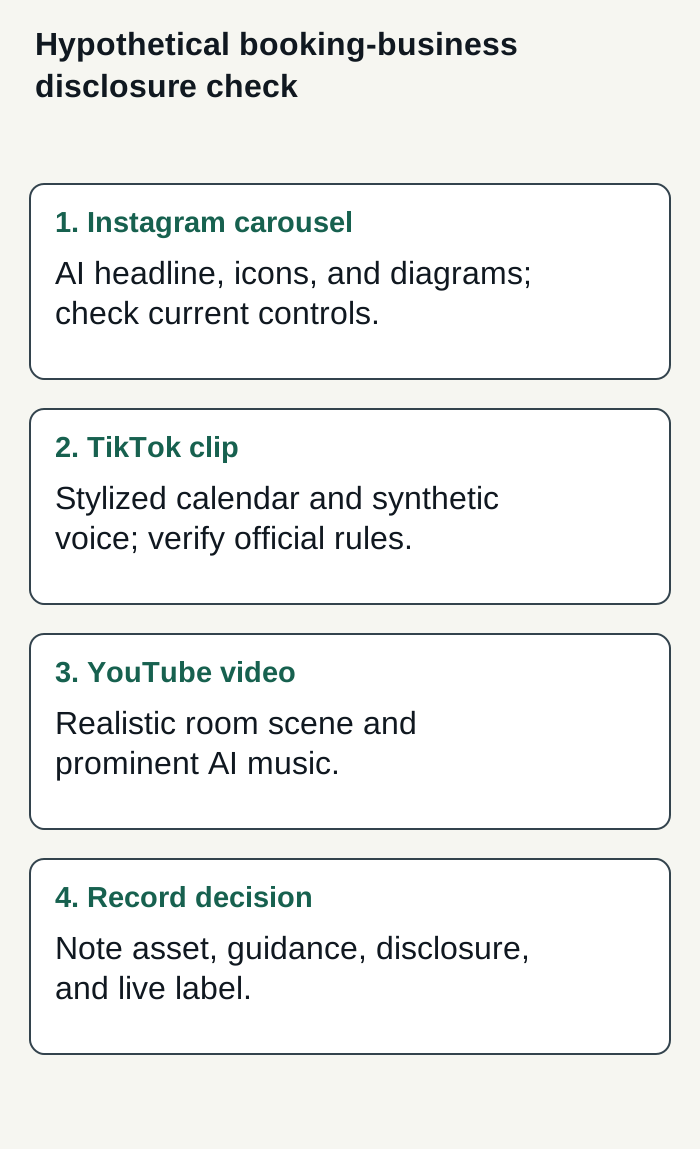
Hypothetical booking-business examples; TikTok requirements are not established by the supplied sources.
Condensed original editorial illustration. Read the surrounding guidance for qualifications and the complete procedure; any example is fictional and shows no verified customer outcome or product screen.
Illustrative worked example by Superdirector editorial team. Created 2026-11-09.
Set and verify the disclosure
For a YouTube video that meets the guide's disclosure requirements, YouTube says to use the AI use setting during upload in YouTube Studio and choose Yes. It says a viewer label follows; its placement can vary with the kind of content. YouTube may also apply labels automatically in some cases, but that possibility does not replace the creator's disclosure decision.
For Instagram, check the current posting flow and Meta guidance for the particular content. Meta says people should disclose qualifying realistic digitally created or altered organic video and audio; its 2024 announcement describes a disclosure tool. Do not infer today's exact button name or location from that announcement. For TikTok, consult its current official requirements because the available evidence here is insufficient.
- Review the final file, including audio and every image or clip, rather than only the caption.
- Check each platform's current official guidance for the specific format.
- Make any required disclosure in the platform's available workflow before publishing.
- After posting, inspect the live item and record what label appears. A missing automatic label does not prove that no disclosure was required.
YouTube states that disclosing AI content alone will not limit a video's audience or eligibility to earn money. That statement applies to YouTube; it does not establish the effect of labels on other platforms.
Decide whether a managed channel fits
If your buying goal is a customizable AI-run channel for about $200 a month, Growth is currently $199/month for two accounts, with no trial. Superdirector can handle research, brand context, content creation and eligible publishing; today, publishing is limited to Instagram image carousels and single X text posts, either approved per piece or covered by an enabled account Auto-post rule. For this disclosure task, you still need to assess what AI changed and check the destination platform’s current guidance. The first hand-approved post must be verified live before Auto-post can be enabled. See Growth plan details and the publishing workflow.
Finished video and fully autonomous channels are upcoming, not current publishing features, so finished videos for TikTok, YouTube or Reels are outside today’s publishing scope. Connected accounts and selected source cards define what can publish; turn Auto-post off to stop unsent work or pause posting to hold the queue. Measure review effort and customer-defined results rather than assuming either.