How-To Guide
Can a brand use trending sounds on TikTok and Instagram?
Check music rights before using a trending TikTok or Instagram sound, choose a cleared alternative and reconsider rights before paid promotion.
By the Superdirector editorial team.
At a glance
Can a brand use trending sounds on TikTok and Instagram?
Sometimes, but there is no universal yes based on a sound’s popularity or its appearance in an app. Check the current terms for the particular audio and intended use. Organic brand content, paid promotion, and reposting are not interchangeable contexts. If the terms do not establish that your planned use is covered, choose audio with terms that do, or use the trend’s visual format with different sound.
- Check the sound’s current terms, not just whether it appears in a picker.
- Decide whether the post is organic only or might become paid or reposted.
- Use original or licensed audio only when the relevant rights cover your intended use.
- Record the source and re-check before changing the post’s distribution.
The short answer: check the sound and the planned use
A brand may be able to use a trending sound, but the trend itself does not answer whether a particular use is covered. A sound’s popularity, or its appearance in an app’s audio picker, is not enough to establish permission for every account, post, placement, or later promotion. Check the current terms that apply to the sound and to your intended use before publishing.
That distinction matters on both TikTok and Instagram. The supplied material does not include current first-party music-use rules for either platform, so this guide cannot give a definitive platform-by-platform clearance list. It offers a practical decision process instead. Planoly’s brand guidance notes that some trends use original audio and recommends adapting a trend’s format rather than relying on its exact song. Treat that as a creative option, not proof that any particular audio is cleared.
A useful starting point is to separate the sound from the idea: you may be able to use the pacing, setup, text treatment, or visual joke without using the same recording. If you cannot establish that the audio fits your intended use, preserve the creative concept and change the sound.
Separate the post’s purpose from its account type
Write down what the content is for. Is it an ordinary post from the brand, a creator partnership, an offer or product feature, or a post you may later promote? These details help identify the usage terms you need to check. Do not assume that an account label alone settles the question.
The Third Chair explainer distinguishes platform-native availability from broader clearance and notes that account type and region can affect Meta music availability. It also describes boosting and whitelisting as changes that can affect the context of a post. This is practitioner guidance, not a substitute for current platform terms.
A post planned as organic today may be considered for paid distribution later. If that is plausible, include it in the audio decision at the beginning. Otherwise you may have to revisit the edit, replace the sound, or confirm new terms before using the post in a different way. Reposting another person’s video deserves its own check: the fact that a customer or creator selected the audio does not establish that the brand’s repost is covered.
Music may also involve rights in both a composition and a recording. Osborne Clarke’s article discusses that distinction in a German-law context and advises businesses to examine music-use terms. Its jurisdiction-specific discussion should not be treated as a universal legal rule, but the practical lesson is relevant: identify what audio you are using and what the applicable terms actually cover.
Choose the audio route before editing
- Check the platform’s current terms and eligible library. Confirm what the library or sound-specific terms allow for your account and intended placement. Do not assume that access in the app grants permission for every commercial or paid use.
- Use original audio only if you control the relevant rights. A recording described as “original audio” may still contain someone else’s music or recording. The label alone does not establish who made it or what uses are allowed.
- Use a production track with applicable written terms. Check that its terms cover the platform, brand use, territory, and any paid distribution you are considering. Keep the terms with the project record.
- Commission or directly license audio when appropriate. Make sure the permission describes the uses you actually plan, rather than assuming a track can be used everywhere because it was licensed once.
- Keep the trend, change the sound. Use a similar visual structure, timing, or text treatment with audio whose terms you can verify, or with no added music.
No single source listed here is automatically right for every post. The decision depends on the applicable terms and the use you intend. Do not rely on a short excerpt, artist credit, an account-type switch, or editing the video elsewhere as substitutes for checking permission. Osborne Clarke specifically says there is no 15-second rule for royalty-free music use in the context it discusses; duration alone is not a reliable clearance test.
Work through a hypothetical brand example
Hypothetical example: A neighborhood café wants to make a short Instagram video using a popular sound. The first version would show a barista preparing a drink and would be posted organically. The owner may later want to promote it as an advertisement. The café should decide how to handle both plans before choosing the audio.
| Decision point | What the café checks | Practical choice |
|---|---|---|
| Organic post | Does the current sound-specific or library guidance cover this brand post, account, and region? | Use the sound only if the terms establish coverage; otherwise choose another track. |
| Possible paid promotion | Do the terms also cover the planned paid placement, or is separate permission needed? | If unclear, use an audio option whose applicable terms cover the planned promotion. |
| Keep the trend | Does the visual format work without the viral recording? | Use the same quick drink reveal with cleared or original audio. |
| Save the decision | Can the team identify the source, date checked, intended use, and supporting terms later? | Keep a short record with the project files. |
The example does not establish what any current Instagram track permits, and it does not predict how the video will perform. It shows how to separate creative choices from permission checks. If the café later decides to repost a customer’s video, that is a changed use: check the audio and the terms for the repost rather than carrying over the original creator’s assumptions.
When enlarged, scroll horizontally to read the diagram.
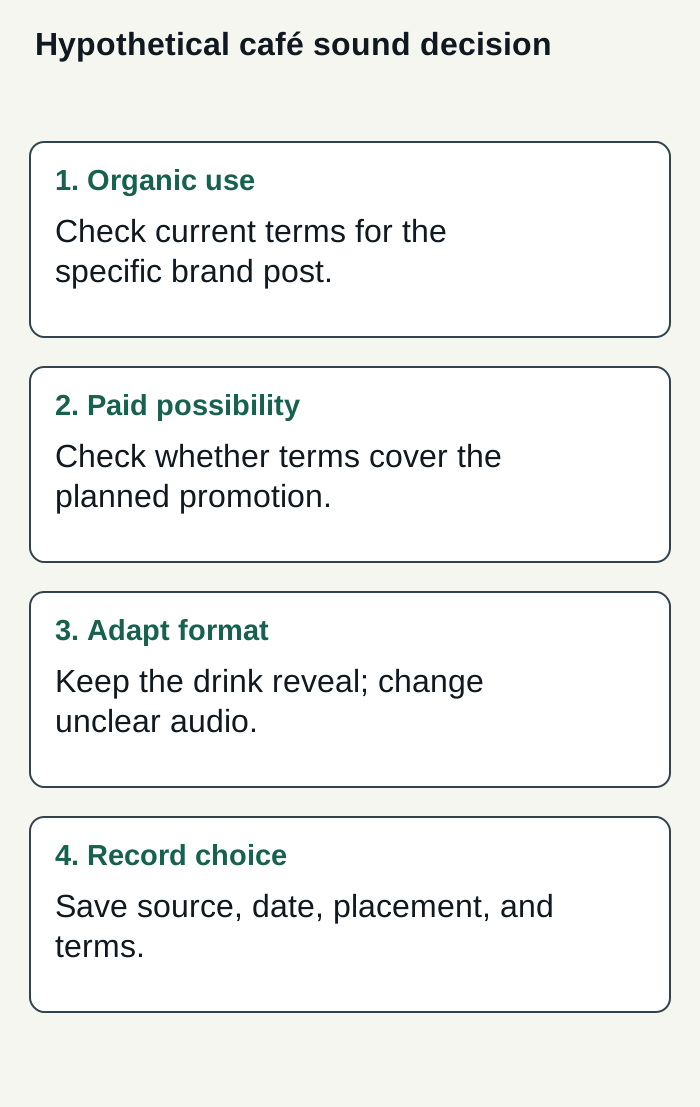
Decision flow for a hypothetical café video; no specific sound is represented as cleared.
Condensed original editorial illustration. Read the surrounding guidance for qualifications and the complete procedure; any example is fictional and shows no verified customer outcome or product screen.
Illustrative worked example by Superdirector editorial team. Created 2026-11-09.
Keep a short record and re-check changes
A simple record makes a later review easier. Save the platform, track or audio description, where you found it, the date you checked, the planned account and placement, and a note or copy of the terms you relied on. Record whether paid promotion, creator partnership, or reposting is planned. This is a workflow aid, not proof that a use is authorized.
Re-check when the plan changes: for example, when an organic post may be boosted, when a creator post is reused on a brand account, or when a version moves to another platform. Do not infer cross-platform permission from a track’s availability on one service. The same discipline applies if the post is edited or republished later.
If the terms are unclear and the campaign depends on a specific recording, pause that audio choice and seek the appropriate permission or qualified advice. For a low-friction creative fallback, preserve the trend’s structure and substitute audio with terms that fit the intended use.
Where Superdirector fits—and where it does not
Treat a customizable AI-run channel around $200/month as the buying goal, not a claim that Superdirector is already fully autonomous or guarantees results. Growth is currently $199/month for two accounts, with no trial. It publishes only eligible Instagram image carousels and single X text posts, either after per-piece approval or under an enabled account Auto-post rule. Finished video and fully autonomous channels are upcoming; TikTok, YouTube, and Reels video workflows are outside current publishing scope. See Growth pricing.
Account connection and selected source cards define what can publish. The publishing guide explains the setup; implementation requires the account’s first hand-approved post to be verified live before Auto-post can be enabled. Turning Auto-post off stops unsent posts, and Pause posting holds the queue. These controls do not clear music or publish finished video. Assess results against your own goals and measure actual review effort rather than assuming either outcome or workload.