How-To Guide
How to reverse-engineer a post’s hook, structure, format and timing
Compare a strong post with the same account's ordinary posts, separate visible clues from private analytics and design a small original test.
By the Superdirector editorial team.
At a glance
How to reverse-engineer a post’s hook, structure, format and timing
Treat a high-performing post as a clue, not a formula. Compare it with relevant posts from the same account, annotate its opening, sequence, format, timing and audience response, then check which clues also show up in ordinary posts. Public observations can suggest a hypothesis; account analytics and a careful follow-up test can strengthen it, but neither proves one feature caused the reach.
- Compare posts at similar ages and against the same account’s baseline; avoid treating a large raw view count as proof of an outlier.
- Separate what the post visibly contains from private evidence such as retention, traffic sources, or unlabelled paid support.
- Test one change in your own original content. A result is a learning signal, not a promise of repeat reach.
Treat a viral post as evidence to investigate, not a recipe
To reverse-engineer a strong post, compare it with relevant posts from the same account, note its hook, structure, format, timing and visible response, then check which features distinguish it from ordinary posts. Use that comparison to form one testable idea. A teardown can show what the post did and suggest what to investigate; it cannot prove that a particular feature caused its reach or guarantee that repeating it will work.
Start with the account’s own baseline rather than an arbitrary view threshold. A post with a large total may be normal for a large account, while a smaller total may be unusual for a smaller one. Compare posts that are reasonably similar in age, topic and format. If the comparison is not fair, note the mismatch rather than forcing a conclusion.
This matters because reach has context beyond the creative. TikTok’s 2020 explanation describes recommendations as personalized and lists interactions, video information and device or account settings among its signals. It also says that follower count and previous high-performing videos are not direct factors in the system it described. That is a dated platform explanation, not a complete or current ranking formula. Use it to remember that one public post cannot reveal how every viewer received it—not to claim that a creative feature guarantees distribution.
Separate visible clues from account-only evidence
For another creator’s public post, you can inspect the opening, sequence, format, posted date, visible counts and comments. You cannot infer private retention, all traffic sources, or whether there was unlabelled paid support from those details alone. For your own posts, use the analytics your platform provides and record the reporting window. On YouTube, for example, the platform describes retention as showing where viewers watch and drop off, and recommends examining traffic sources to interpret performance. That guidance helps you ask better questions; it does not isolate the cause of a result.
| Layer | What to record | What it cannot prove |
|---|---|---|
| Hook | Opening words, image or first moment | Whether viewers stayed or acted because of it |
| Structure | Sequence of beats and where the payoff appears | Where viewers dropped off, unless analytics show it |
| Format | Carousel, short video, text post, audio or visual treatment | Whether format rather than topic explains the result |
| Timing | Post date, observed age and relevant event context | That the hour caused reach or will work again |
| Response | Visible comments and counts, when available | Private shares, saves, retention or traffic mix |
Keep the distinction explicit in your notes: “observed” for what is visible, “account data” for analytics you can access, and “hypothesis” for your explanation. That simple labeling prevents a plausible story about a hook, sound or posting hour from quietly becoming a fact.
Annotate the post in five layers
Make one short note for each layer. Quote only what you need for your private analysis; the goal is to describe the mechanism, not reproduce someone else’s work.
- Hook: What does the viewer see or hear first? Is it a question, claim, demonstration, contrast or promise?
- Structure: What happens next, and when does the post deliver its payoff? Write the sequence in plain language.
- Format: What is the medium and presentation—such as a carousel, talking-head video or text-led post? Note relevant audio or visual choices.
- Timing: Record the date and time shown, the post’s age when you checked it, and any obvious event or topic context. Do not treat one timestamp as a timing strategy.
- Response: Describe visible comments and counts, if available. On your own account, add relevant analytics such as retention or traffic sources.
Look for a relationship between the opening promise and the later payoff. On YouTube, its creator guidance recommends examining retention graphs for drops and rewatched segments. That can help you locate moments to investigate on your own videos. It is not evidence that the same edit or opening will work the same way on another platform or audience.
Worked example: compare the clue with ordinary posts
Hypothetical example: a neighbourhood café’s account has one short video that attracts noticeably more attention than its usual posts. The owner compares it with several recent café videos of similar age and topic. The figures below are invented for illustration, not customer results or research findings.
| Layer | Hypothetical standout | Hypothetical ordinary posts | Useful reading |
|---|---|---|---|
| Hook | Opens with a close-up of a drink being finished | Several also open with close-ups | The image alone does not distinguish the standout |
| Structure | Shows the finished drink, then the steps, then the menu name | Most show steps but omit the final name | A clear final answer is a candidate to examine |
| Format | Short vertical video with on-screen labels | Same format and similar labels | Format is shared, not a sufficient explanation |
| Timing | Posted during a local weekend market | Other posts fall across different days | Event context is a possible confound |
| Response | Comments ask for the drink’s name | Comments ask assorted questions | Questions suggest an information need, not causation |
A cautious takeaway is that viewers may have valued seeing the drink identified after watching how it was made. But the local market could have affected attention, too, and public comments do not show who watched to the end. The owner should not conclude “close-ups go viral” or “weekend posts win.” The useful next move is a test that answers a narrower question.
When enlarged, scroll horizontally to read the diagram.
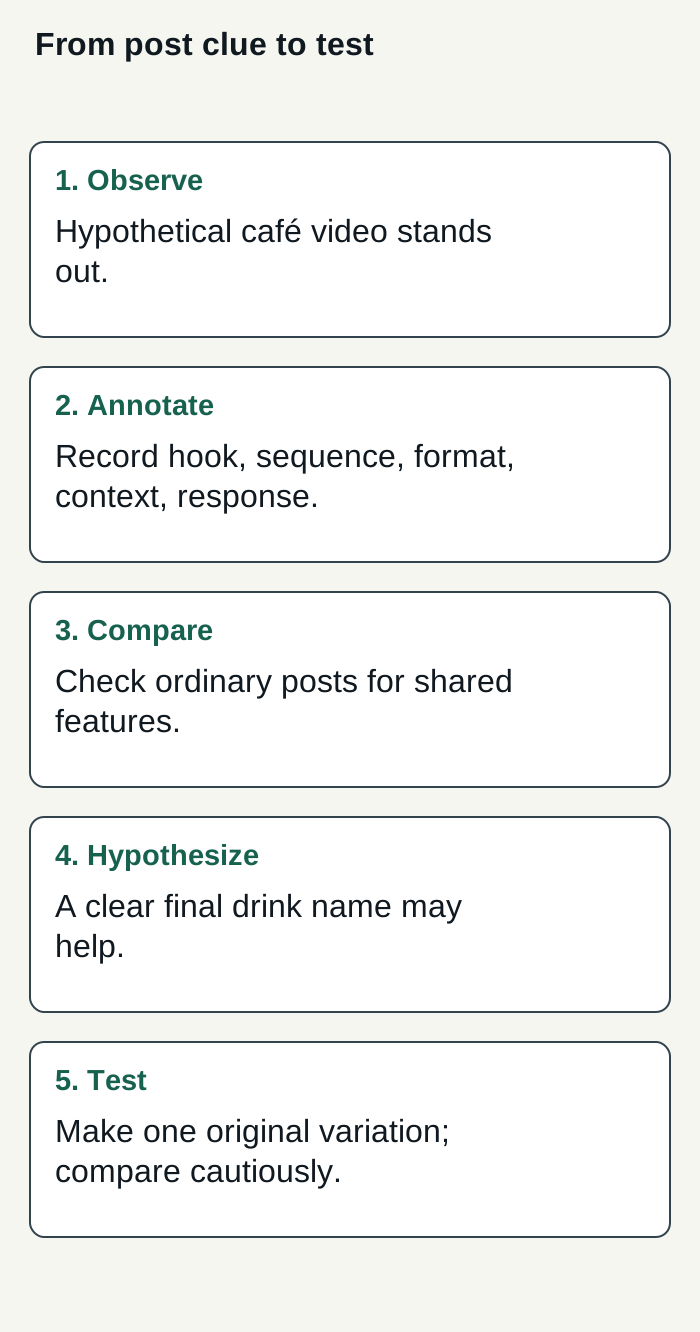
Hypothetical café example: observe a post, compare its features with ordinary posts, and test one original variation.
Condensed original editorial illustration. Read the surrounding guidance for qualifications and the complete procedure; any example is fictional and shows no verified customer outcome or product screen.
Illustrative worked example by Superdirector editorial team. Created 2026-11-09.
Write one test and make an original variation
Turn the candidate into a short test card before making the next post:
Observation: What visibly differed from comparable posts?
Hypothesis: What might that difference help the viewer understand or feel?
Change: Which one main element will I vary?
Comparison: Which recent post or planned version is my control?
Measure: Which relevant account metric will I compare, and when?
Disconfirming result: What outcome would weaken my hypothesis?
For the hypothetical café, the test might keep the general topic and format while changing whether the finished drink’s name appears at the end. Compare the result with a relevant post from the same account and use the analytics available for that platform. Keep other differences as limited as practical, but record unavoidable ones, such as an event or a change in audience source. One post is a signal to learn from, not a controlled proof.
Make a new post in your own words and with your own material. Adapt the general storytelling idea—such as showing a process before naming the result—rather than reposting or closely reproducing someone else’s post. If the test is inconclusive, adjust the question or gather more comparable observations instead of declaring the hook, format or time responsible.
Use platform analytics without mixing platform claims
Choose measures that fit the platform and the question. YouTube’s guide distinguishes click-through rate, retention, traffic sources and videos bringing in new viewers; its retention and traffic-source advice is specific to interpreting YouTube Analytics, not a universal formula for social posts. TikTok’s published recommendation explanations are historical descriptions and may not reflect current ranking details. Do not use an old platform explanation as proof of today’s rules, and do not transfer one platform’s analytics interpretation to another without evidence.
Timing is especially easy to overread. YouTube’s 2024 creator guidance says Analytics can show when viewers are active on YouTube. Treat that as an account-specific planning input, not evidence that posting at a certain hour causes a post to take off. If timing is your hypothesis, compare comparable posts on your own account and keep topic, format and post age in view.
Where Superdirector fits—and where it does not
A customizable AI-run channel for about $200 a month is a buying goal, not a claim that Superdirector currently runs a channel autonomously or guarantees results. Current Growth pricing is $199 a month for two accounts, with no trial. For this teardown workflow, it can help organize research and turn observed patterns into original drafts; you still assess whether a pattern is useful for your business and measure customer-defined results and the review effort required. Eligible publishing is limited to Instagram image carousels and single pure-text X posts, with per-post approval or an enabled account Auto-post rule. Finished video and fully autonomous channels are upcoming; video scripts for TikTok, YouTube or Reels are not finished videos that can currently be published here. Account connection and the source cards selected for a Publishing module define what can publish. The publishing guide explains the setup and controls; implementation requires the account’s first manually approved post to be verified live before Auto-post can be enabled. Turning Auto-post off stops unsent posts, and Pause posting holds the queue. Measure the workflow’s cost, review effort and results against your own goals rather than assuming minimal oversight or promising an outcome.