How-To Guide
Do carousels get more reach and saves than Reels and single images?
Read the available Instagram benchmarks, understand their limits and compare formats on your own account without assuming a universal winner.
By the Superdirector editorial team. This revision uses the cited benchmark reports and product documentation; we ran no Instagram format test of our own.
At a glance
Do carousels get more reach and saves than Reels and single images?
No universal winner is established. The supplied benchmarks disagree about carousel-versus-Reel reach, and they do not provide a comparable saves result for all three formats. Use your account’s own matched test to compare reach and saves separately.
- Reach and views are different measures; do not substitute one for the other.
- Engagement can combine several interactions and does not tell you how many saves a format earned.
- Compare similar topics and use the same measurement window.
The short answer: no format wins every metric
Carousels do not reliably get more reach and saves than both Reels and single images. The supplied studies point in different directions on carousel-versus-Reel reach, and they do not provide a comparable saves result for all three formats. So the practical answer is to choose a metric, then test similar posts on your own account.
Keep the measures distinct. Reach and views are different measures; Buffer defines its reach metric as the number of times an account’s media objects were uniquely viewed. Saves are one kind of interaction, and engagement may combine likes, saves, comments, and shares. Higher engagement does not by itself prove higher saves.
What the available comparisons actually say
These reports are useful as context, not as a forecast for an individual account. They cover different samples and time windows. The supplied reports do not describe a controlled comparison of the same topics posted in all three formats, so they cannot establish that kind of result.
| Source and period | Reported comparison | What it does not settle |
|---|---|---|
| Buffer, Jan 2022–Oct 2024 | More than four million posts sent through Buffer; Reels averaged more reach than carousels, while carousels averaged more engagement than Reels. | A separate saves advantage. Its engagement measure combines likes, saves, comments, and shares. |
| Fanpage Karma, Jan–May 2025 | Almost 700,000 posts; the report says carousels had higher Instagram reach and engagement rate than Reels. | What a different sample, period, or account would show; it reports no separate saves comparison. |
| Metricool, Jan–Jun 2024 | A vendor-issued report on 391,490 professional accounts says Reels reached the highest percentage of users and carousels had the highest engagement rate. | A direct account-level test or a result that applies to every business. |
The disagreement matters: these selected reports are not an exhaustive review, and it is not sound to combine them into a universal ranking. Their samples and measures differ; their findings are descriptive, not proof that format alone caused the outcome.
Sources: Buffer’s reach and engagement analysis, Fanpage Karma’s comparison, and Metricool’s 2024 benchmark release.
Choose the result you want to improve
Before choosing a format, write down what success means for this post. If the goal is to reach more accounts, record reach. If the goal is useful reference material, record saves. If you want to compare how often reached accounts save, calculate saves divided by reach for each post. Keep the raw save count too: the rate and the count answer different questions.
If you also care about comments, shares, or likes, record them separately. A composite engagement figure can conceal different patterns: one format might prompt more comments while another earns more saves. Compare rates only when the denominator and calculation are the same.
For definitions and related context, see our guides to engagement rate and reach vs. impressions.
A hypothetical three-format planning worksheet
The following is a planning example, not real performance data. Imagine a small booking-based business that wants to help prospective customers choose an appointment time. It could make three versions of one low-risk customer question: a short Reel explaining the options, a carousel laying them out slide by slide, and a single image with the essential information.
| Version | Shared topic | Primary question |
|---|---|---|
| Reel | Appointment-time options | How many accounts did it reach after the same elapsed time? |
| Carousel | Appointment-time options | How many accounts did it reach after the same elapsed time? |
| Single image | Appointment-time options | How many accounts did it reach after the same elapsed time? |
Use the table as a worksheet, then repeat the comparison with other questions your audience commonly asks. Keep the core information and offer consistent; adapt the presentation to the format rather than changing the message. Note any meaningful differences, such as a timely topic or unusual promotion, so you do not mistake them for a format effect.
- Choose a small set of comparable customer questions that can be answered accurately in all three formats.
- Write down the same primary goal for each set: for example, reach or saves per reach.
- Plan when to check results and use that same elapsed time for every post in the comparison.
- Record reach and saves separately, alongside comments and shares if they matter to the business.
- Compare the three versions within each topic before looking for a pattern across topics.
This is a plan for collecting observations, not a numerical demonstration or a completed test. The Reel and single-image comparison posts require production and publishing outside Superdirector’s currently listed image-carousel publishing scope. Rotate the format order where practical, keep posting windows comparable and record differences; this organic comparison cannot isolate format as a cause.
When enlarged, scroll horizontally to read the diagram.
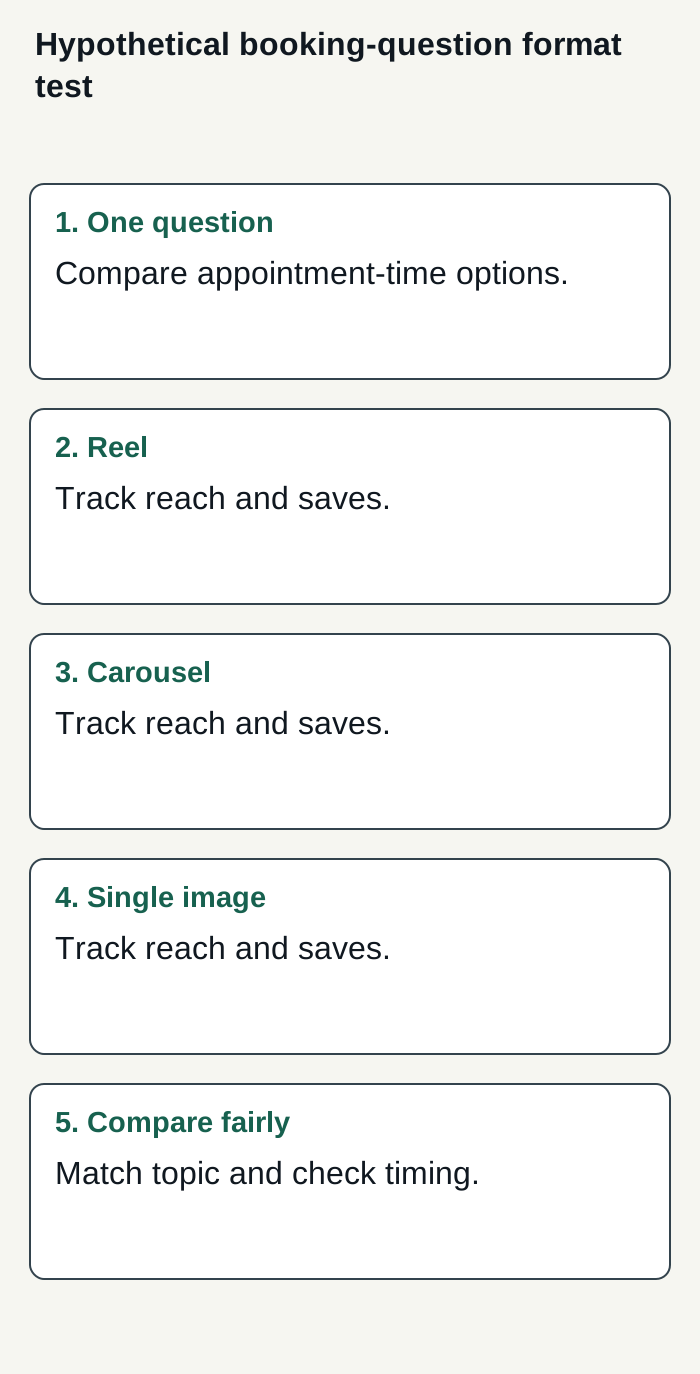
A hypothetical booking-business workflow for comparing formats; no performance outcomes are depicted.
Condensed original editorial illustration. Read the surrounding guidance for qualifications and the complete procedure; any example is fictional and shows no verified customer outcome or product screen. Reel and single-image comparisons describe content formats generally, rather than current Superdirector publishing eligibility.
Illustrative worked example by Superdirector editorial team. Created 2026-11-09.
How to read your results and choose a next step
Do not let a single post choose your strategy. One topic may naturally suit a visual sequence; another may be clearest in a short video or one image. Compare several topic-matched sets and ask whether the same format tends to support the outcome you selected. A small test can suggest what to try next, but it cannot prove that format caused the difference.
Look at both counts and rates. More saves in total may simply accompany more reach; saves per reach puts the save count in relation to the audience reached. Conversely, a better rate on a post seen by fewer accounts does not necessarily mean it contributed more total saves. Decide which of those outcomes matters before interpreting the comparison.
Keep the result practical: repeat a promising format with another set of topics, or revise the creative if the message was unclear. If results are mixed, keep a mix rather than forcing a winner. Revisit the test when your audience, offer, or content changes.
Making and publishing the test posts
For a business weighing a customizable AI-run channel at about $200 a month, Growth is a current, limited publishing workflow—not a fully autonomous channel or a promise of results. It costs $199/month for two accounts and has no trial. It currently publishes only eligible Instagram image carousels and single X text posts, either with per-piece approval or an enabled account Auto-post rule; finished video and full autonomy are upcoming. Publication requires a connected account, selected compatible source cards, and the documented format and account eligibility. Check whether that scope fits your format needs, then measure your review effort and your own customer-defined results.
Before enabling Auto-post, verify the first hand-approved post is live. You can stop unsent work by turning Auto-post off or hold the queue with Pause posting. See pricing and the publishing guide for current terms and controls. Reels and other finished-video comparisons remain outside current publishing scope; video scripts are not published.