How-To Guide
How to correct a wrong fact in a creator campaign report you already sent
Quote the sent statement, source the fix, trace what depends on it, tell the client old and new values and issue a new report version with a receipt.
How should an agency correct a sent campaign report when a source export or post count was wrong?
Open one correction receipt per wrong fact. Quote the sent statement exactly with its report version, pull the corrected figure from a primary source and record its account, date range, filters and pull time, then list every figure and sentence that depended on the wrong value and mark whether a conclusion changes. Send the client a notice with the old value, the new value, the source and what you re-checked. Keep the sent report unchanged, issue a new dated version and file the receipt beside both. Name a cause only if the sources show it.
- Quote the sent statement word for word and pin the report version.
- Record the corrected source’s scope and pull time, and say why the first one differed or that you do not know.
- Never edit the sent report in place; issue a new version and file one receipt for both.
Direct answer
Short answer: correct a sent report with one receipt per wrong fact. The receipt does five jobs. It quotes the sent statement exactly and names the report version. It records the corrected source evidence with its scope and the time it was pulled. It traces every figure and sentence that depended on the wrong fact. It carries a notice to the client that states the old value, the new value and the source. And it points to a new report version, because the sent version stays on file unchanged. The client ends up with an accurate number and a trail from the old one to the new one.
This is for an agency or brand marketer who has already sent a creator campaign report and then finds that a fact in it was wrong, for example a post count, a date range or a figure copied from a source export. The decision is narrow: how to repair the client’s record so the correction is accurate and traceable. It does not decide who was at fault, whether the client is owed anything, or how to word a legal notice. Those calls belong to the deal owner and counsel.
The reason to use a receipt is that a quiet fix leaves two reports in circulation with no explanation of how they differ. The client may have forwarded or acted on the first one. A receipt lets anyone later see what was said, what was true, how you know and what else moved. Use the blank correction receipt, the CSV register and the correction map to keep it in one place.
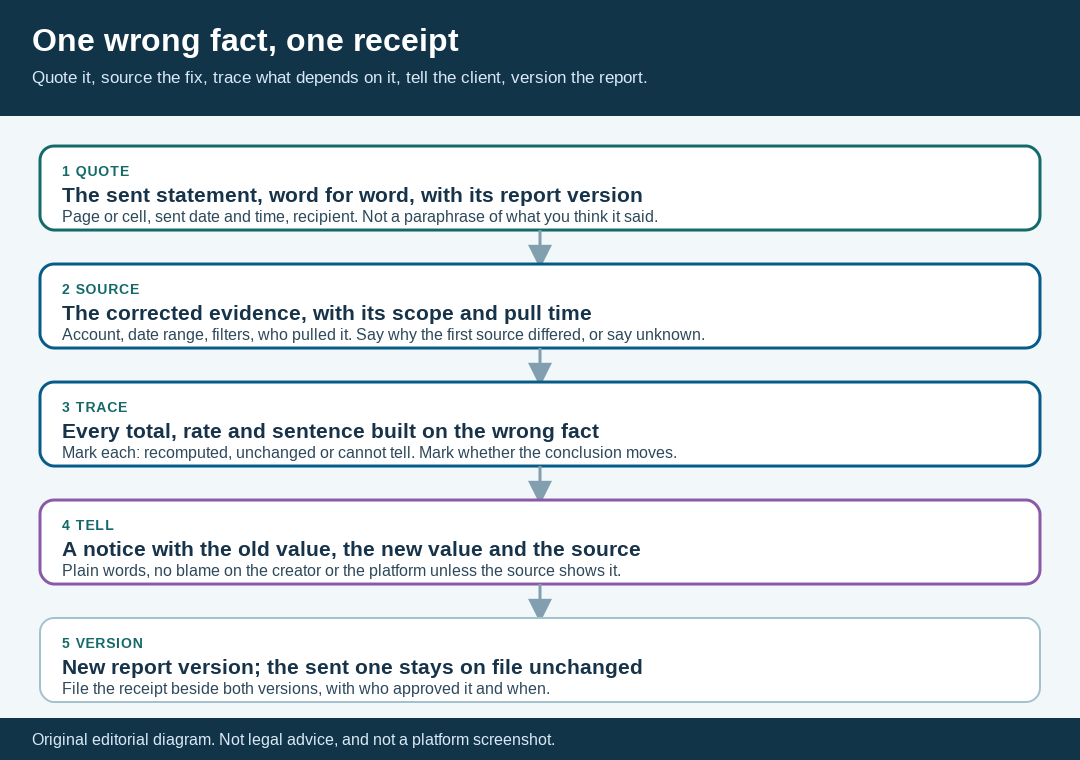
An original editorial map. One wrong fact gets one receipt, and the sent report stays unchanged.
Open the blank report correction receipt (HTML)Download the blank correction register (CSV)
 Superdirector
Have your AI do this for your brand.
7 days free, then $29 a month.
Quote the sent statement and pin its version
Start from what the client actually received, not from the working file you have since edited. Find the sent copy, with its file name, version label and the date, time and time zone it went out, and note who received it. Then copy the wrong statement word for word into the receipt: the sentence, the table row or the chart label, with the page or cell where it appears. A paraphrase becomes your reading of the mistake, and the client may have read it differently.
Name the kind of error in one phrase before you fix anything. A count can be wrong because of the number itself, the date range, the account, a filter, a deleted or private post, or a cross-posted asset counted twice. A value can be wrong because it was copied from the wrong row or the wrong export. You may not know yet, and that is allowed: write “cause not yet known” and move on. What you must not do is write a cause you have not shown.
Record who else saw the report if you know: the client contact, anyone they forwarded it to and any deck or message where the figure was repeated. The correction has to reach the places where the wrong number now lives. If the figure was first sent in a message and then pasted into a report, there are two statements to quote, and each gets its own line on the receipt.
If the wrong fact is a delivery count, check whether the post counts at all before you correct the number. The Instagram collab delivery guide and the cross-post counting guide cover those cases. Here the question is only how to repair a report that is already out.
Get the corrected evidence and record its scope
A correction is only as good as the source behind it. Pull the corrected figure from the primary source you can reach, such as the platform’s own analytics export, the analytics report or the post itself, and record what that source covers: the account, the date range, the filters, who pulled it and the date, time and time zone of the pull. A figure with no scope cannot be checked, and a correction nobody can check just swaps one unverified number for another.
Platforms say plainly that their numbers move. Google’s help page on data freshness says data processing can take 24 to 48 hours, and that data in reports may change during that time. It also says some data can arrive late, potentially up to seven days delayed, and that attribution credit for key events can change for up to 12 days after the key event is recorded. GA4 data freshness. That page describes Google Analytics only. It means that an export you pulled early and an export you pulled later can both be honest and still differ, so the pull time belongs on the receipt.
Instagram’s developer documentation for account insights carries a similar warning: data used to calculate metrics may be delayed up to 48 hours. It also says that if the data you request does not exist or is currently unavailable, the API returns an empty data set instead of 0. Instagram account insights reference. That is a statement about that API, not about every Instagram screen or export, so do not assume an empty cell in a spreadsheet means the same thing. A blank and a zero are different facts, and the missing analytics guide explains how to show them.
YouTube’s help page on limited data says some data may be limited when metrics do not meet a certain threshold, that rows with insufficient data can be left out, and that a report’s overall figure may therefore not match the combined value of its rows. It adds that the thresholds are not published and are subject to change at YouTube’s discretion. Understand limited data in YouTube Analytics. So if your original number was a sum of rows and the corrected one is a reported total, the difference may be the source’s own behavior and not an arithmetic slip.
Finally, write why the first source differed, or write “unknown”. Possible reasons are a different date range, a different filter, a later pull, a creator-supplied screenshot against a platform export, or a typing error. Choose a reason only if you can show it from the two sources side by side. If the corrected figure came from a creator’s screenshot, run it through the screenshot evidence check before it replaces anything.
Trace every figure and sentence that depends on it
A wrong fact rarely sits alone. List everything in the report that was computed from it or reads differently because of it: totals, averages, rates, per-post figures, cost lines, chart bars, rankings, the summary paragraph and any recommendation. Work through the report in order, and write each dependent item as one line on the receipt. The correction map shows where this step sits.
For each dependent item, write one of three results: recomputed with the new value, unchanged because it does not use the corrected fact, or cannot tell because you lack the inputs. “Cannot tell” is a legitimate answer. Then ask one question about the whole report: does a conclusion change? If the corrected post count turns a statement like “every contracted post went live” into a different statement, the sentence changes, not just the number. Mark the conclusion as unchanged, changed or cannot tell yet.
The table below shows the shape of the trace with generic rows. The values are blank on purpose, since this page has no real report to quote.
| Dependent item | How it relates to the wrong fact | Result | What to write |
|---|---|---|---|
| Direct figure | The statement itself, such as a count or a date | Recomputed | Old value, new value and the source row |
| Derived figure | A total, rate or average that used it as an input | Recomputed or cannot tell | The formula inputs, so the client can redo it |
| Chart or ranking | A bar or rank that moves when the value moves | Recomputed | Replace the chart; note the old one is retired |
| Summary sentence | Text that states or implies the old value | Changed or unchanged | Quote the old sentence and the new one |
| Recommendation | A next step that leaned on the old value | Changed, unchanged or cannot tell | Say what it rested on; leave the decision to the owner |
| Unrelated facts | Figures you re-checked and found unaffected | Unchanged | List them, so the client knows they were checked |
Listing the unchanged facts you re-checked matters more than it looks. A client who learns that one figure was wrong will reasonably wonder about the others. A short, honest list of what you checked and why it stands answers that without overclaiming.
If the trace shows the corrected fact moves a figure that changes what the client should do, such as whether a deliverable was met, tell the deal owner before you write the notice. Whether a missed or met requirement changes payment, rights or renewal is outside this page. If you hold a freeze rule for late data, the freeze and late-data guide covers what a late arrival changes before a report goes out. This page picks up after it has gone.
Send a notice with the old value, the new value and the source
Write the notice so that it can stand alone if the client forwards it. It needs six things: which report and version, which statement was wrong, the old value, the new value, where the new value comes from, and what else changed because of it, including what you re-checked and left alone. Add the date and time you found the problem.
Say the correction promptly and prominently, and explain it clearly. That is not a legal rule for agencies. It is a norm from journalism: the Society of Professional Journalists’ code of ethics says to acknowledge mistakes, correct them promptly and prominently, and explain corrections and clarifications carefully and clearly. SPJ Code of Ethics. Borrowing the habit does not make that code binding on you, and it does not tell you what your agreement requires. Check the agreement for any notice clause, and ask counsel if the correction touches payment, rights or a stated requirement.
Be careful with cause. If you do not yet know why the number was wrong, write that. Do not blame the creator, the platform or the client’s own data unless the sources you hold show it, and do not claim the error was “minor”. The client decides what matters to them. State the facts and let them be.
Send the notice to everyone who received the wrong figure that you know of, and by a channel the client reads. If the report is attached to a message, say in the message which attached file replaces which. Record the date, time, time zone and channel on the receipt, and save the notice text beside it. If the client replies, save the reply as written. A reply such as “thanks, noted” is an acknowledgment and not an approval of anything else, so do not record it as more than that.
Issue the new version and file the receipt
Do not edit the sent report in place. An edited file no longer shows what the client was told, and nobody can separate the original from the change. Create a new version with its own ID and its own date, and put a short note at the top that points to the correction and says what changed. Keep the original exactly as it was sent. The receipt is the link between the two.
Then file the receipt beside both versions: the sent report, the new report, the corrected source evidence, the notice and any reply. Write who approved the new version and when. If your team keeps a list of reports, mark the sent version as superseded and name its replacement, so nobody grabs the old one for a later deck. This page does not state how long to keep the file, because the sources we read gave no period. Set that from your agreement, your records policy and counsel.
Last, look for the same error elsewhere. If a wrong date range produced this count, check whether the same range fed other reports for the same client. If a wrong filter was saved in a template, fix the template and note it on the receipt.
Walk through a fictional correction
Fictional exercise: no real brand, creator, campaign or result was inspected. A made-up agency sent a made-up client, Brand A, a report that said “Creator Q published four of the four contracted posts.” A week later a teammate compares the report against the platform export and finds the export covers only part of the campaign window, so a fifth item that the report counted as a post was in fact a story, and the count of posts is three, not four.
The reviewer opens a receipt. Quote: the sentence above, from page two of version 1, sent on a stated date and time to Brand A’s named contact. Source: a fresh export for the full window, with account, range, filters and pull time written down. Why it differed: the first export’s range ended early, which the two files show side by side. Trace: the delivery rate and the cost-per-post line are recomputed, the summary sentence changes, one chart bar is replaced, and the click total is re-checked and left unchanged. Conclusion: changed, because “all contracted posts” is no longer true.
Before sending anything, the reviewer tells the deal owner, since the changed conclusion may bear on the agreement. The notice then states the old and new count, the source, the changed sentence and the list of re-checked facts, without blaming anyone. Version 2 goes out with its own ID and a note at the top. Version 1 stays on file marked superseded, and the receipt links both. Whether any remedy follows is the deal owner’s decision.
What this page does not decide
This method repairs a sent report’s record. It does not decide fault, remedy, payment, or whether a corrected figure means a requirement was missed. It does not tell you what your agreement says about notice. It gives no legal advice, and the SPJ code is quoted as a norm only.
Several neighboring pages cover other points in the same report. The closest is the freeze and late-data guide, which sets the rule for before a report goes out and logs later arrivals in a ledger beside the frozen value. This page begins after delivery, when a figure that was presented as settled turns out to be wrong, and its artifact is a correction receipt tied to a new version. The missing analytics guide shows how to display a gap instead of a zero. The screenshot evidence guide tests whether a creator’s screenshot may support a figure at all. Use those to decide what a report may say, and this one to repair what it already said.
Nothing here measures how often reports contain errors, how clients react to corrections, or how long a correction takes. Those numbers are not available to us and are not claimed. We also did not read TikTok’s analytics documentation for this article, so nothing here states how TikTok exports behave. The page is an editorial method for keeping a sent statement, a corrected source, a dependency trace and a client notice together, so that every claim about a change rests on its own evidence.
Frequently asked questions
Can we just fix the number in the file and resend it?
What if we do not know why the first number was wrong?
Do small errors need a notice too?
Should the notice say who made the mistake?
SuperdirectorHave your AI do this for your brand.
7 days free, then $29 a month.