How-To Guide
How do you get your first customers from social media with no audience?
Find likely buyers, help in relevant conversations, make a clear offer and learn from the response without waiting to build followers.
By the Superdirector editorial team. The workflow example is hypothetical.
At a glance
How do you get your first customers from social media with no audience?
Find a specific problem your intended buyers discuss, show up in a relevant place with useful help, and make a respectful, clear offer when someone shows interest. Track the conversations and outcomes; do not wait for a large following or assume that posting will produce customers.
- Choose one buyer problem and one appropriate place to participate.
- Use replies and outcomes to learn; this is a test, not a guaranteed acquisition formula.
Start with a buyer problem, not a follower count
You can look for first customers before you have an audience. Begin with people who have a problem your offer addresses, find where they already discuss it, and contribute something useful before inviting anyone to take a next step. A social post can help someone understand your offer, but posting itself does not establish demand or guarantee a sale.
Treat this as a small, observable experiment rather than a proven conversion recipe. The sources available here describe platform mechanics and participation rules, not controlled evidence about which tactics reliably turn a new account into customers. Your business, offer, location, time, and budget also affect what is practical.
The practical sequence is: choose a specific buyer problem; find an appropriate place where people discuss it; help without making every exchange a pitch; invite interested people to a clear next step; and record what happens. One-to-one conversations can reveal objections and wording for later posts, but they do not remove the need to listen, adapt, or make a sound offer.
Choose one buyer problem and one place
Describe a buyer narrowly enough that you can recognize a relevant conversation. “Small businesses” is broad; “owners who are unsure how to organize receipts before handing records to a bookkeeper” points toward a concrete question. Write down the problem in the buyer’s language, what you can genuinely help with, and what you cannot.
Then inspect a small number of plausible places: a professional group, a relevant community, or a platform where your intended buyers share questions. Read the local rules and recent discussions before contributing. On Reddit, for example, the platform rules say to participate authentically in communities where you have a personal interest and not spam. That is a Reddit rule, not a universal statement about every platform.
Choose a place because the conversations fit the buyer and your ability to add value—not because a tool or anecdote claims it has the best conversion rate. If no suitable social space is active, consider complementary routes such as referrals, direct conversations with people you already know, or local partnerships. Social media is one route to discovery, not a requirement.
Contribute help before making an offer
Read the question carefully and answer the question asked. Give a concrete next step, explain a useful distinction, or point out what information would change the answer. Avoid pretending to know more than you do. A helpful reply can stand on its own; it should not be a disguised advertisement with a link attached.
Keep platform context in view. YouTube’s help page describes text, image, video, poll, and quiz posts, while its community guide explains how channel owners can reply to viewer posts. Those pages establish available formats and mechanics; they do not show that a particular format wins customers. Pick a format because it suits the answer and audience.
Do not manufacture familiarity or copy-paste the same pitch into unrelated discussions. If someone asks for a recommendation, be transparent about your connection to your own product or service. If a community prohibits promotion, respect that boundary rather than trying to route around it.
Invite interested people to a clear next step
A useful conversation may create an opening to explain your offer, but interest is not consent to repeated messages. Ask whether the person would like more detail, and say what the next step involves. Keep the offer specific: what you provide, who it is for, and how someone can learn more or decline.
For example, after answering a question about organizing receipts, a hypothetical bookkeeper might say: “I offer monthly bookkeeping for small local shops. If it would help, I can explain how I handle receipt organization; no worries if not.” This wording is an illustration, not a customer quotation or evidence of results. Avoid claims you cannot support and do not imply that a brief exchange is a substitute for understanding the person’s needs.
If the person does not respond or says no, leave it there. Do not send repeated unsolicited messages. A lower-pressure next step might be a public service description or an invitation to ask a question, provided that sharing it fits the rules and context.
Worked example: a hypothetical bookkeeping conversation
This example is hypothetical. Imagine a solo bookkeeper with no social following who serves independent shops. The aim is not to assume a sale; it is to test whether the bookkeeper can find relevant conversations and make the offer understandable.
| Moment | What the bookkeeper does | What to record |
|---|---|---|
| Define the problem | Focus on shop owners asking how to keep receipts organized. | The buyer group and question, in plain language. |
| Find a suitable place | Read a relevant local business group’s rules and recent posts. | Where the discussion occurred and whether participation fits. |
| Help first | Reply with a practical receipt-sorting suggestion; do not attach a sales link. | The question, useful answer, and any reply. |
| Offer a next step | If the owner expresses interest, ask whether they want details about monthly bookkeeping. | Whether permission was given, and the next step requested. |
| Review honestly | Note whether the conversation became a qualified inquiry, another question, a decline, or nothing further. | Outcome and what to change next time. |
The bookkeeper should not count a like or a friendly comment as a customer. If people understand the advice but do not ask about the service, that is useful information: the offer may be unclear, the audience may not be a fit, or the discussion may not be a buying context. Change one thing at a time and continue only where participation remains welcome.
When enlarged, scroll horizontally to read the diagram.
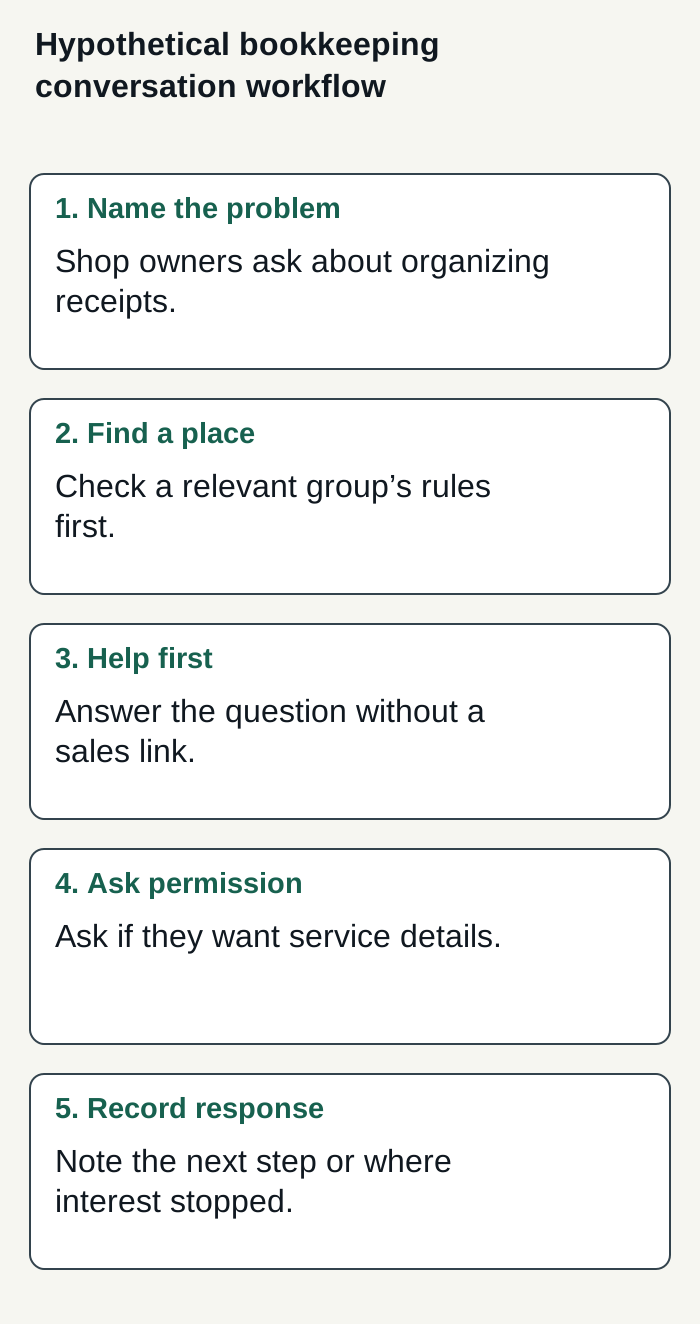
Hypothetical bookkeeping example: a relevant question becomes a helpful conversation, with the response recorded rather than assumed.
Condensed original editorial illustration. Read the surrounding guidance for qualifications and the complete procedure; any example is fictional and shows no verified customer outcome or product screen.
Illustrative worked example by Superdirector editorial team. Created 2026-11-09.
Track conversations, not just visible activity
Use a simple private log: date, platform or community, topic, contribution, response, whether the person asked about your offer, and next action. Add a short note about what you learned. Avoid collecting personal details you do not need, and do not publish someone’s words or identity as a testimonial without their permission.
Review the log after you have enough interactions to notice patterns, without treating a small handful as a reliable benchmark. Did the right people see the contribution? Did they understand the offer? Did anyone request more information? Where a conversation stops, look for a specific friction point rather than concluding that a whole platform does not work.
If social discovery is too slow or the right people are not present, test another route—such as asking existing contacts for introductions or exploring a relevant partnership. You do not need to force a channel that produces no meaningful conversations.
Turn repeated questions into useful posts
When the same genuine question comes up more than once, consider making a post that answers it clearly. Use an example you can explain accurately, state who the advice is for, and distinguish general information from your own offer. Do not invent customer stories or imply that an illustrative scenario happened.
Make the format fit the platform and your capacity. A concise text answer may suit one context; a step-by-step visual may make another easier to follow. YouTube’s help material lists several post types, but that is format guidance rather than evidence of customer-acquisition performance.
If you want to delegate parts of this customer-discovery workflow to a customizable AI-run channel around $200 a month, assess whether the current Growth plan fits: it is $199/month for two accounts, with no trial. Superdirector can research and prepare content, but current publishing is limited to eligible Instagram image carousels and single X text posts, either approved piece by piece or covered by an enabled account Auto-post rule. Finished video—including TikToks, YouTube videos and Reels—and fully autonomous channels are upcoming, not current publishing capabilities. Selected source cards and the connected account define what can publish. Before enabling Auto-post, verify that the first hand-approved post is live. Turn Auto-post off to stop unsent automatic posts, or use Pause posting to hold posts until you resume; see the publishing guide. For this task, judge delegation by whether it frees time for relevant conversations, your customer-defined results, and the review effort it still requires—not by promised leads or minimal oversight.