How-To Guide
Should a brand jump on every trend? A filter for when to join and when to skip
Decide whether to join a social trend, adapt its format, wait or skip it. Includes a practical filter and a worked hypothetical example.
By the Superdirector editorial team. Revised November 9, 2026.
At a glance
Should a brand jump on every trend? A filter for when to join and when to skip
No. A trend is worth considering only when its context is clear, its connection to your audience and brand is genuine, and the execution is timely and appropriate for the platform. If any of those checks fail, adapt the format, wait, or skip.
- Popularity is not the same as audience relevance.
- Check context, brand fit, execution, timing, and downside before making anything.
- A useful outcome can be a clear decision not to post.
Start with a stop check, not the trend’s popularity
No brand needs to join every trend. First ask what the moment means, who it matters to, and what your brand would add. If you cannot answer those questions, do not rush into a post just because a format or conversation is visible.
Start with a stop check: is this about a tragedy, an active crisis, a vulnerable person, or a serious cause your brand has not meaningfully engaged with? If so, a playful trend response is a poor default. Pause rather than trying to make a quick association. The same applies when you cannot tell whether a joke has a second meaning, whether the conversation has changed, or whether the source material is being used in a way your audience would find disrespectful.
Next, trace enough context to describe the trend accurately. Find an original or representative post, read surrounding responses, and check whether the meaning is shifting. Do not treat the first post you find as definitive. TikTok’s trend hub offers perspectives, stories, articles, and reports for understanding platform conversations; it is a research resource, not proof that a particular brand should participate. TikTok likewise describes its annual forecast as a marketer resource informed by changing community interests and behavior, while its methodology uses first-party tools. That is useful context from the platform, not an independent comparison of joining versus skipping.
Write down the trend’s meaning in plain language. If your description needs guesswork, insider slang you do not understand, or a claim about who started it that you cannot verify, wait or skip. Understanding the context is a prerequisite, not a guarantee of a good post.
Test audience fit, brand fit, and timing
Ask who among your actual customers would care, and why. “People online are talking about it” is not an audience insight. A stronger answer names a relevant audience interest, question, or experience and explains how your response would be useful, entertaining, or recognizably in character. YouTube’s 2022 report, for example, framed trends around community, multiple formats, and responsive creativity. Its findings concern its own report and surveyed audience; they are not a universal recipe for a brand on every platform.
Then draft the connection in one sentence, without relying on the trend’s popularity to do the explaining. If you need a long bridge from the trend to your product, the connection may be forced. Check that the tone matches how your brand normally speaks. A brand can adapt its voice, but a sudden persona or a joke aimed at people rather than a harmless situation deserves extra scrutiny.
Finally, check execution. Can the team make something accurate, clear, and platform-appropriate while the moment still makes sense? Identify approvals and production steps before committing. For a sound-based idea, verify that the audio is suitable for the account and intended use; a trending sound is not itself evidence that you have permission to use it. If the idea only works with material you cannot appropriately use, change the execution or skip it.
TikTok’s 2026 forecast advises marketers to leave flexibility to respond to cultural conversations before publication. That is the platform’s advice, not evidence that speed alone creates results. A reasonable decision can be to make a slower, evergreen response—or no response at all—rather than publish an ill-considered post.
Work the filter: a hypothetical booking example
The following is a hypothetical example, not a customer story or a prediction of performance. Imagine a small pottery studio that takes class bookings. A short social format is circulating: creators show a messy first attempt, then reveal a finished result. The studio is considering whether to join.
| Decision check | Studio’s worksheet | Decision |
|---|---|---|
| Context | The format is about a creative process, not a crisis; its joke is understood. | Continue checking |
| Audience | The studio’s potential students may recognize the gap between a first attempt and a finished pot. | Relevant, but not proof of demand |
| Brand fit | The studio can show its own class project and invite beginners to ask about the process. | A plausible, honest connection |
| Execution | The team can make an original sequence from its own permitted material, without copying another creator’s clip or relying on a sound it has not checked. | Possible if checks are complete |
| Downside and timing | A confusing or unkind caption would misrepresent beginner work; the studio can review the post before it goes live. | Rewrite or skip if the risk remains |
The decision is not automatically “join.” A suitable version might show the studio’s own practice piece, acknowledge that learning takes time, and point interested viewers to class information. If the format instead depends on mocking beginners, the studio should not use that version. If the trend has already shifted meaning, the team cannot make an accurate post in time, or the post would require copied material, the worksheet points toward adapting the general before-and-after structure or skipping the trend.
To use the worksheet yourself, write a short answer for context, audience, brand fit, execution, and downside. Mark each “clear,” “uncertain,” or “no.” A “no” on context, fit, appropriate execution, or acceptable downside is a reason to stop or revise before proceeding. “Uncertain” is a prompt to verify or wait, not an automatic yes. This is a decision aid, not a scientifically validated scoring system or a promise of results.
When enlarged, scroll horizontally to read the diagram.
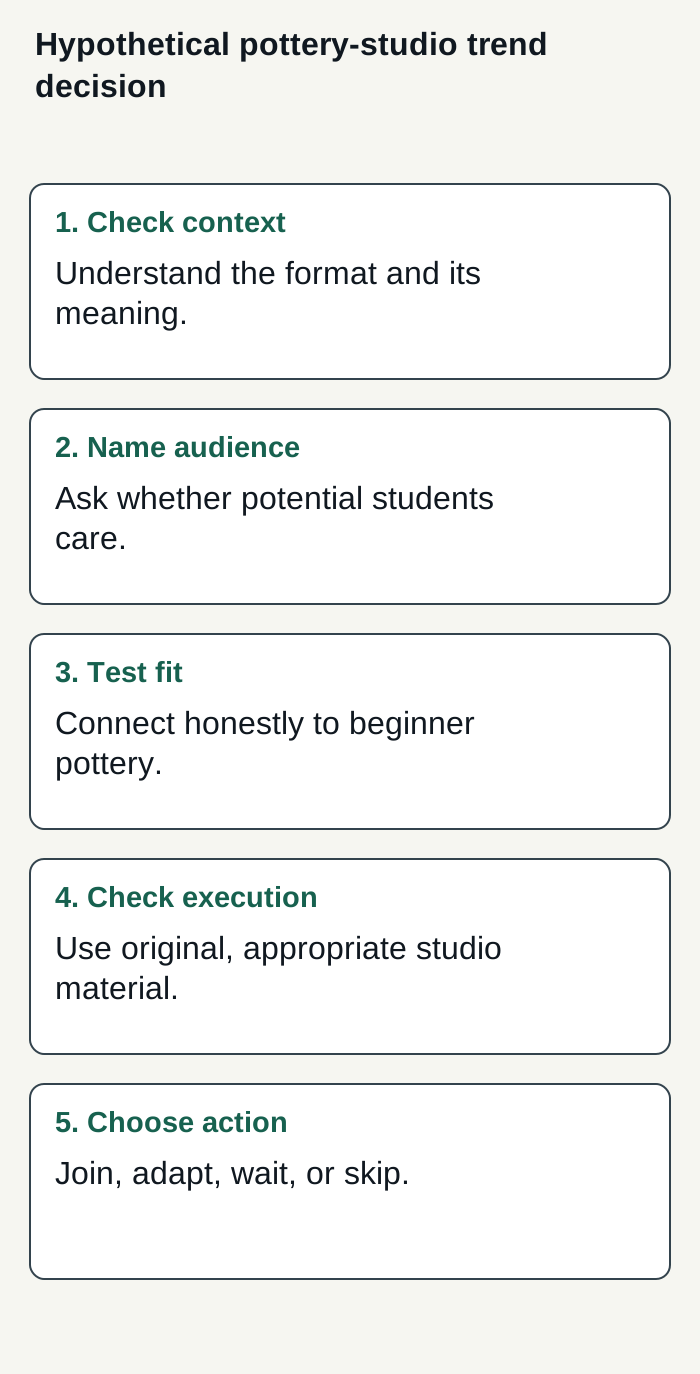
Decision flow for a hypothetical pottery studio considering a social format; no real account or result is shown.
Condensed original editorial illustration. Read the surrounding guidance for qualifications and the complete procedure; any example is fictional and shows no verified customer outcome or product screen.
Illustrative worked example by Superdirector editorial team. Created 2026-11-09.
Choose the smallest useful response and review it
Once the checks are done, choose among four actions: join with an original response; adapt the underlying format to a topic you can speak about credibly; wait until the meaning or audience relevance is clearer; or skip it. You can also respond to the underlying customer question in a familiar format without referring to the trend. Choosing not to join is a real decision, not a missed assignment.
Set the purpose before publishing. Is the post meant to answer a question, start a conversation, or direct people to a booking page? Pick an observable signal that matches that purpose, such as relevant questions or visits to the page, and compare it with comparable posts from your own account. Record what you published, when, and what you noticed. Do not treat one post’s performance as proof that trends generally work; the available sources here do not provide controlled comparisons between comparable brands that join and skip.
If the trend involves a live cultural conversation, build in a final context check close to publication. If the moment changed, revise or cancel. For a recurring process, keep a short log of decisions—including skips—so the team can see whether its selection rules are practical, without mistaking a handful of observations for a universal benchmark.
Separate the content idea from the platform execution. A format that fits one channel may not translate to another, and a trend’s visibility on one platform does not establish its relevance or permitted use elsewhere. Check the intended platform’s current tools and requirements rather than importing assumptions from another channel.
Where a managed channel can help—and where it cannot
A business considering a customizable AI-run channel for about $200 a month is weighing a buying goal, not a promise of current autonomy. For this trend decision, delegated research and drafting can help surface options, but you still need to judge the trend’s context, fit, and downside and decide whether to publish. Measure the review effort and whether the work serves results you define; neither results nor minimal oversight is assured.
Growth currently costs $199 per month, includes two accounts, and has no trial. Publishing covers only eligible Instagram image carousels and single X text posts, by per-piece approval or an enabled account Auto-post rule. Account connection and selected source cards define what can publish; verify the first hand-approved post is live before enabling Auto-post. You can stop unsent work by turning Auto-post off or pause the queue. See the publishing documentation for details. Finished video—including TikTok, YouTube, and Reels video methods—and full autonomy are upcoming, not current publishing capabilities.