How-To Guide
How long does a trend last on TikTok and Reels, and how fast do you have to post?
There is no verified universal trend lifespan. Use the available evidence and a fit-and-readiness check to decide when to join.
By the Superdirector editorial team.
At a glance
How long does a trend last on TikTok and Reels, and how fast do you have to post?
There is no well-supported universal lifespan for a TikTok or Reels trend, and no evidence here establishes an exact deadline for joining one. Some practitioner articles describe micro-trends turning over in days, but those claims are not equivalent to a measured platform-wide lifespan. Treat timing as a decision: is the trend still active in your niche, does it fit, and can you publish a good version while it remains timely?
- TikTok's 2025 trend report is a forecast, not a trend-duration study.
- The supplied Reels benchmark measures posting patterns, not trend lifespan or response speed.
- A sensible deadline depends on your trend, niche, production time, and approval process.
What we know about trend timing
There is no dependable universal answer such as “a TikTok trend lasts three days” or “post within 48 hours.” The evidence supplied for this guide does not establish a platform-wide lifespan for TikTok trends, a Reels lifespan, or a deadline that guarantees useful participation. Treat precise timelines as claims to evaluate, not rules to follow.
One practitioner article from Later says some TikTok and Instagram micro-trends can turn over in days and that some moments peak within 48 to 72 hours. That is useful as a warning that certain moments may move quickly, but it is not a disclosed longitudinal measurement of all trends. Another Later article presents a 24-to-48-hour window as typical, but supplies no trend-sample method for that timing. Neither claim establishes how long a trend in your category will remain relevant.
TikTok's 2025 What's Next report describes evolving content patterns and an annual forecast. It is not a study of individual trend lifespans. For Reels, the supplied Socialinsider benchmark analyzes organic posting and performance patterns; its average monthly Reels volume is not a response-time recommendation and does not show how long a trend lasts.
| Evidence | What it can tell you | What it cannot tell you |
|---|---|---|
| Later's practitioner guidance | Some micro-trends may move quickly. | A universal lifespan or deadline for your niche. |
| TikTok's 2025 trend report | TikTok's forecast and descriptions of evolving patterns. | How many days an individual trend lasts. |
| Socialinsider Reels benchmark | Descriptive organic Reels patterns in its sample. | When to join a Reels trend. |
The practical answer is conditional: act promptly when a relevant trend is still visibly developing and your team can make a fitting version without compromising the work. If it has stopped appearing in the conversations you monitor, or production will leave you imitating a moment that has passed, adapt the underlying idea or skip it. This is an editorial decision framework, not a promise of reach.
Use a practical decision clock
A trend’s age is hard to know exactly. You may discover it late, and a sound, visual template, hashtag, and broader cultural moment can each behave differently. Instead of treating the first post you find as the trend’s start, record when you first noticed it and what you actually observed. Then check recent examples from creators or accounts relevant to your audience.
- Notice: Write down when and where you saw the trend, and save a representative example.
- Check: Look for recent, relevant uses. Ask whether creators are still adding new versions rather than merely repeating old ones.
- Fit: State in one sentence why your audience would care and how your brand can participate naturally.
- Ready: Estimate the real time needed to make, review, and publish a good version.
- Decide: Publish if the opportunity still looks timely and the post is ready; adapt or pass if either condition fails.
This check is more useful than counting down from a supposed universal window. A trend may still be worth adapting after its first burst if the format remains useful; another may be a brief moment that loses meaning quickly. The available evidence does not tell you which one you have. Your niche observations are signals for a decision, not a measurement of platform-wide trend life.
Work through a hypothetical example
Hypothetical example: a local bakery notices creators using a quick decorating reveal: a plain cake appears first, followed by a finished design on a beat. The bakery team first spots it on Tuesday. By checking recent posts from local food creators, it sees several fresh versions, but cannot know how long the format will remain active.
| Decision question | Same-day draft | Next-day approval |
|---|---|---|
| Does it fit? | Yes: the reveal can show the bakery's own decorating style. | Yes: the concept still fits. |
| Can the team make it well? | Yes: existing footage can be edited into a clear reveal. | Yes, if the review is completed as planned. |
| Is it still timely? | Recent local examples suggest it may be active; confirm before posting. | Recheck recent examples before approval; do not assume it is still timely. |
| Decision | Publish if the final edit is accurate and approved. | Publish only if the quick recheck supports it; otherwise adapt or pass. |
The example does not show that same-day posting performs better. It shows how to make a decision without pretending to know the trend’s expiration date. The bakery should choose the version its team can make well, verify the context immediately before publishing, and avoid claiming that the trend guarantees customers, views, or sales.
Use this short worksheet when a trend appears: first noticed; latest relevant example checked; why it fits; time needed to create and approve; publish, adapt, or pass; reason for the decision. If you pass, note whether the reusable idea is the structure, the opening, or the visual reveal. That gives the team something actionable to learn from even when it does not join the moment.
When enlarged, scroll horizontally to read the diagram.
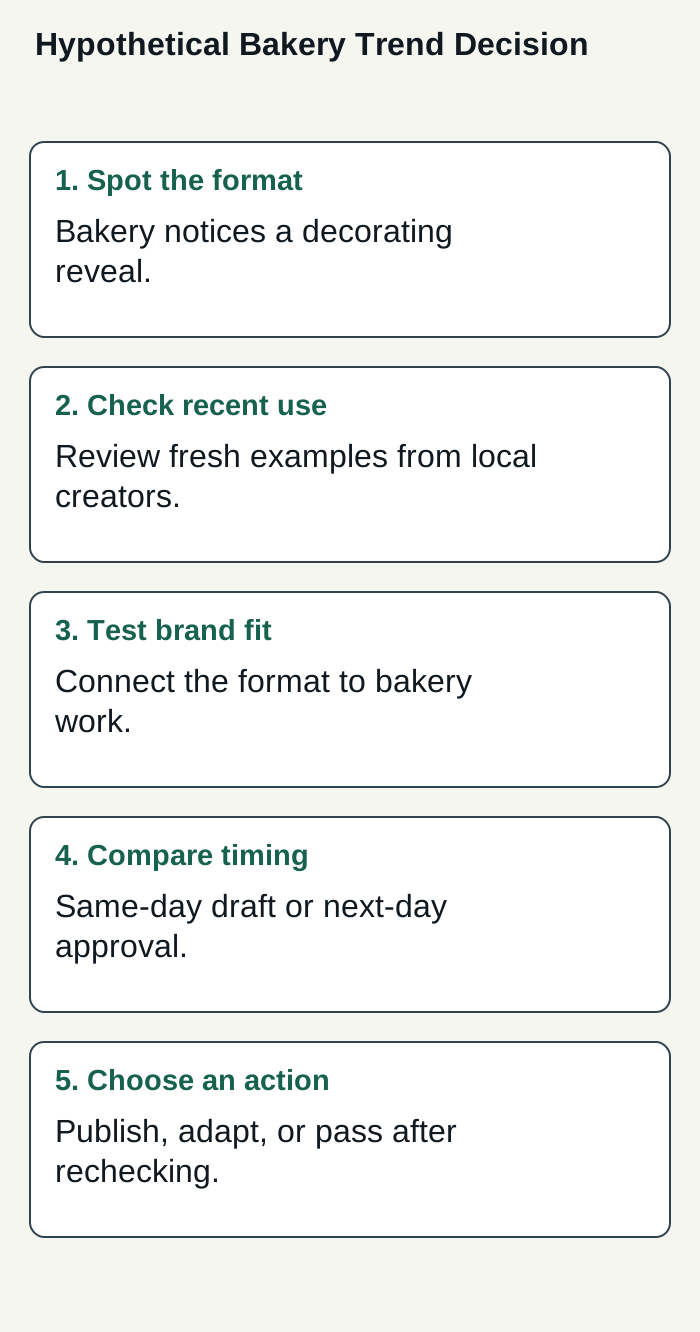
Hypothetical bakery example: a decorating trend decision based on recent activity, brand fit, and readiness—not a promised outcome.
Condensed original editorial illustration. Read the surrounding guidance for qualifications and the complete procedure; any example is fictional and shows no verified customer outcome or product screen.
Illustrative worked example by Superdirector editorial team. Created 2026-11-09.
Measure your own response window
Keep a small decision log rather than turning someone else’s timing claim into your operating rule. For each trend considered, record when you noticed it, the platform and format, whether recent examples still appeared in your niche, your fit decision, and how long creation and approval took. If you publish, record the post date and the outcome you care about, such as relevant comments or profile visits. Compare those results with your usual posts in the same format where practical.
A handful of posts cannot establish that earlier timing caused a result. The trends, creative, audience, and circumstances differ. Use the log to spot operational friction—such as approvals consistently taking longer than your team expects—or to refine your fit criteria. Do not turn a short run of observations into a guaranteed deadline or a universal claim. The objective is a clearer decision process, not a promise that every trend deserves a post.
Also keep trend lifespan separate from the life of an individual post. A trend’s momentum and the period during which a particular video gets views are different questions. The sources here do not provide a common measurement that lets you convert one into the other.
Where Superdirector fits
If your buying goal is a customizable AI-run channel costing around $200 a month and operated toward useful results, Growth is currently $199/month for two accounts, with no trial. It can publish eligible Instagram image carousels and single X text posts, either with per-piece approval or an enabled account Auto-post rule. Finished video and fully autonomous channels are upcoming, not current capabilities; finished TikTok, YouTube, or Reels videos are outside current publishing scope. These limits make Growth a possible step toward your goal, not a promise of results or minimal oversight. See current pricing.
Account connection and the selected source cards define what can currently publish. Before enabling Auto-post, verify that the account’s first hand-approved post is live. You can stop unsent work by turning Auto-post off or pause posting; see the publishing guide for controls. Judge whether delegation is worthwhile by measuring your review effort, brand fit, and results against goals you define—not assumed time savings or promised outcomes.