How-To Guide
Content format vs trend: why formats outlast trends and which to build on
Separate a reusable content format from a time-sensitive trend, choose what to build around and test the choice on your account.
By the Superdirector editorial team. Revised November 9, 2026 using the sources linked below; platform guidance and product descriptions are attributed to their publishers.
At a glance
Content format vs trend: the practical difference
A format is the repeatable promise and structure of a post or series. A trend is a timely subject, convention or creative ingredient. Build around an audience need you can serve repeatedly; adapt the packaging when a relevant trend gives you a timely way in. Formats may be reusable after a trend fades, but the supplied evidence does not establish comparative lifespans or results.
- Write down what stays the same and what changes.
- Make a trend an optional variation, not the whole content strategy.
- Set a goal and measure your own test; do not treat platform forecasts as outcome evidence.
The difference: what repeats and what changes
A content format is a repeatable way to deliver a promise to an audience: a recognizable opening, a sequence of useful beats and an ending. A trend is a timely subject, convention or creative ingredient—perhaps a seasonal question, a popular editing pattern or a sound—that may become less relevant. The two can work together: keep the useful structure and change the example or timely hook.
A reusable structure can be a useful planning unit because it does not depend on one moment staying popular. Whether formats actually last longer or produce better results than trend-led content remains unestablished; treat durability as a hypothesis to test.
| Layer | Question to ask | What might change? |
|---|---|---|
| Audience promise | Why would someone return? | The audience need may shift. |
| Format | What structure delivers the promise? | The sequence can be refined. |
| Topic | What is this episode about? | The subject changes each time. |
| Trend ingredient | What makes it timely now? | The moment or creative cue can fade. |
Choose what to build around
Start with a repeatable audience need, not a platform trend list. A useful format should be specific enough that a viewer knows what kind of value to expect, but flexible enough to accommodate several subjects. For example, “help people make a better choice” is a promise; “compare two options, explain the trade-off, and name who each suits” is a structure.
Use three checks before committing. First, can you name several distinct episodes without stretching the premise? Second, can you make the material credibly and consistently with the people and resources available? Third, could you adapt the opening or example to a current conversation without losing the central promise? If the answer to the first two is no, you may have a one-off idea rather than a format. If the third is no, the format may be needlessly rigid.
Platform documentation can help with construction, not predict results. YouTube describes shows as episodes with a clear connection and identifies consistent topics, hosts or visual feel as common characteristics. Separately, its Shorts template guidance describes a framework that can specify clip length, clip count and other elements. Those are examples of ways to make repetition legible; they are not evidence that any particular structure outperforms trends.
Trends still have a legitimate role. TikTok’s 2026 forecast advises marketers to leave room to respond to changing cultural conversations. That is platform advice, not a measured performance finding. Its Creator Search Insights announcement describes search topics and content gaps as sources of inspiration; those signals do not establish demand, conversion or lasting audience interest. Use a timely signal to shape a relevant episode, not as a substitute for audience judgment.
Worked example: a hypothetical bakery series
The following is a hypothetical planning example, not a customer story or a claim about results. Imagine a neighborhood bakery wants to explain what goes into its products without turning every post into an advertisement. It considers a recurring series called “What’s in the batch?” The audience promise is a plain-language look at one ingredient or production choice and why it matters to the finished item.
| Element | Hypothetical choice | Keep or change? |
|---|---|---|
| Promise | Explain one bakery choice customers may wonder about. | Keep across episodes. |
| Format | Question; show ingredient or process; explain the choice; offer a practical takeaway. | Keep the beats; improve if unclear. |
| Topic | Why this loaf uses a particular grain; what changes with a seasonal fruit. | Swap each episode. |
| Timely hook | A seasonal question about a fruit used in the current menu. | Use only when relevant; it can expire. |
| Measure | Record meaningful questions or visits to the menu page, if observable. | Choose before publishing; interpret cautiously. |
The series can work without the timely hook: a question about an ingredient still fits the same beats. If a seasonal question is relevant, it can provide the opening for one episode without redefining the series. If the question is unrelated to what the bakery can explain, skip it. This is the practical test: remove the trend and ask whether the episode still delivers the audience promise. If not, the idea may be trend-dependent rather than a flexible installment.
Write the brief before making the first episode. Name the audience, promise, opening pattern, sequence, ending and what can vary. Then list several plausible topics. Do not force production simply to fill a calendar; a weak or repetitive topic can undermine a clear format.
When enlarged, scroll horizontally to read the diagram.
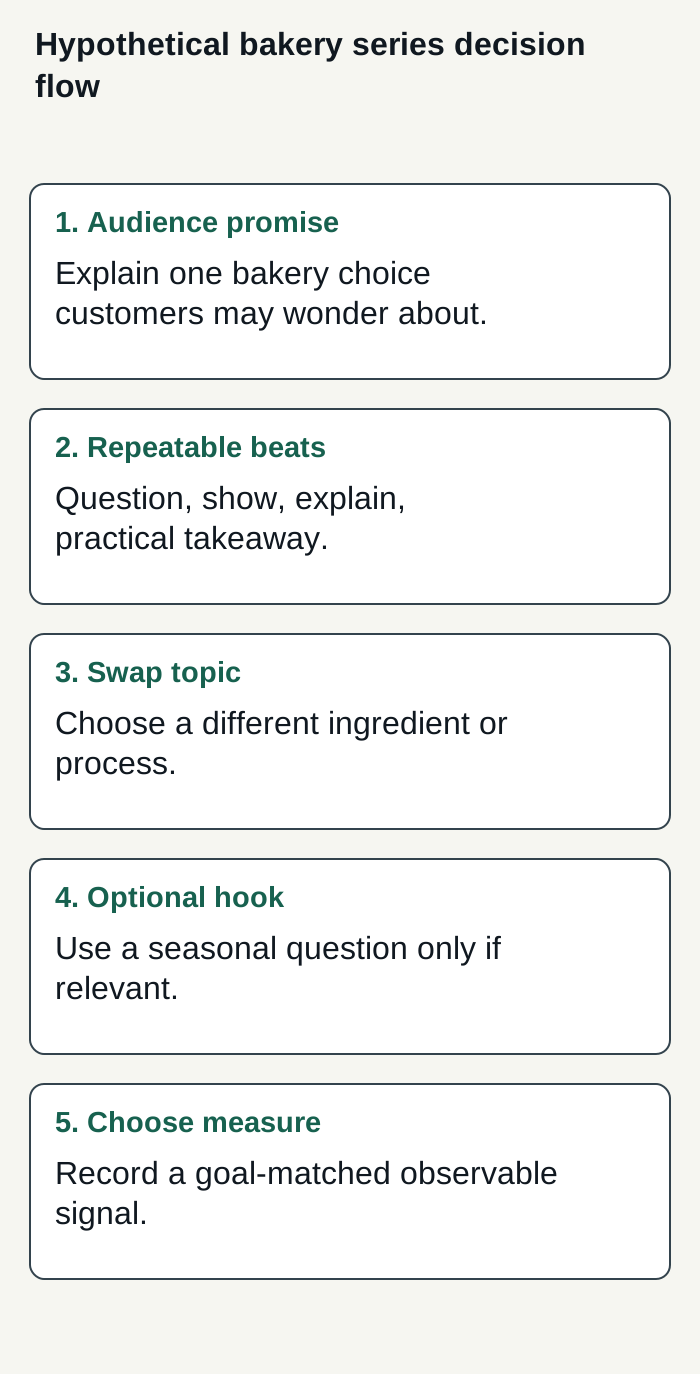
Hypothetical bakery planning example: preserve the promise and beats, vary the topic, and use a timely hook only when it fits.
Condensed original editorial illustration. Read the surrounding guidance for qualifications and the complete procedure; any example is fictional and shows no verified customer outcome or product screen.
Illustrative worked example by Superdirector editorial team. Created 2026-11-09.
Run a small, decision-focused test
Before publishing, choose one primary purpose. Awareness, useful audience interaction and visits to a relevant page are different goals; they should not be judged by the same signal. Pick a measure you can actually observe on the platform and note the context that may affect it, such as topic, distribution, timing or creative changes.
- Write down the format, its audience promise and the changeable elements.
- Set a review point that fits your resources; no universal post count is established by the supplied evidence.
- Record the chosen measure and relevant context for each installment.
- Decide whether to keep the structure, revise one element, or stop. Record the reason so the next decision is deliberate.
Avoid changing the promise, structure, topic and trend ingredient all at once: if the response changes, you will not know which change mattered. Nor should one successful post establish that a trend caused the result. Treat the test as a way to learn about your own audience and process, not as a controlled experiment unless the design genuinely supports that conclusion.
Use this decision worksheet: Repeat when the format still serves the audience and the available evidence supports continuing; adjust when a specific beat or packaging choice appears to create friction; pause when the premise no longer fits the audience or you cannot make it well. Keep the decision proportionate to the quality and amount of evidence you have.
Decide what to delegate—and what to keep visible
A content system can reduce the work of researching ideas, remembering brand context, creating assets and publishing, but those activities do not prove that delegation is worthwhile. Before paying for a service or handing off work, define what success would mean for your business and what oversight you are willing to provide. Track the recurring cost, the time spent reviewing or correcting work, whether posts fit the brand, and the business measures you chose. Revisit the arrangement if the effort or results do not justify it.
If your buying goal is a customizable AI-run channel for about $200/month, assess Superdirector Growth against that goal—not as a currently autonomous service or a results guarantee. Growth is $199/month for two accounts, with no trial; it supports only eligible Instagram image carousels and single X text posts, by per-piece approval or an enabled account Auto-post rule. Finished-video publishing and fully autonomous channels are upcoming. See current pricing. Publishing depends on connecting an account and selecting source cards; the publishing guide explains the setup and controls. Before enabling Auto-post, manually approve the account’s first post and verify it is live. Turning Auto-post off stops unsent posts; Pause posting holds the queue. Finished videos for TikTok, YouTube and Instagram Reels are outside current publishing scope. Measure your review effort and customer-defined results to judge whether the service fits your needs; neither minimal oversight nor results are assured.
Make the next content decision
Choose one audience question you can answer more than once. Write a one-sentence promise, a short sequence for delivering it, three topic variations and any timely ingredient you might optionally add. Then select one appropriate measure and a review point. This gives you a reusable starting structure without mistaking a platform signal, a trend forecast or an isolated post for proof of future results.