How-To Guide
How should a brand send products to influencers after they accept?
Prepare the accepted item, protective pack, private address and route/customs responsibilities. Track dispatch and usable receipt without adding post demands.
By the Superdirector editorial team.
At a glance
How should a brand send products to influencers after they accept?
Confirm the recipient accepted the exact item and arrangement. Check its contents and condition, use suitable protective packing, and give a named sender the private delivery details and actual carrier/destination requirements. Resolve customs documents and cost responsibilities for that route, preserve real dispatch evidence, and confirm usable receipt. A label or carrier event does not establish an intact product, a customer experience or an owed post.
- Send the item the recipient actually accepted, with a real owner for packing, route and problems.
- Carrier/customs instructions are route-specific; free product does not establish a zero declaration value or duty exemption.
- Dispatch, a carrier event, usable receipt and a post are different facts.
Confirm the recipient, exact item and arrangement
Send a product to a creator who actually wants to receive that particular item and has a suitable way to receive it. Begin with their acceptance, the exact variant and contents, whether the item is kept or returned, and any work already agreed. Then give the parcel to a named shipping owner. A public profile address or an encouraging conversation is not an instruction to dispatch an unspecified product.
This guide begins after the decision to offer product. The sample-request guide covers whether to promise a unit; the gifting-versus-paid comparison separates the arrangement. Here, the task is to move the correct physical item through packing, route/customs preparation, dispatch and usable receipt without losing the accepted terms.
| Confirm before packing | Why it changes the parcel | Keep unresolved if unknown |
|---|---|---|
| Recipient accepts the actual item | An unwanted, unsuitable or unreceivable parcel creates a problem rather than product experience. | Variant, size, compatibility, safe-use conditions and receiving availability |
| Included contents and condition | The creator should receive the same item and accessories the brief describes. | Which parts, instructions or separately supplied items belong in the box |
| Gift, agreed work or temporary loan | Keeping, returning and making content are different commitments. | Actual obligations and return arrangements; do not add them in a packing note |
| Route and responsible sender | Destination and contents determine available services and documentation. | Who obtains the route-specific checks and who can answer a carrier/customs question |
Collect the delivery details only for the real shipment through the agreed private channel. The address-request guide covers necessary fields, purpose and access. Let the recipient choose a deliverable location allowed by the actual route, and pass only the needed information to the authorized sender. Keep home addresses, phone numbers, full tracking links and label photographs out of public worksheets and creative reference decks.
Prepare the correct item and protective pack
Have the person packing compare the actual item with the accepted record. Check the version, quantity, included parts, condition and instructions. If the agreed item is unavailable, obtain an accepted change rather than silently substituting a different one. A creator cannot truthfully demonstrate a feature of the promised version by receiving another version without explanation.
USPS’s domestic package guide recommends strong packaging with room for cushioning and preventing movement. It also says to cover or remove old labels, barcodes and addresses on a reused box, and to secure its seams. Those are USPS instructions for the described route; check the chosen carrier’s actual packaging and mailability requirements for the contents you intend to send.
- Check whether the contents are restricted, prohibited or need special handling before choosing a service. Do not assume that a cosmetic, battery, liquid, food or plant can travel by the same method as an ordinary dry accessory.
- Pack the actual product and its parts so they are protected and do not shift. Check the carrier’s required packaging rather than treating decorative presentation as protection.
- Measure and weigh the packed parcel, including cushioning and other packing material. Check any dimensional or nonstandard fees and that the packaging matches the purchased service.
- Keep a private packing record of the contents and visible condition, plus who packed it and when. A photo can document that record; it does not guarantee the box will arrive undamaged.
USPS also advises including a packing slip or recipient/address record inside the box. Keep that delivery information private. A separate product note can name the contents, safe-use material and a real support contact. It should clarify the existing arrangement, not ask for a new review or add an unagreed deadline.
An original note fragment to adapt is: “Thanks for accepting [actual item]. The box contains [actual contents]; [instructions/contact] will help with setup or missing parts. [If true: no post is required under this gift.]” Replace the brackets with verified facts. If the item is a loan or agreed work is owed, say the actual arrangement instead of using the no-obligation sentence.
Assign route, customs and cost responsibilities
Choose the actual origin, destination, carrier and service from the item and recipient’s circumstances. Name who pays the quoted shipping charge, who handles a failed delivery or return, and who will resolve any destination charges or documentation. An estimate is a planning input, not a universal delivery promise. A service suitable for one creator may be unavailable or unsuitable for another country or item.
For packages sent from the U.S. through USPS, its customs page requires specific item descriptions, separate item values and a total shipment value. It explicitly includes small personal gifts among outbound packages needing the detailed-description rules. “Gift” or “sample” is not a useful substitute for describing the actual object and its material/purpose.
| Route question | Evidence the sender should obtain | Avoid assuming |
|---|---|---|
| Can this product travel on this route? | Chosen carrier’s current contents restrictions, destination requirements and any required authorization | The retail item or a previous shipment is automatically eligible |
| What is actually in the parcel? | Specific items, quantities, materials and purpose, with actual value/weight inputs where required | A broad category such as gift or samples describes the contents sufficiently |
| Which form, classification or additional document is required? | Actual service/destination instructions and responsible knowledgeable owner | One universal form, commodity code or gift exemption |
| Who handles money or a customs query? | Agreed sender/recipient responsibilities and any carrier/broker arrangement | No cost can reach the recipient because the product itself was supplied free |
| What if the route fails? | The actual return, correction or contact path for the selected shipment | A fixed transit time or automatic replacement entitlement |
USPS’s International Mail Manual, section 123 places import/export compliance and required destination documentation with the mailer. Its current customs page describes tools that can assign HS codes from acceptable descriptions; the manual still keeps responsibility for accuracy and completeness with the mailer. Software assistance does not turn an unchecked description into a correct classification. Obtain qualified help for the actual item and destination when needed.
The fact that a recipient pays no purchase price does not answer the required shipment-value question. Ask the appropriate sender/customs owner for the actual declaration basis. Do not invent a zero value or select a category merely to avoid a charge. Neither this guide nor a “gift” note provides duty, tax, clearance or exemption advice for every country.
An editorial worksheet is not a customs declaration. For example, the USPS manual says PS Form 2976-R is a worksheet presented at a retail counter, not a stand-alone customs form. Use the carrier’s authorized process and actual required documents. The blank asset below only tracks who checked them and where the private evidence is held.
Hand over the parcel and record the actual evidence
Once the package and documents are ready, follow the selected service’s actual dispatch process. Give the intended recipient the appropriate private tracking or delivery information and a contact for problems. Record when the parcel was physically handed over, along with the available carrier receipt or other evidence. Creating or paying for a label is preparation; it does not by itself show that someone gave the parcel to a carrier.
| Handoff to record | Retain privately | What it does not establish |
|---|---|---|
| Pack ready | Correct item/contents/condition, final parcel measurements and responsible packer | Carrier possession or arrival |
| Dispatched | Actual handover time/method and the available acceptance evidence | An on-time arrival or correct contents at receipt |
| Carrier reports an event | Exact source/status/time and any stated location or exception | That the intended creator personally has an intact usable item |
| Recipient confirms receipt and condition | What arrived, missing/damaged parts, and any setup issue | A draft, endorsement or public post |
These are original handoff categories, not a quoted list of universal carrier status names. Read the chosen carrier’s actual event description. If the carrier reports delivery but the recipient cannot locate the box, keep usable receipt unresolved and have the shipping owner follow the carrier’s current procedure. Do not declare the creative work late because an unlocated parcel appears delivered on a tracker.
Keep changes attached to their actual dates. If a package is returned or held for a documentation question, record that event and its owner rather than rewriting dispatch as a successful arrival. If the route changes, update the recipient and the person depending on the product. Share the amount of information each role needs, without forwarding unrelated private correspondence.
When enlarged, scroll horizontally to read the diagram.
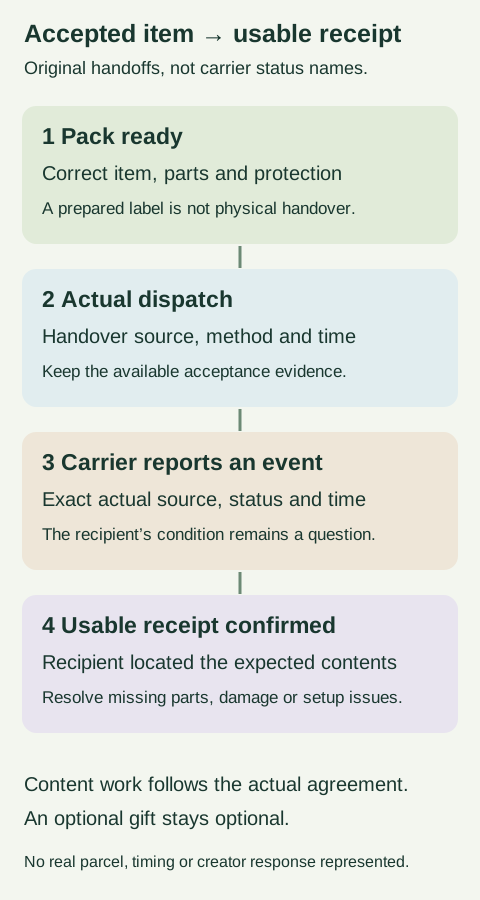
Original editorial map. No real account, parcel, carrier timeline or result is represented.
Original visual by Superdirector editorial team. Creation date not recorded.
Confirm usable receipt before the next task
A short delivery check can ask whether the intended parcel arrived, whether its contents and condition match, and whether the recipient needs help. That is a logistics question. It should not quietly add a posting request, demand praise or imply that accepting a gift created a new obligation.
Original fictional illustration — no creator, parcel, carrier event or product was inspected. A made-up brand offers a plastic desk-organizer tray with two removable dividers as a no-obligation gift. The recipient accepts that item. The packer’s record should therefore describe one tray and two dividers, not merely “three products.” Any international description, classification, weight and value would still need the actual route owner’s work; these invented contents are not a completed or approved declaration.
| Fictional evidence received | Correct next decision | What not to infer |
|---|---|---|
| Only a prepared label exists | Ask the shipping owner for actual dispatch evidence and current plan | That the creator has the tray |
| A carrier reports delivery; recipient cannot find the parcel | Keep receipt unresolved and use the actual carrier’s problem route | That the creator is withholding a post |
| Recipient finds the tray but both dividers are missing | Resolve the missing contents and any effect on intended use | That a complete product demonstration is ready |
| Recipient confirms the accepted set arrived intact | Close the logistics question or answer a genuine setup query | That an endorsement, positive opinion or post is owed |
For agreed work, use actual usable receipt and the agreement to discuss the next production dependency. If an item is wrong or damaged, tell the creator how that changes the assignment instead of asking them to pretend it worked. For a reusable loan shared between creators, the single-sample schedule handles custody and the separate content clock.
The manual parcel handoff and blank CSV retain the accepted item, packing/route owners, private evidence references and next unresolved question. They contain no address or real tracking record and do not purchase postage, create documents, track a parcel or save automatically. Use the existing authorized shipping/campaign record for the actual data.
If the recipient later mentions the gifted product in an endorsement affecting U.S. consumers, FTC staff guidance says disclosure can be needed even when no mention was requested. That is separate from a delivery check. The same guidance says a creator cannot talk about experience with an untried product. Receipt enables real use; it does not supply an experience, opinion or result that has not occurred.
Sources and limits
Before drafting on November 5, 2026, Pacific time, we read the complete retained USPS domestic package guide, U.S. customs-form page, International Mail Manual section 123 and FTC Disclosures 101. The USPS materials are carrier- and route-specific. Their service options, forms, country requirements and conditional fields do not define every carrier or jurisdiction.
The tracking FAQ returned a short shell, so no current status-name definition or carrier-resolution sequence is taken from it. No source videos, physical item, packaging, account, postage purchase, customs filing, tracking event, recipient reply or delivered campaign was tested. The handoff categories, fictional tray and worksheet are original editorial methods. We give no open, response, posting, delivery or sales rate and no universal import-duty or tax conclusion.