How-To Guide
Is auto-posting safe for your accounts, and what gets accounts flagged?
Separate scheduled publishing from risky account behavior, check platform-specific requirements and run a cautious posting pilot.
By the Superdirector editorial team. Platform documentation and product information reviewed November 9, 2026.
At a glance
Is auto-posting safe for your accounts, and what gets accounts flagged?
The supplied sources do not show that ordinary, authorized scheduling by itself gets an account flagged, and they do not establish that any scheduler is risk-free. The documented concerns are specific: platform publishing requirements, certain policy-violating content or engagement, and mistakes such as publishing without the required consent or settings. Check the rules for the platform and action you plan to automate, review what will go live, and verify the post. Do not mistake a platform’s technical limit for a safe posting target.
- A publishing API limit describes a technical boundary, not a recommended cadence or guarantee against enforcement.
- YouTube’s anti-spam and fake-engagement rules are evidence about YouTube, not proof of Instagram, TikTok, or X enforcement.
- When platform policy or publishing requirements are unclear, keep the post under individual review until you can verify the applicable rule.
Separate scheduling from the behavior being automated
The useful question is not simply “Is automation safe?” Ask what the tool will do, on which account, and under which platform’s rules. Preparing a post and sending it at a chosen time is one action. Generating replies, liking posts, following accounts, or trying to inflate engagement would be different actions and need their own policy check.
The supplied evidence does not compare account-flag rates for manual posting, approved schedulers, and standing auto-post rules. It therefore cannot quantify the risk of ordinary scheduled publishing or certify a tool as safe. Equally, examples of problematic automated behavior do not prove that every scheduled post is suspect.
Keep platform scope precise. YouTube says its policies prohibit certain artificial engagement and describe repetitive automated or synthetic mass-production as a spam concern. Those are YouTube rules; they are not evidence of how Instagram, TikTok, or X will handle a particular post. Start with the destination platform’s own current guidance, not a cross-platform generalization.
Check the platform-specific publishing requirements
A platform’s publishing documentation can tell you whether a particular publishing route is technically available and what conditions apply. Instagram’s Content Publishing guide describes API publishing for professional accounts and supported media requirements. Its rate-limit and carousel-limit passages give different figures, so check the current limit applicable to your account and publishing route. It says the limit is enforced when the media-publish endpoint is called. These are technical API constraints—not recommendations to publish frequently, safety thresholds, or statements that ordinary scheduling causes flags.
Requirements differ elsewhere. TikTok’s Direct Post documentation says users must give explicit consent to send their video, the selected privacy level must match the creator’s available options, and unaudited clients’ posts are restricted to private viewing. These are details about TikTok’s documented API workflow; they do not establish Instagram or X rules.
Before connecting a tool, check its actual publishing route and actions. Before each type of post, check the destination’s applicable requirements for account eligibility, format, consent, privacy, and any relevant label or disclosure. Do not rely on a limit copied into a blog post when the platform documentation or live account settings may have changed.
- Name the platform and account the tool will publish to.
- Confirm the post format is supported by that publishing route.
- Check whether the platform requires a particular account setting, consent, privacy selection, or disclosure.
- Separate a platform’s technical cap from a policy recommendation; do not invent a safe cadence from the cap.
Use a reviewable, limited publishing workflow
Write a small rule for the workflow before enabling automatic publishing: what the tool may publish, what needs your approval, and what should never be automated. For example, you might permit a reviewed announcement post, but keep an unverified claim, a post with an uncertain offer detail, or an unfamiliar format in manual review. The boundary is a practical recommendation, not a platform rule.
Check the content as a customer would see it: does the post accurately describe the offer, match its destination, and use the right account and format? On YouTube, the Spam Policy gives examples including repetitive automated content and misleading viewers to boost engagement. Its Fake engagement policy says automatic systems must not artificially inflate views, likes, comments, or other metrics. Apply these examples to YouTube, and consult each other platform’s own policies for its rules.
Finally, verify the result in the destination account. A queued item is not evidence that it published correctly. Check the live post, its text and media, and whether the account shows a prompt or restriction. If the outcome is unclear, inspect status before retrying so you do not accidentally create a duplicate.
Run the worked example and verify the result
Hypothetical example: a small studio wants to use an Instagram professional account to answer a recurring customer question—whether a booking can be moved. It drafts a carousel with the actual rescheduling steps and links to the studio’s booking information. This example describes a decision process, not a real business result or a guarantee about what Instagram will approve.
| Draft or workflow | Decision | Reason |
|---|---|---|
| One reviewed carousel with accurate steps and a matching booking link | Eligible for a cautious publishing test | The content is specific and reviewed; still check Instagram’s current account and format requirements. |
| A carousel promising a policy the studio has not confirmed | Hold for a human check | Automation cannot validate whether an uncertain business claim is true. |
| The same generic question-bait caption repeated on a loop | Rewrite before scheduling | It adds little customer value. YouTube’s rules also illustrate why repetitive or engagement-manipulating behavior should be assessed under that platform’s policies. |
| A tool action that likes or replies to other accounts automatically | Do not treat it as ordinary scheduling | It is a separate account action; check the destination platform’s rules before considering it. |
For the first test, leave the carousel for individual approval. Confirm the account, media, caption, and destination link; approve it; then check the live post and any account notifications. Record whether it published as intended and what correction or follow-up was needed. Only consider a standing rule for this narrow, reviewed type of post if the workflow is understandable and you can still notice mistakes. This is a cautious operating recommendation, not proof that the account is protected from flags.
If the platform or tool reports a problem, pause that workflow and inspect the stated issue rather than repeatedly sending the same item. Resolve the cause using the platform’s guidance, then decide whether this post type should return to review or remain manual.
When enlarged, scroll horizontally to read the diagram.
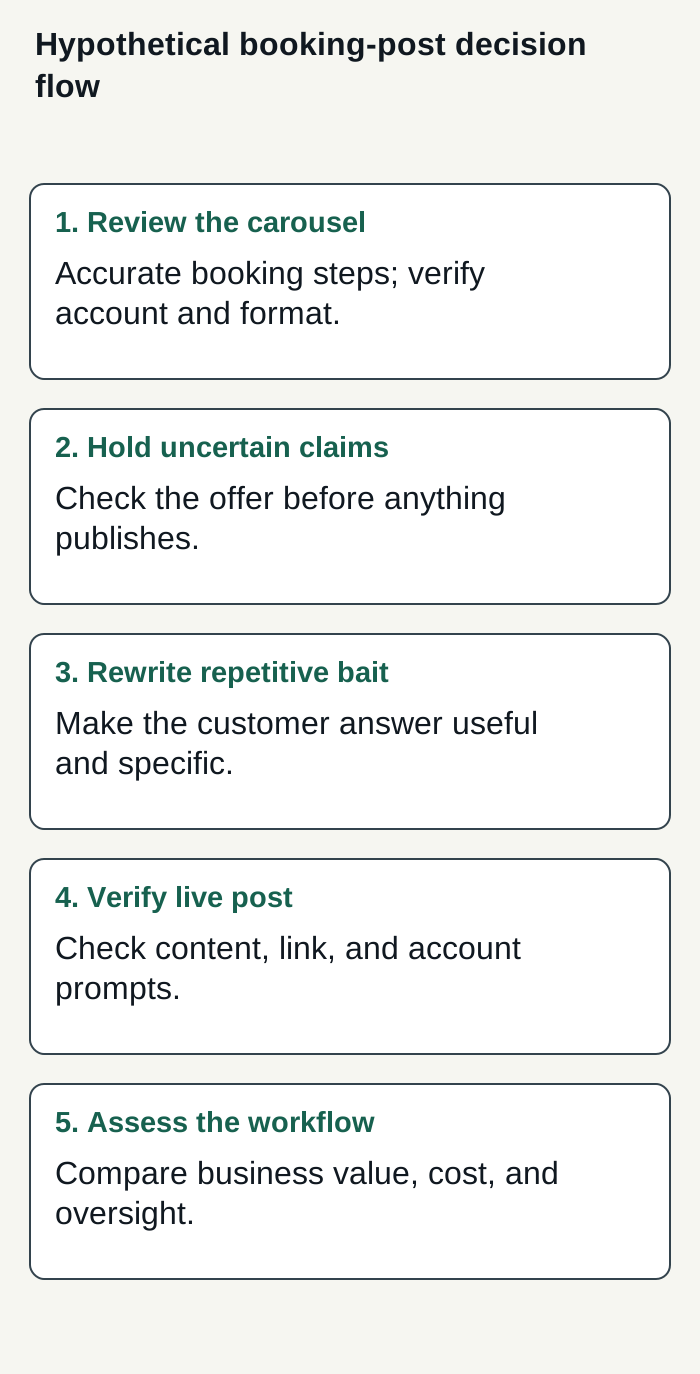
Hypothetical booking-question example: review, verify the live post, then assess value and oversight. This workflow does not guarantee account safety.
Condensed original editorial illustration. Read the surrounding guidance for qualifications and the complete procedure; any example is fictional and shows no verified customer outcome or product screen.
Illustrative worked example by Superdirector editorial team. Created 2026-11-09.
Measure whether delegation is worth continuing
Safety is only one part of the decision for a business owner. Also ask whether delegated publishing produces a worthwhile result for the business and whether the time spent reviewing, correcting, and checking posts remains acceptable. Track those questions separately; a live post alone does not prove business value.
- Before the test, write down the business goal—for this example, helping customers find accurate booking information.
- After publishing, check whether the post is live, correct, and useful for that goal; record any corrections and follow-up required.
- Compare the result and oversight needed with the tool’s cost and the time the workflow was meant to save.
- Keep the narrow workflow, add review, or stop it based on what you observed; do not assume a good result will repeat.
To test whether delegation is worthwhile for this account-safety workflow, compare customer-defined results and time saved with review, corrections, and oversight—not a promised outcome. Superdirector’s Growth plan costs $199/month, includes two accounts, and has no trial. Current publishing is limited to eligible Instagram image carousels and single X text posts, individually approved or covered by an enabled account Auto-post rule. Finished video—including TikTok, YouTube, and Reels methods—and fully autonomous channels are upcoming.
Publishing depends on connecting the account and selecting the source cards that may feed it. Before enabling Auto-post, verify that the first hand-approved post is live. You can turn Auto-post off to stop unsent posts or pause posting to hold the queue; see the publishing setup guide for the controls. Assess the workflow’s actual results and review effort before deciding what, if anything, to delegate further.