How-To Guide
How do you write a one-page brand voice guide for social posts?
Build a compact social voice guide from real posts, with clear voice and tone rules, platform notes and a worked example you can adapt.
By the Superdirector editorial team. Sources reviewed November 9, 2026. The bakery example is hypothetical.
At a glance
How do you write a one-page brand voice guide for social posts?
Start with your audience and the purpose of your posts. Define a few voice traits as observable writing behaviors, explain how tone shifts by situation, and add the language and platform rules a writer needs most. Finish with contrasting examples from your own work. Keep the page concise, and link to separate policies for topics that need more detail.
- Voice is the consistent personality; tone varies with the context. [Buffer explains the distinction](https://buffer.com/resources/social-media-style-guide/).
- There is no universal required format: [Buffer notes that social media style guides can include fewer or more sections](https://buffer.com/resources/social-media-style-guide/).
Start with the reader and your existing posts
A useful one-page brand voice guide is a working reference, not a miniature encyclopedia. Put on it the audience and purpose, a few behavioral voice traits, how tone changes by situation, essential language rules, relevant platform notes, and examples of wording to use and avoid. Build those choices from your actual communication rather than selecting attractive adjectives in isolation.
Begin by writing one sentence: “We write for ___, and our posts help them ___.” Then gather a small sample of your recent social posts. Mark examples that sound like the brand you want to represent and examples that feel wrong. Look for concrete differences: Did one explain the point sooner? Use plainer words? Sound dismissive, overexcited, or generic? Record the pattern, not just your verdict.
This review does not establish what audiences prefer or prove that a particular voice performs better. It gives you evidence about your existing writing to discuss and refine. Sprout recommends examining communications for inconsistencies and useful examples; its broader brand voice guidance also treats voice as a personality used across communication.
Define voice, tone, and language rules
Choose a few traits, then translate each into an instruction a writer can apply. “Friendly” alone could mean many things. “Friendly: address the reader directly and explain unfamiliar terms; do not presume intimacy” is more actionable. Pairing a desired behavior with its boundary helps prevent a trait from being taken too far. Sprout similarly recommends giving voice descriptors behavioral direction rather than relying on a broad label.
Separate voice from tone. Buffer describes voice as the consistent sound of the brand and tone as the way that voice shifts with the situation. Make this distinction practical: note what stays steady, then name a few contexts that call for a different emphasis. For instance, an announcement might be more upbeat, while an answer to a confused reader should prioritize clarity and patience. Neither context requires abandoning the brand's basic personality.
| Guide element | Write this | Check it by asking |
|---|---|---|
| Audience and purpose | Who the post addresses and what it should communicate | Would a writer know what the reader needs? |
| Voice traits | A few traits described as actions, plus boundaries | Could two writers apply the same instruction? |
| Tone by situation | How the voice shifts for an announcement, question, or concern | Does the context change the emphasis, not the identity? |
| Language rules | Preferred terms, words to avoid, punctuation, or emoji approach | Would this rule settle a real drafting choice? |
| Examples | A short on-voice line beside a contrasting line | Can a reader see the difference without guessing? |
Keep the language section selective. Include choices that recur in your posts, such as whether you use contractions, how you name a product, or whether humor belongs in customer replies. A full spelling manual, visual identity system, or response policy can live elsewhere. Buffer's guide covers areas including formatting, emoji, hashtags, multimedia, and breaking news; its example is a source of options, not a mandatory one-page checklist.
Add only the platform notes you need
Add a brief note for each channel or format you actively use when it changes how your writing should be presented. Your voice can remain recognizable while the post structure changes: a carousel may need a concise opening slide, while a single text post may need its point stated directly. Include channel-specific choices such as whether hashtags or emojis fit your practice only when they help a writer make a decision.
Do not turn this section into a collection of supposed universal platform rules. Record your own editorial choices, and check current platform documentation separately if a rule depends on a platform feature or requirement. Sprout's social media style guide recommends documenting social profiles and adapting guidance to the channels a team uses. If you only manage one or two channels, keep the notes proportionate.
A one-page voice guide is also not a complete social media policy. Customer-care procedures, legal concerns, visual standards, and account responsibilities may need their own documents. Point to those documents instead of squeezing complex instructions into shorthand that could be misunderstood.
Worked example: a neighborhood bakery announcement
The following bakery and copy are hypothetical, created to demonstrate how the worksheet works. Imagine a neighborhood bakery whose posts help nearby customers understand what is available and when. Its short guide might say: “Write clearly and warmly. Be specific, not gushy. Use everyday words, not insider baking terms without explanation. Keep the voice helpful; make announcements lively but not pushy. In replies, answer the question before adding extra context.” A person still handles customer conversations, including checking availability and responding to messages.
| Situation | Off-voice draft | Revised draft |
|---|---|---|
| New item announcement | BIG NEWS! Our life-changing loaf is finally here!!! Get yours NOW before everyone else does! | Our rosemary focaccia is on the counter today. It has a crisp edge and soft middle; ask us to set aside a piece. |
| Question about availability | Obviously, we have lots of amazing things. Come see! | The focaccia is available today while it lasts. If you are coming later, message us and we can check. |
The revision removes exaggerated claims and urgency, names the item, and offers useful next information without guaranteeing availability. The availability wording is hypothetical too; use it only if accurate. It reflects the example guide's specific, warm, helpful behavior, but another business may choose a different voice. Replace these lines with examples that reflect your brand, product, audience, and actual policies.
To make your own example, choose a real recurring post type and write two versions: one that follows the guide and one that breaks a rule in a recognizable way. Mark the difference explicitly—such as “specific, not inflated” or “helpful, not dismissive.” If the distinction still depends on personal taste, revise the instruction until a writer can identify what to change.
When enlarged, scroll horizontally to read the diagram.
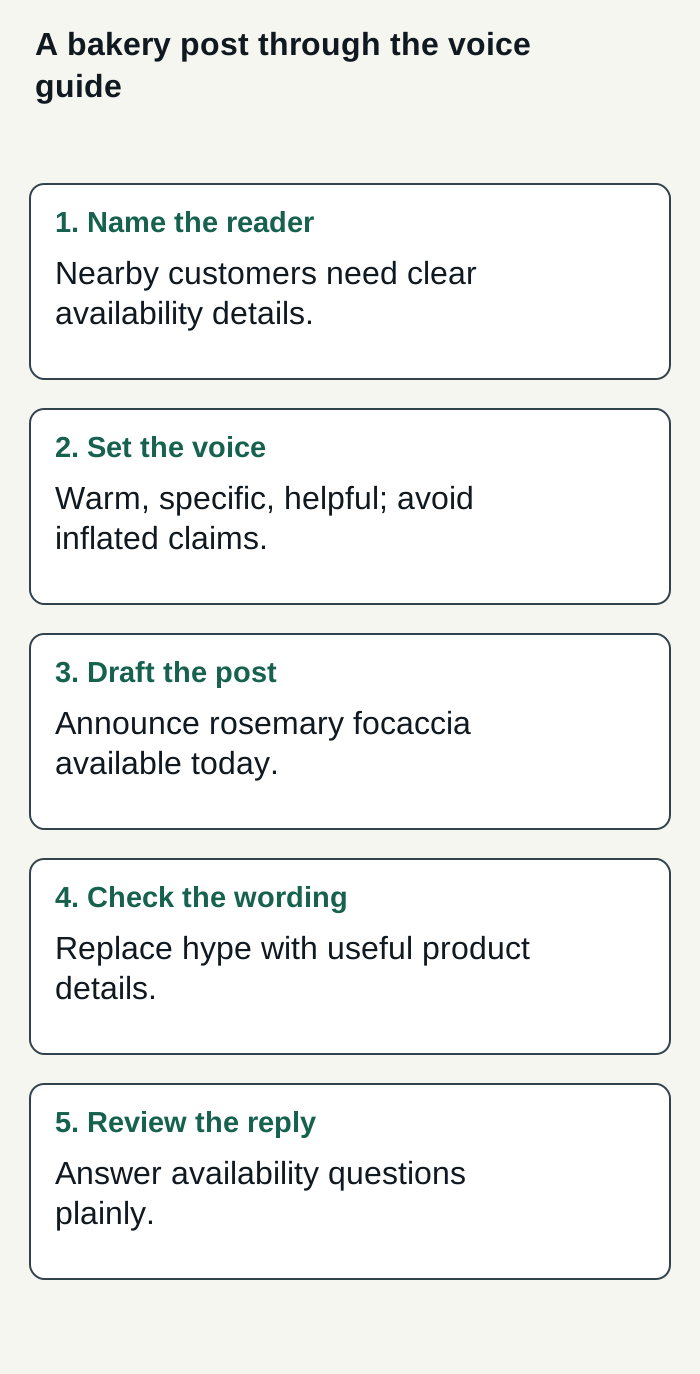
Hypothetical neighborhood bakery example: apply a compact voice guide to an announcement and availability reply.
Condensed original editorial illustration. Read the surrounding guidance for qualifications and the complete procedure; any example is fictional and shows no verified customer outcome or product screen.
Illustrative worked example by Superdirector editorial team. Created 2026-11-09.
Use the guide, then revise it
Keep the finished page beside the place where posts are drafted. When reviewing a draft, point to the relevant instruction: Does it explain the point? Does its tone suit the situation? Does it use the preferred product name? A note such as “too salesy” is difficult to act on; “remove the unsupported superlative and state what is available” gives the writer a next move.
Ask a colleague or contributor to use the page on a new draft and note where they had to guess. That exposes missing instructions more usefully than adding rules for hypothetical edge cases. Revisit the guide when the brand, audience, channels, or repeated writing choices change. Sprout recommends reviewing and refining voice guidance at designated times; the interval should suit your team's work rather than follow a claimed universal standard.
A customizable AI-run channel at around $200 a month is a buying goal, not a claim that the channel already runs fully autonomously or guarantees results. Growth currently costs $199/month for two accounts and has no trial. For this task, AI can help apply a brand guide to drafts; you still need to assess whether its voice rules reflect your business and measure review effort and results against your own criteria. Current publishing is limited to eligible Instagram image carousels and single X text posts, with per-piece approval or enabled account Auto-post. Account connection and selected source cards define what can publish; verify the first hand-approved post is live before enabling Auto-post. Turn Auto-post off to stop unsent work, or pause posting to hold the queue. See the publishing guide for setup. Finished video, including TikTok, YouTube, and Reels methods, is outside current publishing scope; finished video and full autonomy are upcoming.
For the meaning of voice in a related short-form context, see the brand voice glossary. For guidance covering more than voice, see how to create a short-form content style guide. You can also explore building a personal brand on social media or developing a content strategy from a brand profile.