How-To Guide
How do you go viral on TikTok as a brand in 2026?
Make useful TikTok videos, compare creative variations and measure results against your own account. No tactic guarantees a viral result.
By the Superdirector editorial team.
At a glance
How do you go viral on TikTok as a brand in 2026?
There is no dependable way to make a TikTok go viral on demand. Brands can improve their chances of learning what resonates by answering a real audience question, making the topic clear, testing a small creative variation, and comparing results with their own recent posts. Treat a breakout as an observation, not a repeatable guarantee.
- Test one creative choice at a time where practical, using original footage and wording.
- Use clear topic language, but do not mistake practitioner advice for a verified ranking formula.
- Compare similar posts at the same age and judge them against your own account.
A realistic way to pursue TikTok reach
No brand can reliably command a viral result. A more useful goal is to make a video that a defined audience has a reason to watch, then learn from the response. Start with a real question, make the topic obvious, deliver the answer without a long preamble, and compare the post with your own recent work.
Be careful with confident claims about the algorithm. Hootsuite says TikTok has not publicly confirmed a point system and describes exact signal weighting as proprietary and subject to change. Its recommendations to use clear keywords and monitor watch time, completion, shares, and saves are practitioner guidance—not confirmation of current ranking weights. The available sources do not verify current official ranking guidance or provide account-level experiments.
That uncertainty does not make testing pointless. It changes what you can conclude: analytics can help you notice patterns in your own account, but they cannot by themselves prove why a post travelled further. Set a business-relevant aim too. Reach may support discovery; it does not automatically mean a viewer became a customer.
Choose a viewer question worth answering
Pick a question your audience genuinely asks and that your brand can answer credibly. A useful video can teach a small skill, clarify a choice, show a process, or explain a common point of confusion. Spark Social recommends question-answering videos as a search-oriented approach; that is a practitioner recommendation, not a guarantee that search or recommendations will surface a particular post.
- Write down questions customers ask in comments, conversations, or customer-service messages.
- Choose one that can be answered clearly in a short video without turning the answer into a sales pitch.
- Define what a useful outcome looks like: for example, a viewer understands a distinction or knows what to look for next.
- Check that the idea fits the brand and that you can make it with footage and claims you can stand behind.
This focus is more defensible than copying a trend just because it is popular. Dash Social recommends content pillars aligned with audience and business goals, while also recommending regular analytics review. Use those ideas to keep your experiments relevant, not as evidence of a guaranteed growth method.
Build a small, fair creative test
Make a few versions of the same useful idea with different openings. Keep the core answer and audience question substantially alike so you have a clearer comparison. Change one visible choice—such as the opening question or first shot—rather than changing the topic, length, format, and caption all at once. That will not create a laboratory experiment: timing, audience, and other differences can still affect results.
Here is a worked hypothetical example for a neighborhood bakery. The bakery wants to answer a genuine customer question about keeping a loaf fresh. It films its own bread and uses a truthful, practical explanation. These are proposed creative options, not real posts or reported results.
| Version | Opening idea | Keep consistent |
|---|---|---|
| A | “How do you keep today’s loaf fresh?” | Same answer, footage, and call to action |
| B | “Bought bread this morning? Try this.” | Same answer, footage, and call to action |
| C | Show the loaf first, then ask the question | Same answer, footage, and call to action |
The bakery should record which version it posted and note the publish date, opening, and any meaningful difference between versions. It should not assume the most dramatic hook will win, or that one result proves that hook caused more reach. If it cannot make the versions genuinely comparable, it should call the exercise a creative trial rather than a controlled test.
Make the topic clear and deliver the promise
Give viewers the subject immediately. Say it, show it, or put it in readable on-screen text; a concise caption can add context. Hootsuite recommends clear keywords in captions, voiceovers, and text overlays. Treat that as sensible practitioner advice for clarity and categorization, not as proof that repeating keywords increases reach.
- Open with the question, outcome, or visual that makes the subject understandable without a long brand introduction.
- Answer the question the opening raises; do not use a hook that promises something the video never delivers.
- Use captions or on-screen text where helpful, and keep the words natural rather than stuffing in keywords.
- End with a next step that fits the video, such as inviting a specific question—not an unrelated demand for engagement.
Dash Social advises brands to adapt content to TikTok rather than treating every platform alike. In practice, that means reviewing whether the pacing, framing, and explanation work for the intended viewer, rather than simply uploading an unchanged advertisement. A polished production is not a substitute for a clear idea.
Check rights and brand fit before posting
Before adding music, check the current terms and available music options for the account and intended use. TikTok’s Commercial Music Library is a relevant place for businesses to investigate; do not assume that a trend or a sound’s availability elsewhere settles whether it suits your use. If the applicable terms are unclear, choose an option you have confirmed is suitable or publish without that track.
Also check that the idea sounds like the brand and serves the audience. A trend can be a useful creative prompt, but forcing a brand into an unrelated joke can confuse viewers. Avoid lifting another creator’s video or distinctive wording; build the post from your own footage, words, and perspective.
Compare results and decide what to test next
Choose a consistent review point before comparing posts—for instance, compare each post after the same amount of time rather than reading one immediately and another weeks later. Record the measures available in your account analytics. Hootsuite recommends tracking watch time, completion, shares, and saves; pair relevant platform measures with a business measure when you have one, such as profile visits or enquiries. The appropriate measure depends on the goal.
- Write down the post, its opening, publish date, and review age.
- Compare it with recent posts from your own account that serve a similar audience or purpose.
- Look for repeated patterns across posts rather than declaring a winner from one unusually strong result.
- Choose one next test: repeat a useful approach, change one creative element, or try a different audience question.
For the bakery example, imagine version B has the most views at the chosen review point. The team should first check whether it also held attention or led to the intended next step, and whether comparable posts show a similar pattern. This is hypothetical; it is not a claim that version B performed better in a real account. Even if it did, the result would justify another test, not prove that its opening caused the difference.
Use a median or a simple side-by-side list if that helps describe what is typical for your account. Do not apply an unsupported universal multiplier and call it an official definition of viral. Views alone say little about whether the result mattered to the business, and no comparison can guarantee the next post will travel as far.
Where Superdirector fits—and where it does not
For a business whose buying goal is a customizable AI-run channel around $200 a month, Superdirector’s current Growth plan is $199/month for two accounts, with no trial. For this TikTok task, it can support research and video scripts, but filming and final editing remain with you. Finished videos—including TikToks, YouTube videos, and Reels—and fully autonomous channels are upcoming. Assess whether each audience question fits your brand and measure customer-defined results and review effort; neither outcomes nor minimal oversight are guaranteed.
Current publishing is limited to eligible Instagram image carousels and single X text posts, either approved piece by piece or covered by an enabled account Auto-post rule; finished TikTok, YouTube, and Reel videos are outside that scope. Account connection and the selected source cards define what can publish. Verify the first hand-approved post live before enabling Auto-post, as the implementation requires. Consult the publishing guide for setup; you can stop unsent work by turning Auto-post off or pause posting. AI credit use varies by task.
When enlarged, scroll horizontally to read the diagram.
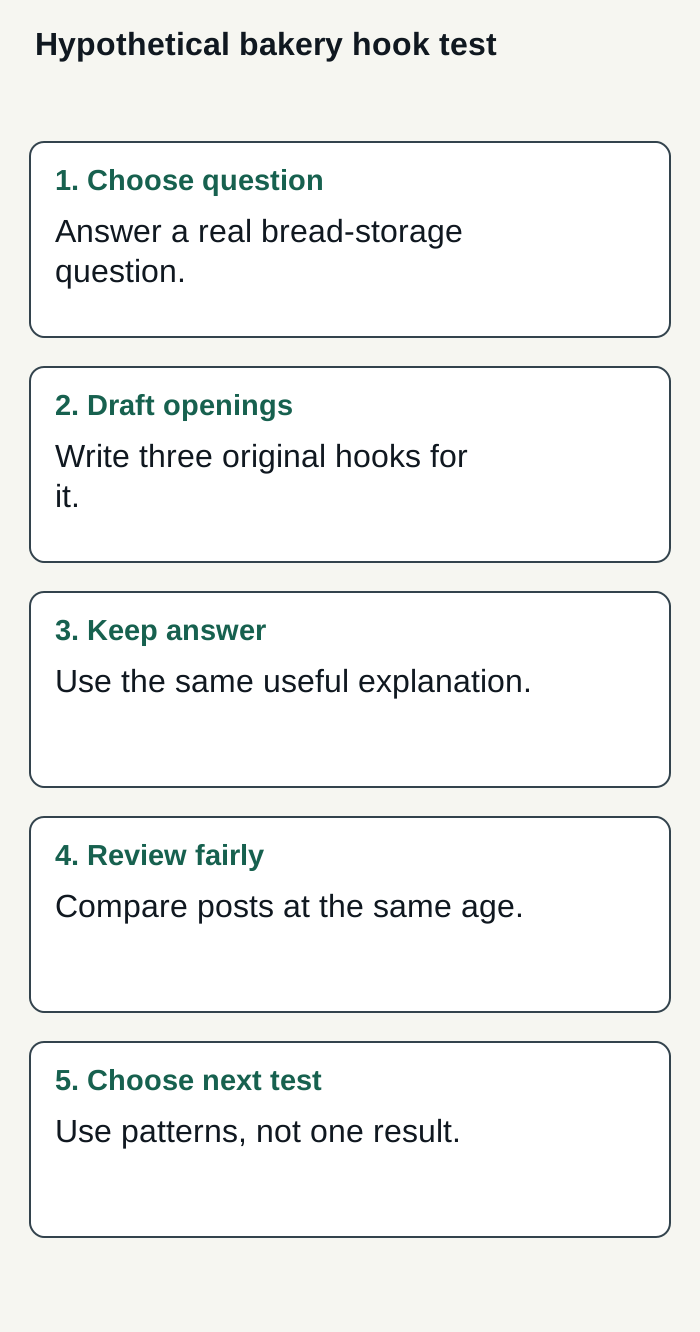
Hypothetical bakery test plan; examples and results are not real account observations.
Condensed original editorial illustration. Read the surrounding guidance for qualifications and the complete procedure; any example is fictional and shows no verified customer outcome or product screen.
Illustrative worked example by Superdirector editorial team. Created 2026-11-09.