How-To Guide
How do you use AI to find trending topics your audience cares about?
Organize trend signals with AI, check audience and brand fit, and use a coffee-shop example and worksheet to decide what to test.
By the Superdirector editorial team. Revised using official Google and platform resources, with a clearly hypothetical worked example.
At a glance
How do you use AI to find trending topics your audience cares about?
Define the audience and goal, gather signals from both public trend sources and your own customer evidence, then use AI to group the material and suggest angles. Check the evidence and factual claims yourself before choosing a small test. A spike or a model’s confident summary is a lead to investigate, not proof of audience demand.
- Use several distinct signals; keep their source and date.
- Ask AI to organize evidence and propose angles, not certify popularity.
- Choose topics for audience fit, accuracy, and a clear business purpose.
Define the audience and the decision
AI is most useful here as an organizer: it can help you turn a messy collection of searches, questions, and observations into topic candidates. It cannot establish that a topic will perform for your brand. Start by writing one sentence that makes your decision concrete: “For [audience], what should we explain about [need] that supports [business goal]?”
For example, a small coffee-equipment shop might ask what to explain to home brewers considering cold brew. That is more actionable than asking for “viral coffee trends”: it gives you an audience, a subject boundary, and a reason to publish. Choose the market and platform you actually serve. A broad national trend may not match your local customers or your expertise.
Keep separate columns for evidence and interpretation. “Several customers asked how coarse to grind beans” is an observation; “grind size is becoming a trend” is a conclusion that still needs checking.
Collect signals from distinct sources
Make a short list of places where your audience might reveal a need. Depending on your business, that could include support tickets, sales conversations, community discussions, comments, platform search suggestions, or queries in your site’s Search Console report. Google says Search Console can show search-performance trends by query, page, and country, including impressions and clicks. Those are signals about people reaching your site through Google Search, not a complete picture of customers.
Add public discovery tools as another layer. Google Trends helps compare relative interest across a chosen geography and time range. Its data is normalized against total searches and scaled from zero to 100; it is not a count of buyers. Google also warns that low-volume terms can show as zero and that a spike does not reveal why people searched. Treat Trends as one input, not a poll or verdict.
If you are planning platform-specific content, consult a relevant platform resource too. TikTok’s captured Creative Center page presents trend perspectives, stories, articles, and reports. Such material can help you notice platform conversations, but it does not prove your customers share those interests. Note the date and scope of each observation so an old report is not mistaken for a current signal.
Use AI to organize, not certify, the signals
Give the model a dated set of observations with their sources. Ask it to group exact customer phrases, distinguish direct evidence from inference, identify missing context, and propose a few content angles. Require it to leave unsupported ideas unranked rather than inventing evidence. A useful prompt is:
Group these dated audience and trend observations into possible content topics. Preserve each original phrase and its source. For each topic, show which evidence supports it, what is only an inference, what needs checking, and one practical content angle. Do not claim popularity or predict performance from a single signal. Mark unsupported suggestions as hypotheses.Review the output against the input. Did the model omit a useful question, merge different needs, or turn an isolated comment into a broad claim? Open cited sources rather than relying on a generated summary. If you cannot trace a claim to evidence, remove it or label it as an idea to investigate. The model should make the evidence easier to inspect, not harder.
Compare candidates with a decision worksheet
The following is a hypothetical example, not observed customer research or a report of results. Imagine that, during April 1–30, 2026, a coffee-equipment shop records two customer questions about cold brew, a site query for “cold brew grind size,” and a Google Trends comparison for “cold brew” in its service area. The operator compares April with March 2026 and records the geography, query, dates, and relative-interest values before interpreting any rise. The shop also notes one platform post about a decorative coffee drink, dated April 18. AI can sort these candidates; a person still checks what each signal does and does not establish.
| Candidate | Evidence to record | Fit and check | Decision |
|---|---|---|---|
| Cold-brew grind size | Two customer questions; site query; Trends comparison and date | Directly answers a brewing question; verify the shop’s advice against reliable product guidance | Test a practical explainer |
| Decorative coffee drink | One platform post; note platform and observation date | May be visually relevant, but customer interest is unconfirmed; check whether it connects to the shop’s offer | Hold for another signal |
| Health benefit claim | Model suggestion only; no supporting customer evidence recorded | High factual-verification need; do not repeat without appropriate evidence | Skip for now |
This worksheet avoids a false-precision score. For each candidate, write: the audience question; the evidence and dates; what the evidence does not establish; brand fit; the claim or detail to verify; and the decision—test, hold, or skip. If you do use ratings, write down what each rating means and do not disguise a judgment as a measured outcome.
For the cold-brew candidate, the next action could be a concise explainer about how grind size affects the brewing process, after checking the shop’s advice. The example does not show that the topic is rising among all coffee buyers or that a post will succeed. It shows how separate signals can support a cautious, useful test.
When enlarged, scroll horizontally to read the diagram.
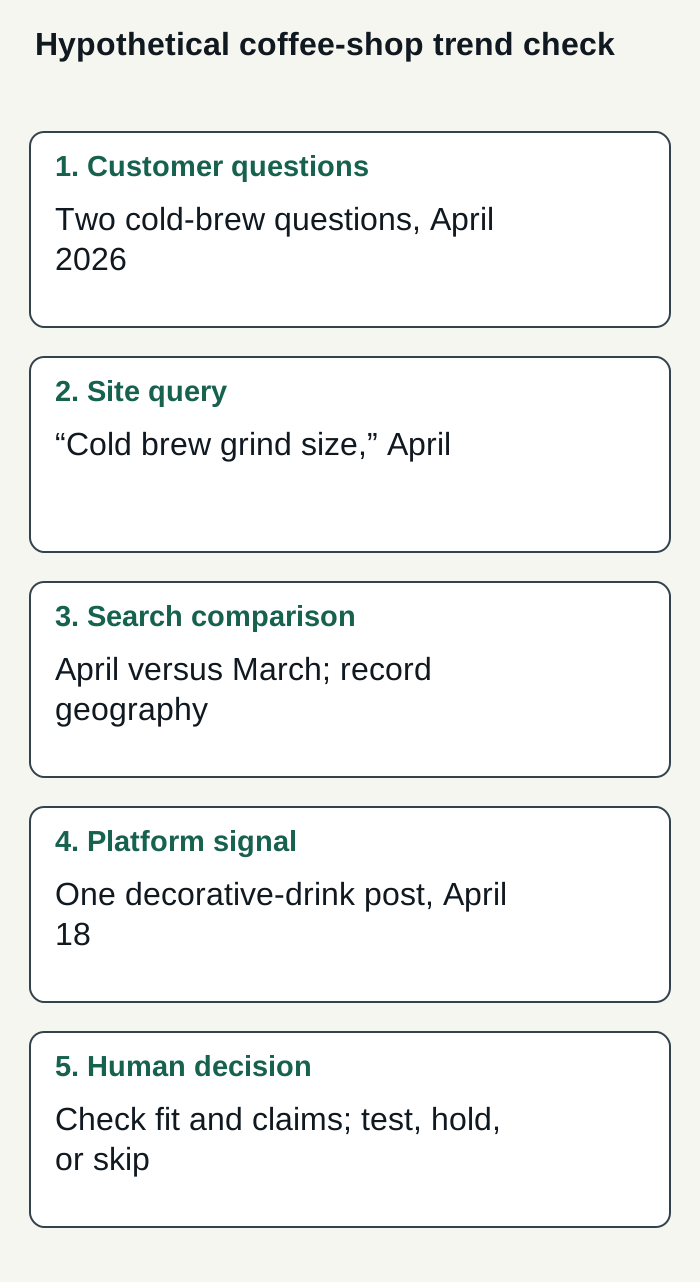
Hypothetical example only: record dates, scope, and evidence before interpreting signals or choosing a test.
Condensed original editorial illustration. Read the surrounding guidance for qualifications and the complete procedure; any example is fictional and shows no verified customer outcome or product screen.
Original visual by Superdirector editorial team. Created 2026-11-09.
Publish a small test and learn
Choose one topic that has a clear audience question, a defensible connection to your business, and claims you can verify. Make the content useful even if the trend fades: answer the question rather than copying a format or attaching your brand to a passing conversation without context. Decide beforehand what you will observe, such as relevant replies, saves, clicks, or follow-up questions, based on the platform and your goal.
After publishing, record the post, its evidence trail, and the response you actually observe. One post cannot establish a general rule about your audience. Use the result to refine the next question: did people ask for more detail, misunderstand the explanation, or respond to a different part? Search Console can also help website owners inspect query, page, and country trends; Google says a monthly check or a check after content changes may be appropriate, rather than requiring daily visits.
For this trend-research workflow, a customizable AI-run channel around $200 a month is a buying goal—not a promise of full autonomy or results. Superdirector’s current Growth plan is $199/month for two accounts, with no trial. Scheduled research and content operations may help organize candidate topics, but assess whether the work fits your audience and measure your own review effort and customer-defined results. Current publishing is limited to eligible Instagram image carousels and single X text posts, with per-piece approval or an enabled account Auto-post rule; finished video and fully autonomous channels are upcoming. Account connection and the selected source cards define what can publish. Before enabling Auto-post, approve a first post and verify it live. Turn Auto-post off to stop unsent posts or pause posting to hold the queue. See pricing and the publishing setup.
Related reading: TikTok trend tools compared, in-house trend monitoring, analyze competitor content, and plan quarterly content themes.