How-To Guide
What is founder-led content, and what should a founder post each week?
Choose weekly topics from real customer questions and founder decisions, then plan a sustainable posting routine and review the results.
By the Superdirector editorial team. Revised from the original article using practitioner accounts and official YouTube scheduling guidance.
At a glance
What is founder-led content, and what should a founder post each week?
Founder-led content is content grounded in a founder’s real expertise, decisions, customer conversations, and point of view. A flexible weekly menu might include a useful answer to a recurring question, a genuine founder lesson or decision, and—when there is something accurate and useful to show—a product explanation. These are content types to draw from, not a recommendation to publish all three each week or a proven optimum; choose a pace the founder can sustain.
- Start from actual customer questions and company experience, not invented stories or borrowed claims.
- Separate the purpose of a post from its format; adapt the same idea to the channel.
- Review usefulness, business purpose, audience response, and production effort before adding more.
What founder-led content means
Founder-led content is public content shaped by the founder’s knowledge, decisions, customer conversations, or point of view. The founder may write and publish it personally, or provide the raw material for an editor to shape and return for review. A founder blog, social post, podcast appearance, product walkthrough, or useful answer to a customer question can all fit. The defining feature is the real founder perspective—not a particular platform, posting frequency, or polished personal brand.
The business purpose matters too. Relato describes founder-led marketing as using the founder’s knowledge and presence to communicate for the company, rather than treating the project solely as a way to build the founder’s independent following. Its article also discusses product education and audience listening alongside social posts. Those are practitioner framings, not proof that any one format or approach produces a particular result. See Relato’s overview of founder-led marketing.
For a small team, keep the definition practical: share something the founder can honestly explain that helps the people the business serves understand a problem, a decision, or the product. Do not turn routine activity into a dramatic story or imply that a founder post will necessarily generate attention, leads, or sales.
Choose a purpose before a format
Start with the reason someone might find the post useful. A customer question could call for a clear explanation or step-by-step answer. A difficult decision could become a lesson about the trade-off and what informed it. A product post could show a real workflow and explain whom it is designed to help. If there is no useful insight yet, wait: a post does not become valuable simply because it fills a slot.
Steli Efti’s account of creating content for Close describes two sources he used: problems ideal customers brought him and lessons from building the company. He also describes recording rough voice memos as material for an editor. That is one practitioner’s process, not a guaranteed shortcut, but it suggests a simple prompt: “What did someone ask, and what can I explain from direct experience?” See Efti’s account of founder-led content.
Only after choosing the purpose should you choose a format. A written answer, a short recorded explanation, a diagram, or a product demonstration may each serve the same underlying idea. Adapt it for the channel rather than assuming that identical copies suit every audience or publishing format.
CXL’s practitioner guide groups LinkedIn examples into authority, personal, and sales content and suggests a particular mix. Treat that mix as the author’s recommendation, not an independently established formula for what founders should publish. The more transferable planning question is whether the week offers something useful, something genuinely rooted in the founder’s experience, and—when appropriate—an accurate explanation of the offer. See CXL’s founder-led marketing guide.
Build a week from real material
The following is a hypothetical planning example, not a customer case study or a report of results. Imagine a small B2B invoicing product. Its founder has heard customers misunderstand how to follow up on an overdue invoice and has recently been reconsidering the onboarding flow. Use those real kinds of observations as prompts; use only details that are actually true for your business.
| Planning slot | Purpose | Hypothetical post brief | Check before publishing |
|---|---|---|---|
| Monday | Answer a recurring question | Explain one practical step for following up on a late invoice, and clarify what the advice does not address. | Is this based on a real question and appropriate to the founder’s expertise? |
| Wednesday | Explain a founder decision | Describe a choice made while simplifying onboarding and the question that prompted it. | Is the account of the decision accurate? Do not claim an unmeasured improvement. |
| Friday, if useful | Show the product honestly | Walk through an actual invoicing workflow and explain what the product is designed to help users do. | Does the demonstration match the current product and avoid overstated promises? |
This is a menu, not a quota. If only one post is sustainable, choose the most timely and useful idea and leave the others for another week. If a customer question exposes uncertainty about the offer, take that uncertainty into customer conversations instead of publishing a confident-sounding guess. If the founder has not personally observed a story, do not present it as their experience.
When enlarged, scroll horizontally to read the diagram.
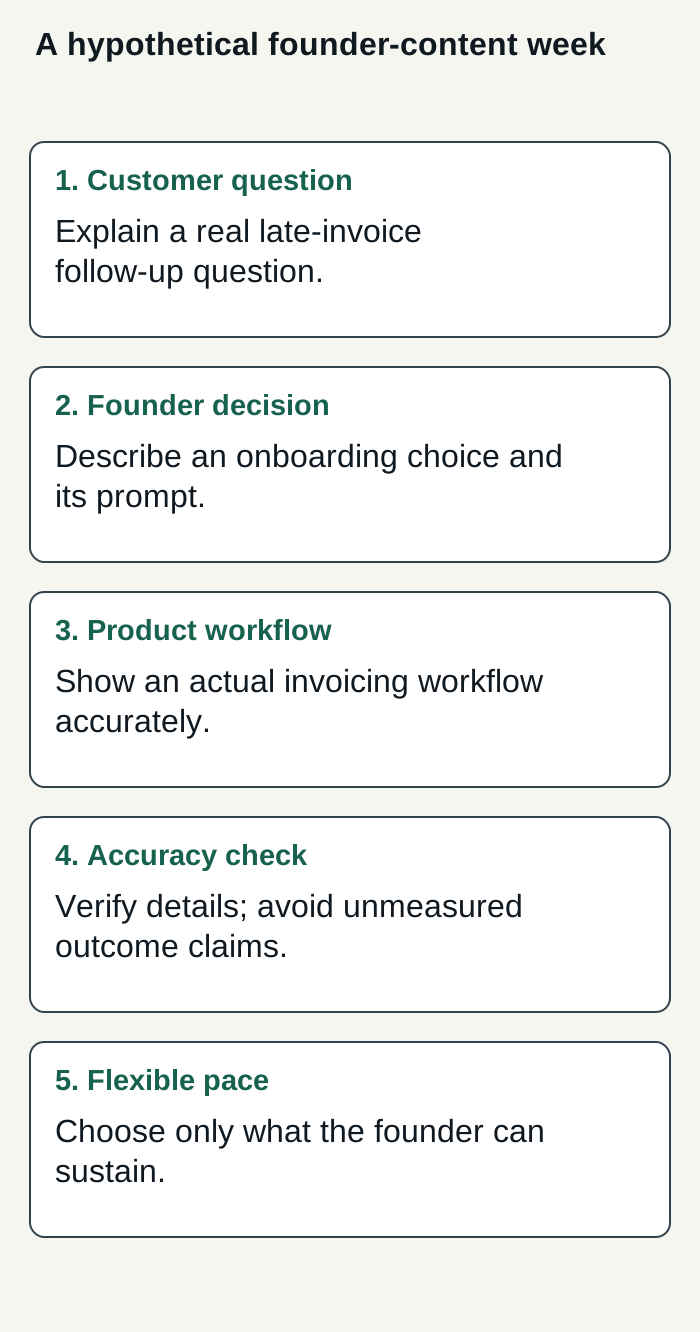
Hypothetical invoicing-product planning example; these are possible post purposes, not a customer case study or claimed results.
Condensed original editorial illustration. Read the surrounding guidance for qualifications and the complete procedure; any example is fictional and shows no verified customer outcome or product screen.
Original visual by Superdirector editorial team. Created 2026-11-09.
Capture ideas and preserve the voice
Keep a short idea record with four fields: the question or event; what the founder directly knows; the practical point for the audience; and any facts that need checking. Add items after customer conversations, product reviews, or decisions while details are fresh. This is less demanding than inventing topics during a separate writing session, and it gives an editor useful material without asking the founder to produce a finished draft.
For each item, ask the founder for the explanation they would give a customer. A voice note or brief interview can work if it is easier than drafting. An editor may clarify structure and remove repetition, but should not manufacture emotion, results, quotations, or certainty. Return the draft to the founder to check both the facts and whether it sounds like something they actually believe.
Match the production method to the channel and available capacity. A detailed video takes different effort from a short written answer. For YouTube specifically, its official upload-schedule guidance asks creators to consider sustainable frequency, production time, goals, and the costs of a format. That is guidance for YouTube, not a rule for every social platform; its broader planning lesson is to account for the work as well as the publishing date.
Review and adjust the workload
After a few weeks, review each post against the purpose you chose. Did it answer the question clearly? Did it express a real founder perspective? Did people raise useful follow-up questions? Did it help the team understand how readers interpret the product or its positioning? These are prompts for learning, not evidence that a particular response will predict revenue. A quiet post can still be useful; a busy comment thread does not automatically make a post valuable.
Record the time and effort required too. If the plan repeatedly displaces customer work or leaves the founder drained, reduce its frequency, simplify the format, or use editorial help. Close’s first-person account describes changing motivation and eventually handing content work to staff after burnout. Relato likewise flags founder time and key-person dependence as constraints. Those accounts are not universal forecasts, but they are good reasons not to equate consistency with posting every day.
A useful review ends with one decision: repeat, revise, pause, or investigate. Repeat a format if it is manageable and serves its purpose. Revise it if people misunderstand the message. Pause it if there is no genuine material to share. Investigate a recurring audience question before turning it into a product claim. Do not rely on unsupported comparisons between platforms or on a fixed content ratio as a substitute for learning about your own audience.
When a content system can help
For a business considering a customizable AI-run channel at about $200 a month, evaluate Superdirector’s current Growth package against that goal: eligible Instagram carousels and single X text posts with per-piece approval or an enabled account Auto-post rule. Finished video and fully autonomous channels are upcoming. If the founder has useful ideas but little time for research, drafting, and scheduling, a managed content system may be worth evaluating against the actual work it takes off the team’s hands. Superdirector describes a customizable AI-run channel organized around a customer’s business goal, with research, saved brand context, content creation, and publishing as parts of delivery. That describes the offer, not independently verified content quality or business results. Decide whether paying for delegation makes sense by measuring the effort displaced, the work delivered, the founder’s review burden, and the results your own business considers worthwhile.
The Growth offer checked on 2026-11-09 was $199 per month for two accounts, with no trial. Its 2,000 monthly credits are an AI-usage allowance, not a fixed asset count: tasks use varying amounts, and cards show an estimate before a run. Current stated publishing scope covers eligible Instagram image carousels and single X text posts. Each post needs individual approval unless an enabled Auto-post rule for that account covers it. Before enabling the rule on an account, approve a post manually and verify that it appeared live on that account. Finished AI video and fully autonomous channels are upcoming, not current capabilities. Check the current Growth offer and scope and how publishing works before making a decision. If your plan is built around video or another unsupported publishing format, do not assume the product will publish it.
Whether the founder does the work or delegates production, the essential input remains truthful founder knowledge and a clear business purpose. Measure the arrangement over time; do not assume that automation eliminates review or that publishing alone produces a particular outcome.
The publishing setup connects selected source cards to the chosen account; Instagram requires a Business or Creator account. When you enable Auto-post for that account, finished eligible posts from those cards, including posts made in chat, can publish at their calendar times without individual approval. Turning it off stops unsent posts; Pause posting holds the queue. These controls define current delegated publishing, rather than promising a fully autonomous channel or business results.