How-To Guide
How to close a creator quote you cannot meet without promising what you cannot keep
State a limit you can prove, check the quote is final, then send four lines that thank, give the true reason, close this scope and promise nothing more.
By the Superdirector editorial team. FTC guidance reviewed October 30, 2026.
At a glance
How can a brand close a creator quote it cannot meet without harming the relationship?
Check that the quote is final and state your limit in one sentence you can support with a record. Then send four lines: thank them for something specific, give the true reason as your own limit, say that this scope at this figure for this project is closed, and optionally add a present-tense invitation that promises nothing. Do not comment on their rate, and do not promise future work, budget or a list place unless a dated plan and an owner exist. No wording guarantees how a creator responds.
- State a limit you can show a record for, not a borrowed or invented one.
- Close this scope, at this figure, for this project; leave the creator out of the verdict.
- Promise nothing that no one owns, and log every sentence you sent.
Direct answer
Short answer: close an unaffordable quote with four lines and no promise you cannot keep. Line one thanks the creator for something specific. Line two gives the true reason, stated as your own limit. Line three says what is closed: this scope, at this figure, for this project. Line four is optional, and if you use it, it is a present-tense invitation that asks nothing of the creator and commits you to nothing beyond reading a reply. Before you write any of it, state your limit in one sentence you could show a colleague a record for, and check that the quote is final.
This is for an agency or brand marketer holding a creator’s quote that the team cannot meet and has decided not to meet. The decision is narrow: whether to close, and how to word one honest close. It does not choose a price to counter with, split a bundle or rank the creator. Those are other pages, linked in the boundary section below.
The reason to be strict is that a close is read twice. The creator reads it now, and may read it again when your brand next appears in their inbox. A sentence like “we’d love to work together next quarter” sounds kind and creates an expectation. If nobody owns that expectation, the next message is a broken promise. Use the blank close card, the CSV register and the close map to keep each close in one record.
Write down the limit you can state as true
Name which of your limits the quote runs into. There are only a few honest kinds. An approved figure: someone with authority approved a number for this scope, and the quote is above it. Scope: the quote prices work you did not ask for, such as extra videos or a longer exclusivity period. Rights: the quote includes or excludes paid use in a way you cannot take. Timing: the creator cannot deliver in your window. Product: the brief depends on something you cannot send. Write the limit in one sentence and note the record that supports it: the approval message, the brief or the schedule, with a date.
The test is simple. If the sentence says “our budget is fixed at X,” there should be an approved figure behind it. If the real situation is that you would rather spend the money on another creator, the true sentence is about priority, not budget, and you should not write “we have no budget.” A close that gives a false reason is easy to expose later, when the creator sees your brand working with someone else. It is also not necessary. “We chose a different direction for this project” is shorter and true.
Do not borrow limits. “Our client won’t approve” is a statement about a third party, and unless the client has said so in writing, it is a guess. If the figure is not yours to decide, say so to your own team first. The budget-reply page covers what you may say about money before a scope exists; here, the quote is already on the table and your limit is already settled.
Check that the quote is final before you close
A quote is not always a final price. Some creators send a figure as an opening position, some as a minimum for a stated scope and some as a take-it-or-leave-it number. Read the message again for words that signal which. Phrases about flexibility, about what the figure includes or about what changes if a line is dropped are questions waiting for an answer. If the message is silent, the status is “not stated,” and the honest next move is one factual question, not a close.
Before closing, make sure you have the creator’s own statement of what the figure covers. If you cannot list the lines, you do not know whether the figure is beyond your limit or merely beyond your limit for a scope you assumed. The bundle-quote page shows how to open a quote into stated lines, and the partial-acceptance page covers a creator who declines only one item. If one dropped line would bring the quote inside your limit, you are not at a close. You are at a counter.
Record the result on the card: final, open or not stated. A creator who has said the figure is final and a creator who has only named a figure are not the same case, and your close should not treat them as one. Someone who has not said the figure is final has not refused anything yet, so a close that says “since you can’t be flexible” puts words in their mouth.
Choose close, counter or pause
Pick exactly one of three routes, and write the reason in a sentence. Close when no scope you can write down fits the figure, or the creator has said it is final and it is above your limit. Counter when a narrower or different scope, with the creator’s own price for it, would fit your limit. Pause when you do not yet know what the figure covers or whether it can move, and one question would settle it. The table shows how the evidence maps to the route.
| What you know | Route | What you send |
|---|---|---|
| Figure is above your limit and stated as final | Close | The four-line close |
| Figure is above your limit, the creator has not said it is final, and a smaller scope exists on paper | Counter | A new scope with the creator’s own price requested, not a number from you |
| You cannot list what the figure covers | Pause | One factual question about the lines it covers |
| The creator has asked a question you have not answered | Pause | The answer first, then decide |
| Your limit is priority, not money | Close | The four-line close, with line two worded as priority |
A close is final for this scope and this project, not for the creator. That distinction does the work in line three. Whether to reopen a creator later on new evidence is a different decision, covered in the declined-creator page; a close does not need to promise it, and it should not.
One more guard. If you are closing because the quote is above your limit, do not also send a counter in the same message. Two messages in one send the creator an offer and a goodbye together, and they cannot tell which one you meant.
Write the four-line close
Write four lines, in this order. Line one: thanks, for something specific. Name what you read or received: the quote itself, the time they took to set out the lines, the sample reel. A generic thank-you reads as a template, and a specific one is true only if you actually read the thing. Line two: the true reason, stated as your limit and nothing more. Use the sentence from step one. Do not comment on whether the figure is fair, high or low. A creator’s rate is their own statement of what the work costs them, and your message is about your constraint.
Line three: what is closed. Say that you will not be moving forward with this scope at this figure for this project. That is precise, it cannot be read as a judgment on the creator, and it leaves nothing for them to wait on. Line four is optional. If you use it, make it a present-tense statement that costs you nothing to keep, such as “If your rates or the scope you offer change, you are welcome to send an updated quote.” It asks the creator for nothing and promises no outcome. Do not write “we’ll keep you in mind,” “we’ll be in touch next quarter” or “we hope to work together soon” unless a dated plan and a named owner exist.
Keep the whole message short and plain. Leave out apologies that imply you did something wrong, praise you do not mean, a request for a discount the creator has not offered, and any hint that they might get work later if they lower the figure. If you hold feedback on their reel that they did not ask for, leave it out; a close is not a review.
Check for formal requirements separately. The FTC’s CAN-SPAM compliance guide says the law makes no exception for business-to-business email, that a commercial message must carry the sender’s valid postal address and an opt-out notice, and that a message’s primary purpose decides whether it is commercial or transactional or relationship content. It says the law reads the transactional and relationship categories narrowly. A close that only declines a quote is a different thing from a message that pitches something, and we are not saying which category yours falls in. If you add a pitch for future work to your close, it moves toward promotion. Decide the category with counsel, and if you are unsure, include the address and opt-out.
When enlarged, scroll horizontally to read the diagram.
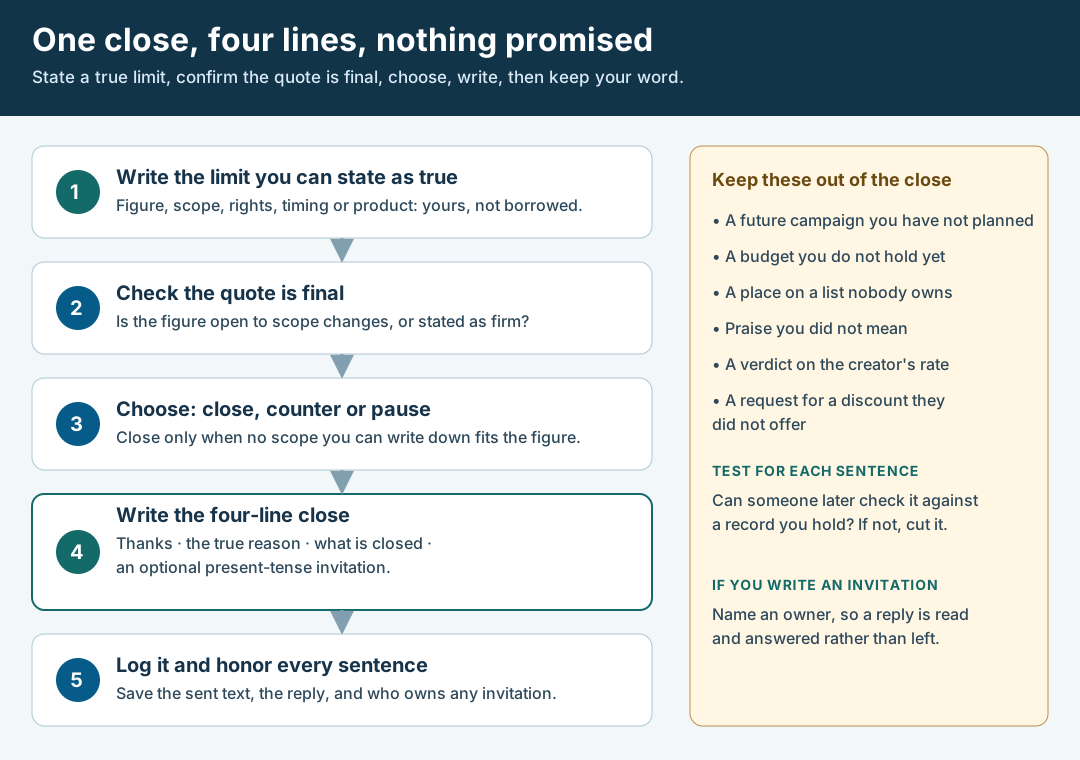
An original editorial map. Each sentence of the close must be checkable against a record you hold.
Original visual by Superdirector editorial team. Creation date not recorded.
Walk through a fictional close
Fictional exercise: no real brand, creator, rate or result was inspected. A made-up brand, Brand A, asked Creator Q for one short video and a link in the bio. Creator Q’s manager replied with a figure for the video, a second figure for twelve months of paid use and the sentence, “This is our standard package.” Brand A’s approved figure covers the video only, and the approval message is dated and on file.
Step one: the limit is an approved figure for the video alone, supported by the approval message. Step two: the manager listed the lines and called the package standard, which is not the same as final, so Brand A asks one factual question: “Is the paid-use line separable?” The manager replies that it is not, and that the figure is final for this package. Step three: no scope Brand A can write down fits, so the route is close.
Step four, the close, in four lines. “Thank you for setting out the video and the paid-use line so clearly.” “The approved figure we hold for this project covers the video only.” “So we will not be moving forward with this package at this figure for this project.” “If the paid-use line can be quoted separately in future, you are welcome to send it.” Line four is conditional and costs nothing to keep. The scenario predicts nothing about any real creator, manager or price.
Log the close and honor what you wrote
Save the text as sent, the time with its time zone, the channel and the quote it answers. Paste the creator’s reply as written, with its time. If line four invited a reply, name who reads it and answers it, because an invitation nobody answers is a small broken promise. Add the date by which that person will check the thread. Keep the card with the quote, your limit sentence and its supporting record.
Then list every promise the close contains. A well-formed close contains almost none: the thanks is not a promise, the reason is a statement and the closing line is a conditional invitation. If the list has anything else, such as a date, a named future campaign or a place on a list, write down who owns it, or take it out of the draft before you send it. Honoring what you wrote is the whole mechanism by which a close keeps a relationship intact. It does not guarantee the creator will want to work with you again, and no step here claims it will.
If the creator answers with a changed scope or a new figure, treat it as a new quote. Start again from step one rather than continuing the old thread, so your limit sentence and your record match the new numbers.
What this page does not decide
This page covers a single decision: closing a quote you have already decided not to meet. It does not set a price, rank creators or predict how a creator will respond. We have no data on how closes are received and no evidence that any wording protects a relationship, so we make no such claim. The only claims are about the process: that each sentence can be checked against a record, and that a close promising nothing leaves nothing to break.
Compared with the closest existing pages: the budget-reply page is about answering a creator who asks about money before a scope exists; this page starts after a quote exists and ends in a close. The bundle-quote page opens a quote into lines to compare costs; here the lines only decide between close, counter and pause. The partial-acceptance page handles a creator who agrees to most of the work and declines one item. The declined-creator page covers when to reopen a creator you declined, which this page deliberately leaves unpromised.
Nothing here is legal, tax or contract advice. Whether a message counts as commercial email, and what your agreement or any prior correspondence requires, are questions for counsel. We cited only one primary source, the FTC’s guide, and only for the points stated above. We did not read any platform’s help pages on declining or withdrawing an invitation, so we make no statement about platform behavior.