How-To Guide
Which viral video and post formats work for brands, and how is each one built?
Eight short-form formats brands can reuse, from the question hook to the green screen reaction, with the beats of each and what to swap in for your product.
By the Superdirector editorial team. Platform and vendor pages read November 6, 2026.
At a glance
Which viral video and post formats work for brands, and how is each one built?
The formats brands can reuse are the ones with a fixed skeleton you can refill: the question hook, the five-slide list, mirror talk, POV, before and after, the myth-buster, the tier list and the green screen reaction. Each follows the hook, body and close that TikTok's own Creative Codes describe. Pick the one that matches the proof you already have, keep its beats, and replace every word, shot and sound with your own.
- Choose by proof: a demo suits a question hook, documented results suit before and after, expertise suits a list or a myth-buster.
- Copy the beats, never the post. YouTube's monetization rules say borrowed material has to be changed significantly to become your own.
- Judge a format against your own recent posts, one changed beat at a time.
Eight formats and how each one is built
A format is the part of a viral post that survives when you change the topic: the order of the beats, the kind of opening line, where the proof goes and how it ends. That is why a brand can reuse a format but should never reuse a post. The eight below are a practical starting set for a small brand, and each one fits the three-part structure TikTok gives advertisers in its Creative Codes: a hook that grabs attention with suspense, surprise or emotion, a body that carries the message, and a close with a clear call to action.
| Format | Video or carousel | Beats (about 30 s or five slides) | What a brand swaps in | Proof it needs | Skip it if |
|---|---|---|---|---|---|
| Question hook | Video or carousel | 0-2 s the question on screen and spoken; 2-10 s the one-line answer with a demo; 10-25 s two reasons, each with proof; close on what to do next | A question from your inbox, reviews or comments | A demonstration you can film | The honest answer needs a claim you cannot show |
| Five-slide list | Carousel (or a five-cut video) | Slide 1 the promise; slides 2-4 one point each; slide 5 the takeaway and a reason to save or send | Points from your own expertise; the product is one point at most | Nothing beyond what you know | You have one point stretched over five slides |
| Mirror talk | Video | 0-2 s an opinion or confession in on-screen text; body: talk to the mirror while doing the routine; close on a question | Your routine with the product used as it really is | Real use on camera | Nobody on the team will appear on camera (make the carousel version) |
| POV | Video | On-screen 'POV: you...' sets the scene; the camera plays the viewer; one turn; payoff in the last 3 s | The moment your buyer's problem shows up | A believable everyday scene | The scene only works if an actor claims to be a customer |
| Before and after | Video or carousel | Show the after first; then the before; then the 2-4 steps between them | A change you made and documented | Dated photos or footage of both states | The result needs claims you cannot document |
| Myth-buster | Video or carousel | The belief on screen; 'not quite' with the evidence; what to do instead | A belief in your category your product or method changes | A source, a test or a demonstration | The 'myth' is a competitor you are naming unfairly |
| Tier list | Video (green screen board) or carousel | The board and the criterion; each item 2-4 s with a reason; the top tier last | Ingredients, methods, tools or habits in your niche | A stated criterion | You would be ranking named rivals on vibes |
| Green screen reaction | Video | The thing on screen behind you; your reaction in one line; your correction or addition; close | A review, a question or a news item in your category | Rights to show the background, and a point of view | Your reaction adds nothing to the original |
The same table is available as a CSV you can copy into a content calendar. The timings are a working template for a 25 to 35 second post, not a measured optimum; YouTube Shorts and Instagram Reels can both run up to three minutes, so the limit is rarely the problem.
When enlarged, scroll horizontally to read the diagram.
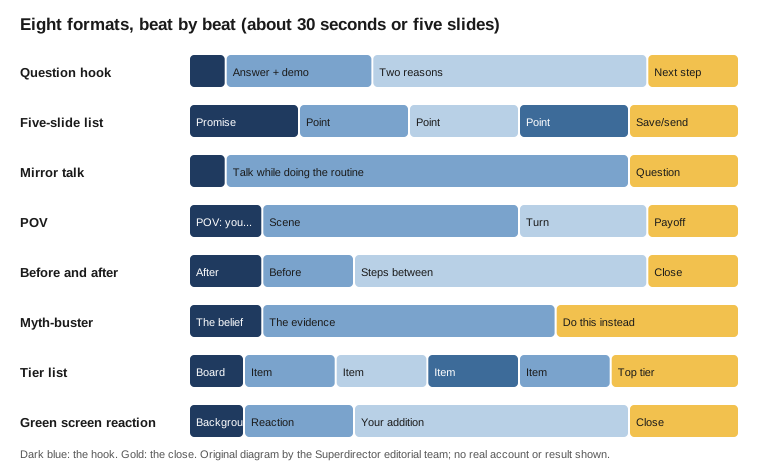
Original diagram; timings are a working template, not a measurement.
Original visual by Superdirector editorial team. Creation date not recorded.
Pick a format by the proof you already have
A common way a format fails for a brand: the format promises something the brand cannot show. A before and after with no documented before is a claim, not a post. So start from what you can put on screen this week.
- If you can demonstrate the product in under ten seconds, start with the question hook or the POV.
- If you have dated photos or footage of a change, use before and after.
- If your edge is knowledge, use the five-slide list, the myth-buster or the tier list. None of them needs filming.
- If someone on the team is happy to talk on camera, add mirror talk and the green screen reaction. They carry personality, which is the hardest thing to fake.
For a founder doing this alone, two formats are enough to start: one that needs no filming (the five-slide list) and one that shows the product in use (the question hook). Both can be made from the same idea, so one week of thinking gives you two posts. If you are new to planning beats, the beat structure lesson covers the basics.
Question hook
Open on a question your buyer actually asks, written on screen and said out loud in the first two seconds. Answer it in one line with a quick demonstration, give two reasons, each with something the viewer can see, and close on what to do next. NemoVideo's guide reports that TikTok's current creative guidance puts the content proposition in the first three seconds and the hook within the first six, which this format meets by design.
Brand swap: take the question from support tickets, reviews or comments, word for word. 'Why does my bread go stale in two days?' beats 'Here is why our bread box is great', because the viewer recognises their own problem before they recognise an ad. For more opening lines, see the hook formula for short videos.
Five-slide list
Slide one states the promise ('3 mistakes that make a 20-minute meal take an hour'). Slides two to four carry one point each, in large type, with a single image. Slide five gives the takeaway and a reason to save the post or send it to someone. Instagram carousels allow far more than five slides (Sprout Social and Metricool both put the limit at 20 photos or videos), but five keeps each point strong and is quick to make.
Brand swap: the points come from what you know about the category. Your product earns one slide at most, and only when it is the honest answer to that point. The same five beats also work as a five-cut video, which is how one idea becomes a carousel and a Reel.
Mirror talk
A person talks to their reflection, or to the phone propped at the mirror, while doing an everyday routine: getting ready, packing a bag, making coffee. The first line goes on screen as text because the speech starts mid-routine. The body is the talk; the close is a question that invites replies. YouTube's Shorts editing guide makes the same point about text in short videos: it can 'guide your viewers' through fast edits with clearer context.
Brand swap: the product appears because it is part of the routine, used the way it is really used. If no one will appear on camera, make the five-slide version of the same opinion. Creator-made versions of these formats are covered in types of UGC videos.
POV
On-screen text sets a scene from the viewer's side ('POV: it is 7 a.m. and the oat milk is gone'). The camera plays the viewer, the scene has one turn, and the payoff lands in the last few seconds. It works because the viewer is cast in the story before the brand appears.
Brand swap: write the moment your buyer's problem shows up. Keep actors as actors. A POV scene should never present a hired person as a real customer describing a real experience.
Before and after
Show the after first, then the before, then the two to four steps between them. Leading with the result is one of the four openings NemoVideo's guide lists, and it suits this format because the result is the reason to watch. The steps are where your product or method appears.
Brand swap: a room you fitted out, a garden you planted, a spreadsheet you cleaned up, a pan before and after the cleaner. Keep the dated files of both states. Results that depend on health, money or body claims need evidence most brands do not have, so leave those to the professionals who do.
Myth-buster
Put the belief on screen ('You need to post every day to grow'), say 'not quite', show the evidence, and end with what to do instead. The format earns comments because people who hold the belief want to answer back, which is fine as long as your evidence holds up.
Brand swap: pick a belief in your category that your product or your method changes, and cite where the evidence comes from: a platform's own guidance, a test you ran with the numbers shown, or a demonstration on camera.
Tier list
Show a board with tiers from S to D and state the criterion in one line ('ranked by how long they keep coffee hot'). Each item gets two to four seconds and a reason; save the top tier for last. As a video it usually runs on a green screen board; as a carousel, one tier per slide works.
Brand swap: rank ingredients, methods, habits or tool types in your niche. Ranking named competitors on taste invites disputes; rank approaches, or rank things you have actually tested and say so.
Green screen reaction
You stand in front of something on screen, such as a review, a question, a headline or a post, give your reaction in one line, then add what the original missed. TikTok's ads blog lists green screen and duets among its platform-native features, and YouTube's Shorts camera has a Green Screen tool that can use a photo or video from your gallery, or an eligible YouTube video or Short, as the background.
Brand swap: react to a customer review, a common question or category news. The reaction has to add something; a background with nothing new in front of it falls short of what YouTube's monetization policy asks of reused content.
Remake the structure, not the post
When you see a post taking off in your niche, write down its beats before you look at its words: what happens in the first two seconds, where the proof appears, how it ends. Then rebuild it with your own script, footage, voice and examples. YouTube's monetization policy puts the line plainly: if you borrow content from someone else, 'you need to change it significantly to make it your own', and content should not be mass-produced, generic, repetitive or manipulative. To see which formats are rising before you pick one, start with these TikTok trend tools.
Platforms also offer a sanctioned way to reuse a structure. YouTube's Shorts templates give you a framework taken from an eligible Short, covering the length and number of clips plus elements like text, music and effects, and creators can opt out. TikTok's creative best practices post calls trends storytelling templates and reports, citing a 2021 TikTok Marketing Science study, that 77% of users like it when brands use trends, memes or challenges to make new content.
- Keep: the beat order, the type of opening line, where the proof sits, the length.
- Replace: every word, every shot, the examples, the voice.
- Check: that the audio is cleared for business use on your account type, and that a reaction shows material you have the right to show.
- Label: AI-made visuals or voices where the platform asks for a label. You remain the publisher of what goes out.
Test one beat at a time
A format is a hypothesis about your audience, so test it like one. Change one beat per post (the opening line, the length, where the proof appears or the close) and compare against your own recent posts of the same type. Swarmify's guide defines a breakout for a business as performance well above its own baseline with the right audience, which is the only bar that means anything for a small account.
Two measurement traps are worth knowing. Since 31 March 2025 YouTube counts a Shorts view every time a Short starts or replays, with no minimum watch time, and keeps the old measure as engaged views, so compare formats on engaged views. And TikTok's For You feed standards say a video that is not getting many views has not necessarily broken a rule; check analytics before you blame the platform. Hootsuite's Reels guide points to Instagram's trial Reels, which show a Reel to non-followers first, as a low-risk way to try a new format. Hooks can be checked one at a time with the free hook analyzer.
Where Superdirector fits
Superdirector is our product, so read this as the publisher talking. Its home page names three of these formats as examples, Question hook, Five-slide list and Mirror talk, because spotting and remaking formats is the job it does. It watches accounts, keywords and hashtags in your niche on Instagram, TikTok, YouTube and X, picks the posts and formats that are taking off, and rebuilds them with the same hook and structure in your brand. Today that means carousels, X posts, video scripts and storyboards, and on the Growth plan it posts Instagram carousels and single X text posts after your first approval or with standing Auto-post. Finished AI video and full autopilot are coming soon. You decide what goes out and stay the publisher.