How-To Guide
How should a brand use memes in social media marketing without it backfiring?
Use a meme only when it fits your voice, buyers and product, the image is yours to use, and it is days old. Real backfire cases and an eight-point checklist.
By the Superdirector editorial team. AMA, U.S. Copyright Office, Instagram and vendor pages read November 6, 2026. Not legal advice.
At a glance
How should a brand use memes in social media marketing without it backfiring?
Use a meme only when the joke sounds like your brand, your buyers already share the meme, and it connects to what you sell. Build it from an image you own or have licensed, not a stranger's photo, a celebrity or a character, and check how the meme is used so you do not miss a cruel or discriminatory reading. Post fast: research summarised by the American Marketing Association found a meme's boost in attention dissipates within one to two weeks. Add your own text or graphics so it says something new, then measure it and read the comments.
- Most meme backfires are about rights, meaning or timing, and all three are checkable before you post.
- Instagram counts an edited meme template as original only when your additions meaningfully change it.
- Recreating the format with your own picture is safer, and Instagram stops recommending accounts that mainly repost.
When a meme helps a brand, and when it backfires
A meme works for a brand when three things line up: the joke sounds like you, your buyers already know the meme, and it connects to what you sell. It backfires for four reasons: you use an image you have no right to, the joke carries a meaning you missed, you arrive after everyone else, or you repost it unchanged. The research behind the timing point is specific. Summarising Michael R. Ward's study in the Journal of Interactive Marketing, the American Marketing Association reports that a temporary elevation in attention dissipates within just one to two weeks, and that overuse and inappropriate use of memes in marketing can destroy the brand value.
| Check | Post it | Skip it |
|---|---|---|
| Voice | Your account already jokes like this | The joke would sound borrowed from someone else |
| Buyers | They share this meme themselves | Only your team has seen it |
| Product | The joke points at a real buyer situation | The product is pasted on at the end |
| Image | Your own photo, a licence you hold, or a format you recreate | A stranger's photo, a film still or a character |
| People | No real person's face or name you have not cleared | A stranger, a celebrity or a child used without consent |
| Meaning | You have read how the meme is used and what it implies | It has a cruel, sexist or political reading, or a tragedy is in the news |
| Timing | Started spreading in the last few days | Every brand in your feed has posted it |
| Edit | Your text or graphics change what it says | You added a logo, a border or a caption only |
When enlarged, scroll horizontally to read the diagram.
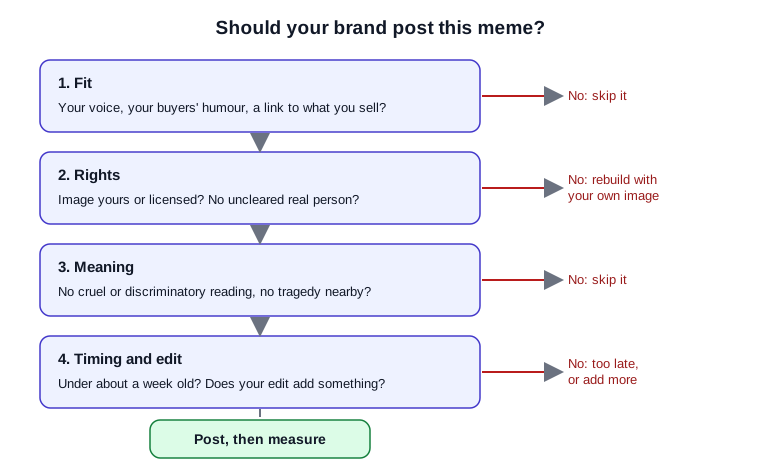
Original decision diagram for this guide; not legal advice.
Original visual by Superdirector editorial team. Creation date not recorded.
Three documented ways memes went wrong
Most meme marketing guides list wins. The losses are more useful, and they are documented.
- A famous face is someone's property. Grumpy Cat Limited sued Grenade Beverage over its use of the cat's image; in January 2018, according to Wikipedia's account, a federal jury in California ordered Grenade to pay $710,000 in damages for copyright and trademark infringement.
- A child in a meme has a parent. In January 2020 Laney Griner, mother of the boy in the Success Kid meme, sent a cease-and-desist letter to Representative Steve King over its use in a fundraising campaign; Wikipedia records that the dispute ended with a jury awarding $750 in damages to Griner. The sum was small; the headlines were not.
- A joke can carry a meaning you did not intend. In September 2018 Sweden's advertising ombudsman found that internet provider Bahnhof had broken rules against gender discrimination with a recruiting ad built on the Distracted Boyfriend meme, as Wikipedia summarises.
The Distracted Boyfriend photo is also a reminder that many meme images are commercial stock. It is a 2015 stock photograph by Spanish photographer Antonio Guillem, who has said it is not allowed to use any image without purchasing the proper license.
Check that the meme fits your voice, buyers and product
The AMA summary puts the test plainly: understand the audience's humour and references, make sure the meme aligns with the brand's voice and values, and keep it relevant to the product or service being marketed. In practice, three quick questions:
- Has your account made jokes like this before? If your normal voice is careful and practical, a chaotic meme reads as someone else's account.
- Have you seen your buyers share this meme? Check the comments on posts in your niche, not your team chat.
- Can you name the buyer situation the joke points at? "Me at 2 a.m. checking if the order shipped" is a buyer situation. "Our logo on a popular image" is not.
If one answer is no, skip it. A missed meme costs nothing; a forced one costs trust. For other ways to stop the scroll, see the pattern interrupt and our hook library.
Find out where the image came from
A meme's popularity does not change who owns the picture. Before you use one, find out what it is built on:
- A photograph: someone took it. It may be stock, like the Distracted Boyfriend image, and need a licence.
- A real person: the right of publicity, as Cornell's Legal Information Institute explains, prevents the unauthorized commercial use of an individual's name, likeness, or other recognizable aspects of one's persona. In the US it is mostly state law, and only about half the states have distinctly recognised it.
- A character or brand: cartoons, film stills and logos belong to their owners. Zoomsphere warns that memes with celebrity images or recognizable brands can backfire without proper licensing.
- Music: on TikTok, businesses cannot use the general music library for commercial usage; use the Commercial Music Library or your own audio.
Parody and commentary can be fair use, but the U.S. Copyright Office says courts evaluate fair use claims on a case-by-case basis, and the first factor they weigh is the purpose and character of the use, including whether the use is of a commercial nature. A brand post is commercial. This is not legal advice. For anything that will run as a paid ad, ask a lawyer first.
Rebuild the format with your own picture and words
The safe and better version is usually the same move: keep the meme's structure and make the picture yourself. A two-panel reaction meme can be two photos of your own product or team. A labelled-image meme can be your own photo with your own labels. An illustrator can draw the format in your brand style.
Instagram's ranking now rewards that. Its originality update of April 30, 2026 extends its reels rules to photos and carousels, and says material edits to third-party content, meme templates included, may be considered original when your additions meaningfully enhance the content. Adding just a border, watermark, subtitles, or a credit in the captions is not enough. As TechCrunch quotes Instagram, an original meme comes from adding humor, social commentary, cultural references, or a relatable take through unique text, creative edits or voiceover.
Post within days and stop once it is everywhere
Ward's study modelled memes on Reddit forums, not brand accounts, but its finding fits what you see in any feed: attention to a meme peaks and fades within one to two weeks, and saturation then leads to less spread. Treat a week from the first time you saw it spreading as the outside limit. That cut-off is our working rule.
Speed needs a process agreed before the meme appears. Sprout Social's guide to memes suggests you outline who needs to be looped in on timely posts and how quickly they reply. For a founder running the account alone, the process is the checklist: if all eight checks pass, post; if not, skip without debate. Sprout's trendjacking guide has examples, such as Popeyes' "pope yes" post on X after the selection of Pope Leo XIV.
Turn the meme into a carousel
A single meme image is one joke. A carousel lets you turn the joke into something useful, which gives people a reason to save and send it. A simple build:
- Cover slide: the meme's setup, recreated with your own image, with a line that names your buyer.
- Slides 2 to 4: the same format applied to three real situations your buyers face.
- Slide 5: the turn: how your product changes one of those situations, shown, not claimed.
- Last slide: one question for the comments that only your buyers can answer.
Keep the slides plain: big text, one idea each, your own images. The joke opens the post; the useful slides are what people save. The viral hooks formula has more cover-line patterns.
Measure it and read the comments
The AMA summary advises managers to track engagement metrics and monitor for any potential backlash. Compare the meme post with your own typical results for the same type of post, then read the comments. Confused replies ("what does this have to do with you?") mean the product link was too weak. Offended replies mean the meaning check failed. Either way, do not repeat the format.
One number to stop repeating: Wyzowl attributes to The NYU Dispatch a claim that traditional marketing graphics have 5% engagement while memes can yield 60% organic engagement, and CodeDesign repeats a version of it without that source. Neither page gives a method, a sample or a date. Measure your own.
The go / no-go checklist holds the eight checks, counts the yeses and records who approved the post.
Where Superdirector fits
Superdirector, which publishes this guide, watches the accounts, competitors, keywords and hashtags you choose on Instagram, TikTok, YouTube and X, picks the formats taking off in your niche and remakes them with the same hook and structure in your brand, with a control for how close the remake stays to the source idea. It never reposts someone's post, footage or audio, and you stay the publisher, so the rights and meaning checks above are still yours. Carousels and X posts are made today, and on the Growth plan it posts Instagram carousels and single X text posts after your first approval or by standing Auto-post; AI video and full autopilot are coming soon. See how it works.