How-To Guide
Check offer-code report detail before promising creator performance payments
Check documented redemption fields and available payment evidence before treating offer-code counts as creator-caused sales or payable commission.
By the Superdirector editorial team.
Giving each creator a different subscription code can make a campaign easier to describe. It does not automatically supply every fact needed to pay a commission on revenue. Before promising performance-based compensation, name the payable event and check whether the report actually measures it.
Apple documents custom-code detail in its Subscription Offer Redemption Report. That is useful evidence for redemptions. It is not a reason to turn a redemption row into an identified customer, a paid renewal or proof that a creator caused an otherwise absent purchase.
Start with the payment question, not a tracking-tool purchase
A founder in RevenueCat's community asks whether several custom codes under one offer can be compared for influencer payouts. The staff reply explicitly lacks firsthand experience with the report and recommends checking actual results. It does not establish that code-level reporting is unavailable.
In a separate iOS founder discussion, the author asks how to give each influencer a coupon code and pay based on purchases through it. Vendor recommendations and old pricing in the replies are not current product evidence. The two questions establish a qualitative founder task, not a recommendation to buy an attribution service.
Write the intended basis in plain language: payment for an accepted creative, a qualified redemption, a first paid transaction, or a share of defined proceeds. These are different arrangements. This guide prepares the evidence question; it does not set compensation, interpret a contract or authorize a payment.
Read the report's actual fields
Apple's Subscription Offer Redemption Report reference documents date, app and subscription identifiers, offer reference name, offer code, territory and redemption count. It defines Offer Code as the custom code created in App Store Connect; the field is blank for one-time-use code redemptions.
This means the documented report has a custom-code field: do not tell a founder that every code is necessarily collapsed into the offer reference name. It also means a blank code field for one-time-use redemptions should not be filled by guessing which recipient redeemed an allocated code.
The listed fields do not identify an individual subscriber or state the creator commission due. Nor does a row contain the revenue history required to calculate an arbitrary percentage-of-proceeds arrangement. Those are limits of this report's documented contents, not a claim that no other authorized data source could supply relevant information.
Reconcile identifiers before comparing creators
For a fictional planning example, suppose one app has an offer reference named autumn-practice and two custom codes assigned to Creator A and Creator B. These names are invented labels, not working codes or a recommendation to create an offer.
Keep a dated mapping of the exact app, subscription, offer reference, custom code and intended placement. Do not join reports on an attractive campaign nickname when the product identifier differs. If the same public code is used in several placements, a redemption count for that code does not separate those placements by itself.
Apple's report-download guide says Sales and Trends reports use Pacific Time and distinguishes next-day performance data from final proceeds in financial reporting. Preserve the report period and its timezone. A creator's local posting day and a report day can describe different time boundaries.
For an authorized review, retain the original exported report and record any filters or aggregation applied. Do not silently combine different subscription products, territories or periods and call the total a like-for-like creator comparison.
When enlarged, scroll horizontally to read the diagram.
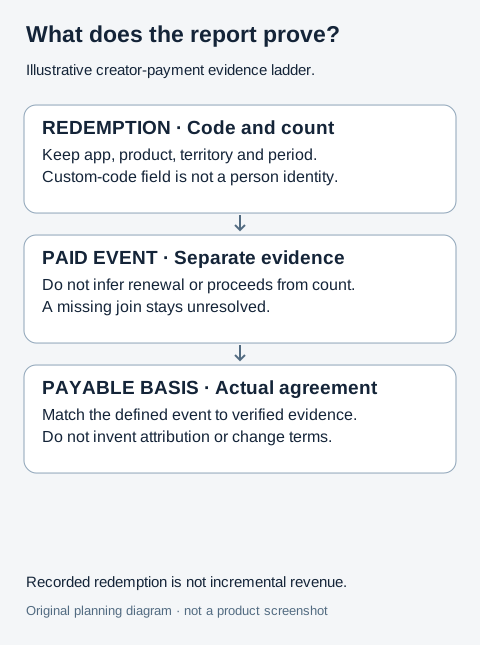
Original report-to-decision model: do not fill missing payment evidence by inference.
Original visual by Superdirector editorial team. Creation date not recorded.
Use a fictional reconciliation to expose the missing fact
Suppose the illustrative report shows 12 redemptions for Creator A's code and 8 for Creator B's code in the same selected period. Those are invented counts, not campaign results. They support only the stated comparison of recorded redemptions under the selected filters.
If the proposed payment is based on first paid renewals, neither 12 nor 8 is yet the payable count. The relevant offer period may not have ended, and this redemption report does not supply that renewal history. If payment is based on proceeds, multiplying redemptions by a displayed subscription price skips the evidence needed for that calculation.
Even a separately verified payment does not prove incremental impact. A public code can be passed beyond its original placement, and an existing prospective buyer can encounter it elsewhere. These are attribution possibilities to consider, not observed leakage in this fictional example. A code labels redemption behavior; it is not a controlled experiment.
Choose a compensation basis you can actually verify
Before making a commitment, have the responsible business owner check the proposed payable event against available evidence. Record:
- The exact event that would count, and any relevant exclusions.
- The source that can verify it and the period it covers.
- The code-to-creator mapping and treatment of shared placements.
- How later corrections, refunds or disputed attribution would be handled under the actual agreement.
- What remains unavailable and who can resolve it.
If the intended basis cannot be observed reliably, hold that performance promise. A different arrangement, such as a separately scoped creative fee, may be considered by the owner; it is not automatically cheaper or appropriate. Do not change an already-agreed payment basis merely because the available report is inconvenient.
No live report, transaction, creator agreement or payout was inspected for this article. Any production purchase or report-access test needs the appropriate authorization. Public documentation can establish field definitions, not validate your account's actual rows.