How-To Guide
Choose an app-acquisition test without mistaking subscriber share for conversion
If most subscribers use iOS but most new users arrive on Android, you do not yet have a reason to put the remaining advertising budget into either platform.
If most subscribers use iOS but most new users arrive on Android, you do not yet have a reason to put the remaining advertising budget into either platform. Those percentages describe the composition of two groups. They do not tell you the probability that an equivalent new user will pay, how much that user costs to acquire, or whether another campaign would create additional buyers.
The useful decision is narrower: which acquisition question can you answer with a bounded, authorized test? You may choose one channel hypothesis, repair the comparison first, or keep the money uncommitted. A forced Apple Ads versus Meta ranking is not the deliverable.
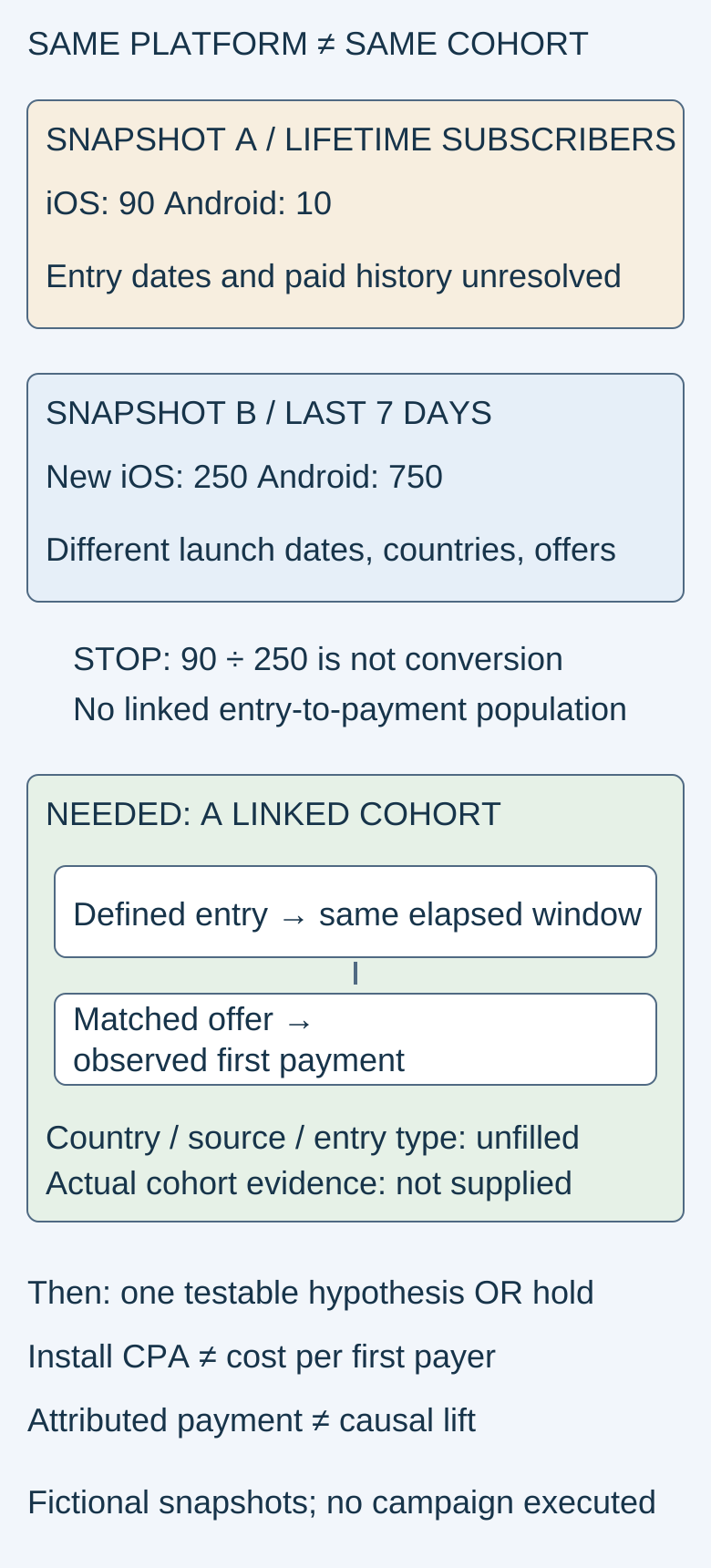
Original planning diagram. The snapshots are fictional, the matched cohort is unfilled, and no channel performance is measured.
 Superdirector
Make it work for your brand
Find it. Remake it. Post it. Superdirector turns the viral formats in your niche into your brand's carousels, X posts and video scripts, and keeps the calendar full.
Start with the decision the money must inform
Write one question before inspecting headline metrics. For a fictional language-practice app, PhraseDeck, it might be: “Can a particular iOS acquisition route bring new users who choose the current paid practice offer?” That differs from asking whether anyone wants the product, whether the onboarding works, or whether the campaign pays back its cost.
An independent founder discussing early Apple Ads results explicitly clarified that they were deciding whether to continue development, rather than validating a business model at that point. That is a legitimate learning objective, but downloads cannot silently become evidence of paid acquisition economics. Define the decision you are actually funding.
Find the denominator mismatch before calculating a rate
Consider an original fictional example, not a campaign result. PhraseDeck's lifetime dashboard shows 90 active iOS subscribers and 10 active Android subscribers. Its most recent seven days show 250 new iOS users and 750 new Android users. Android launched later, reaches a different country mix, and currently has a different free tier.
Dividing 90 by 250 and 10 by 750 would be convenient and wrong. The subscription counts do not identify which recent entrants paid. Existing active subscribers also reflect different amounts of time to subscribe, cancel or renew. The platform comparison bundles acquisition history, offer differences and maturity into one label.
A founder's actual platform-allocation question presents a similar subscriber-share versus new-user-share tension. Its self-reported figures are context, not a verified dataset or a spending recommendation. The fictional numbers above illustrate the missing linkage rather than estimating that founder's conversion.
Build one comparable cohort row
For each candidate comparison, record:
- Entry period and definition: first-time download, new account or another explicitly named event.
- Platform, country and available product version.
- Acquisition source, with unknown sources left unknown.
- Offer, price, free-access scope and eligibility when the person entered.
- A consistent elapsed observation window after entry.
- First paid transaction linked to that entry cohort, with refunds and later subscription states separately recorded.
Do not replace a missing field with a platform stereotype. If iOS users saw a different offer or arrived months earlier, name that difference. Narrow the decision to a comparable subset if one exists; otherwise retain separate descriptive rows instead of inventing an adjusted winner.
An active-subscriber snapshot is still useful for understanding the current business. It simply answers a different question from a new-entry cohort. Mature renewals and repeated useful practice should remain separate observations, not be folded into a single conversion percentage.
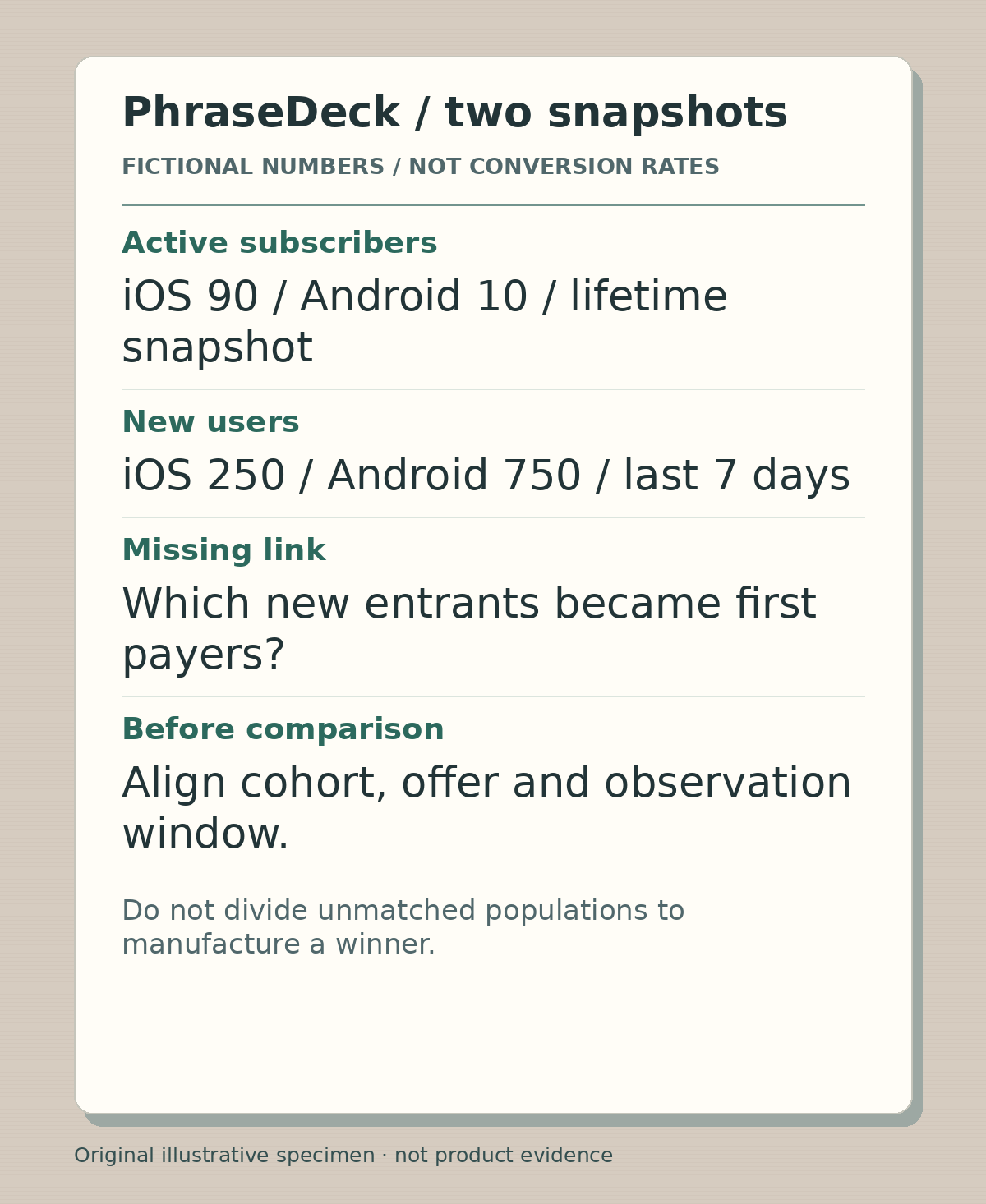
Original specimen using the article’s fictional PhraseDeck figures. The populations cover different periods and are intentionally not divided into conversion rates or used to recommend spending.
Keep install CPA separate from payer economics
Apple's reporting definitions define install CPA using installs, not paying subscribers. Install reporting can include new downloads and redownloads. Its documented tap-through and view-through attribution windows also differ: 30 days and one day respectively. Record which measure and window you used before comparing reports.
For your own decision card, keep media spend, preparation cost, first-time entrants, first payers, refunds and observed proceeds in separate fields. If you calculate cost per first payer, identify the linked payer cohort and the costs included. A media-only figure is not an all-in acquisition cost. When there are no observed payers, report that fact rather than dividing by zero or inventing a forecast.
Do not extrapolate lifetime value from a short observation window. A positive payment is not proof of durable margin, and a platform-attributed payment is not proof that the advertisement caused an incremental purchase. These limitations matter more, not less, when the budget is small.
Compare testability, not platform reputations
In a second fictional planning example, PhraseDeck can consider an iOS-only test. One hypothesis concerns people searching for a specific practice task; another concerns showing that task in a social-feed creative. Keeping the product, storefront, new-user offer and observation window comparable would reduce some differences. It would not make the audiences or delivery systems identical.
Before selecting either hypothesis, ask:
- Is the intended audience eligible to use and buy the current product?
- Can the proposed route and offer be verified without changing the question mid-test?
- Is there a usable way to identify the entrant cohort and observe the decision-relevant result?
- What result would lead to another decision, and what would remain inconclusive?
- What total exposure, end condition and preparation work have actually been authorized?
If only one proposal is ready, that may make it the next testable question. It does not establish the better platform. If neither is ready, repair the missing evidence or hold spending. Splitting a tiny budget equally can produce two ambiguous results rather than a fair comparison.
Translate a budget setting into an exposure boundary
Apple's current budget guidance describes the daily budget as an average, not a hard daily spending cap. It documents a monthly bound based on 30.4 times that daily budget and an aggregate bound for campaigns with an end date. The page also describes changes affecting lifetime-budget campaigns from June 2026. Check the applicable current configuration before treating a setting as your total commitment.
A media budget setting does not include every preparation or measurement expense. Keep those costs in the owner-approved exposure record, and do not assume that a daily amount alone creates the intended stop condition.
This guide does not compare current Meta campaign settings. Before running a Meta test, verify its budget controls, attribution definitions and campaign requirements in current official documentation and the relevant account. That information gap is not evidence that Meta is unsuitable.
Finish with a decision, including an honest hold
Use the blank cohort and testability worksheet to choose one of three outcomes: prepare one bounded hypothesis, repair a specific comparison gap, or hold acquisition spending. State the reason and the next evidence needed in a sentence.
The source discussions are anecdotal and do not establish a universal channel winner. All numerical examples here are fictional. Start by reconciling one real cohort, not by spending to make incompatible percentages look convincing.