How-To Guide
Film a sticker-removal demo that does not quietly promise reuse
Separate sticker removal, surface residue, sticker integrity and reapplication in a demonstration that does not imply untested reuse.
By the Superdirector editorial team.
A sticker peeling cleanly from a surface answers one question: what happened during that removal. It does not establish that the sticker will stick again, remain intact after months of use or leave every surface unchanged.
For a sticker seller, those differences should shape the product video. A buyer decorating a laptop for years is making a different choice from someone repositioning a label immediately after applying it. Show the time and sequence your evidence actually covers rather than compressing all three claims into “removable.”
Separate the buyer's two desired outcomes
In a public sticker-preservation question, a buyer wanted to save meaningful stickers before a possible laptop repair and put them back afterward. The desired result was not merely a clean laptop: it was a usable sticker after removal.
A separate request for reusable, repositionable stickers asked about repeated placement on different surfaces. These are real public questions from separate discussions, not evidence that any particular sticker material can meet the requirements. Do not adopt commenters' removal tricks as tested instructions for a customer's electronics.
The marketing task is to let the buyer distinguish remove from the first surface from successfully attach again before choosing the product.
Read the material's actual claim, not its nickname
Collect the current supplier specification for the exact adhesive and face material you sell. Terms such as permanent, removable and repositionable are not a substitute for the supplier's conditions.
For example, Avery's help on repositionable labels, checked October 26, 2026, describes short-term repositioning for the listed products and says the time to permanence depends on the surface and repositioning. Its separate removable-label residue guidance identifies time adhered and temperature exposure as factors.
Those are facts about Avery's described products, not proof of your sticker stock. They explain why a campaign needs a time condition. Do not borrow a supplier's favorable term while omitting its limits.
Another manufacturer, StickerGiant, states that its own stickers use permanent adhesive and are not reusable after removal. That is a useful counterexample to the assumption that “I can peel it off” means “it is sold for reuse.” It is not a claim that all stickers behave like StickerGiant's.
Define three claims before choosing the shots
Use a separate evidence requirement for each proposed phrase:
| Proposed phrase | Evidence question |
|---|---|
| “Reposition while applying” | Can the stated item be moved during the specified application period under the documented conditions? |
| “Removes after use” | What happens after the stated dwell time on the identified surface, including residue and visible surface change? |
| “Reusable” | Does the removed sticker remain suitable for another stated placement, and for how many observed cycles? |
A single immediate peel cannot approve every row. Nor does a clean surface establish an undamaged sticker. Keep the surface outcome and sticker outcome as separate observations.
Avoid “damage-free anywhere,” “reuse forever” or “no residue ever.” Those claims extend far beyond a short demonstration. If the supplier does not support a proposed use, do not make a customer's valuable device the experiment.
Design a time-aware demonstration
Here is a fictional planning exercise, not a report of a tested adhesive. A seller wants to promote decorative stickers for temporary use on a specified reusable display board. The seller plans three matched samples: immediate repositioning, removal after a stated short interval and removal after a stated longer interval.
Before starting, define the exact material batch, board surface and finish, application method, intended indoor conditions, start time and observation time. Use safe, sacrificial sample surfaces appropriate to the supplier instructions. If the real intended-use period is months away, that result is not yet available. Mark it pending rather than substituting a fresh sample.
For each sample, record:
- Whether the sticker remained attached during the observation period.
- What happened during removal using the supported method.
- Whether residue or visible change remained on the surface.
- Whether the sticker tore, stretched, curled or otherwise changed.
- Whether a later reapplication was actually attempted and observed.
These are observation fields, not predicted results. Do not fill them with plausible successes. If reapplication is outside the product's supported use, stop the claim there rather than presenting an unofficial experiment as an approved feature.
When enlarged, scroll horizontally to read the diagram.
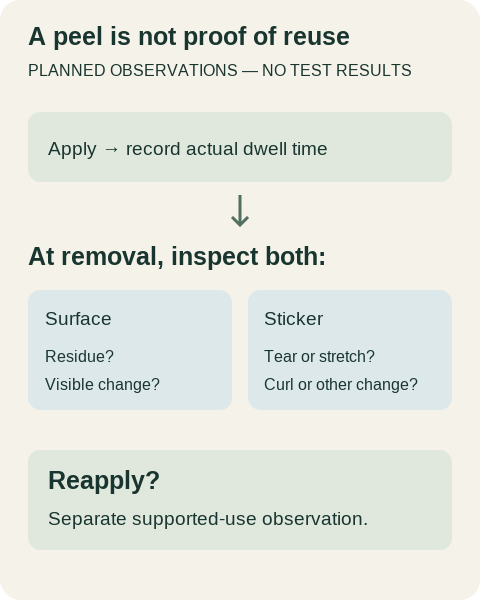
Illustrative demonstration record separates dwell time, the surface after removal, the sticker after removal and any reapplication. It reports no durability test result.
Original visual by Superdirector editorial team. Creation date not recorded.
Make elapsed time visible in the edit
A useful Instagram sequence can show application, the labeled observation interval, removal and the two outcomes: surface condition and sticker condition. A longer YouTube version can explain the sample setup and limitations.
If footage jumps forward in time, label that transition accurately. Do not use a speed ramp or a day/night animation to imply months of exposure that did not occur. Keep the original dated sample record so an editor can distinguish a real later observation from an illustrative timeline.
For a hypothetical observed short-interval result, the caption structure might be: “Sample shown removed after [actual interval] from [identified surface and finish] under [relevant conditions]. Reuse was not tested.” This is a template, not a claim ready to publish with brackets removed. Replace it only with actual documented observations.
If reuse was tested, report the observed scope rather than converting one successful reapplication into unlimited reuse. Show the later placement long enough to support the claim being made; a momentary touch is not proof of lasting attachment.
Do not turn a product demo into unsafe removal advice
The buyer threads contain suggestions involving heat, blades and solvents. This article does not endorse them. A cleaning method suitable for one material may be inappropriate for another device, coating or printed surface.
Your campaign should use the exact supplier-supported application and removal instructions for the product and surface. If the buyer asks how to rescue an unknown old sticker from electronics, direct them to the relevant product or device guidance rather than improvising a universal remedy in a comment.
Likewise, avoid reproducing a customer's sticker artwork or laptop photographs without the necessary permission. An original abstract sample design is enough to demonstrate the decision.
Match the product choice to the demonstrated use
The final CTA should help viewers choose among genuinely available options. If the product is intended to stay put, say so. If it allows initial repositioning but is not sold for repeated reuse, make that distinction visible before purchase. If long-dwell removal remains untested, do not promote the sticker as ideal for a long-term surface-preservation goal.
The useful outcome is a buyer who can tell which promise has evidence. It is not a claimed reduction in complaints or an invented durability result.
To organize the demonstration timeline and claim approvals, see the planning workflow. Keep time, surface outcome and sticker reuse as separate fields so the edit cannot silently turn one successful peel into three unsupported promises.