How-To Guide
Show where a cleaning tool belongs, and where it does not
A cleaning-tool video can create an unsupported promise without saying a word.
A cleaning-tool video can create an unsupported promise without saying a word. A quick montage across a coated pan, an indoor press and an outdoor grill suggests the same tool is suitable for all three. A small disclaimer at the end may not undo the impression created by the footage.
For a seller or creative team, the task is to keep the demonstrated surface within the exact tool's documented scope. Put meaningful exclusions next to the relevant scene. Keep unverified combinations separate from explicitly prohibited ones.
This is an editorial review method, not cleaning, disinfection or appliance-safety instructions. Manufacturer references were checked on October 24, 2026. Follow the current instructions for both the exact tool and the surface or appliance being cleaned.
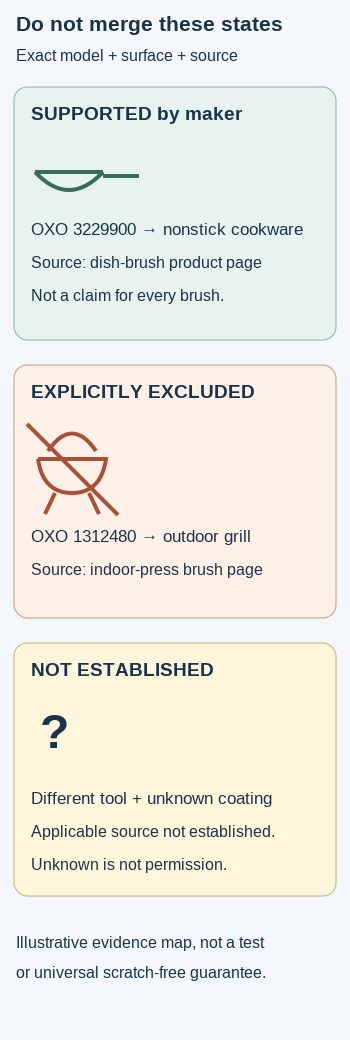
Original evidence-category illustration. Product-specific suitability must come from the relevant manufacturer instructions, not from the icon or its color.
 Superdirector
Make it work for your brand
Find it. Remake it. Post it. Superdirector turns the viral formats in your niche into your brand's carousels, X posts and video scripts, and keeps the calendar full.
Identify the tool before choosing the scene
Record the tool's model, head or attachment, material and applicable manufacturer instructions. A replacement head can matter to the demonstration. Do not assume two similar-looking brushes have the same use and care limits.
Then identify the surface. “Kitchen” is a location, not a compatibility specification. A coating, appliance type or specific material can change which evidence is relevant. If the tool's instructions and the appliance's instructions do not establish the proposed use, leave that scene out until the uncertainty is resolved.
For a real example of model-specific scope, OXO's Steel Dish Brush page identifies SKU 3229900, describes nylon bristles as suitable for nonstick cookware, and lists dishwasher-safe care. Those are the manufacturer's claims for that product, not independent proof that every brush or every technique is safe on every coating. OXO dish-brush reference
Separate supported, excluded and unknown uses
Create three evidence categories before writing the script:
- Supported for the exact model: current manufacturer guidance covers the proposed combination.
- Explicitly excluded: the manufacturer says not to use the tool in that setting.
- Not established: you do not yet have applicable evidence for the combination.
An unknown is not permission. It is also not the same as a documented prohibition. Preserve the distinction so a reviewer can see what needs more evidence and what should be removed outright.
OXO UK's Electric Grill & Panini Press Brush page names indoor cleaning applications and explicitly excludes outdoor grills. That boundary is a useful example of why a category word such as “grill” is too broad for a creative brief. It does not provide a universal temperature limit or permission to clean an operating appliance. OXO indoor-grill brush reference
Place the boundary beside the action
For an illustrative indoor-press brush demonstration, show only a setup permitted by the applicable instructions. Put the indoor-use description near the scene and make the outdoor-grill exclusion visible where the viewer could otherwise generalize it. The example is a script concept, not a report that this demonstration has been performed.
Avoid an exclusion that depends only on sound. Someone watching a silent clip should still understand the scope. Use readable words as well as any symbol. A crossed-out grill silhouette without an accompanying label can be misread as a statement about all grills, or simply missed.
Do not film an excluded use to dramatize damage. The purpose is to explain a boundary, not create an unsafe experiment. An original explanatory graphic can communicate the exclusion without showing the product being misused.
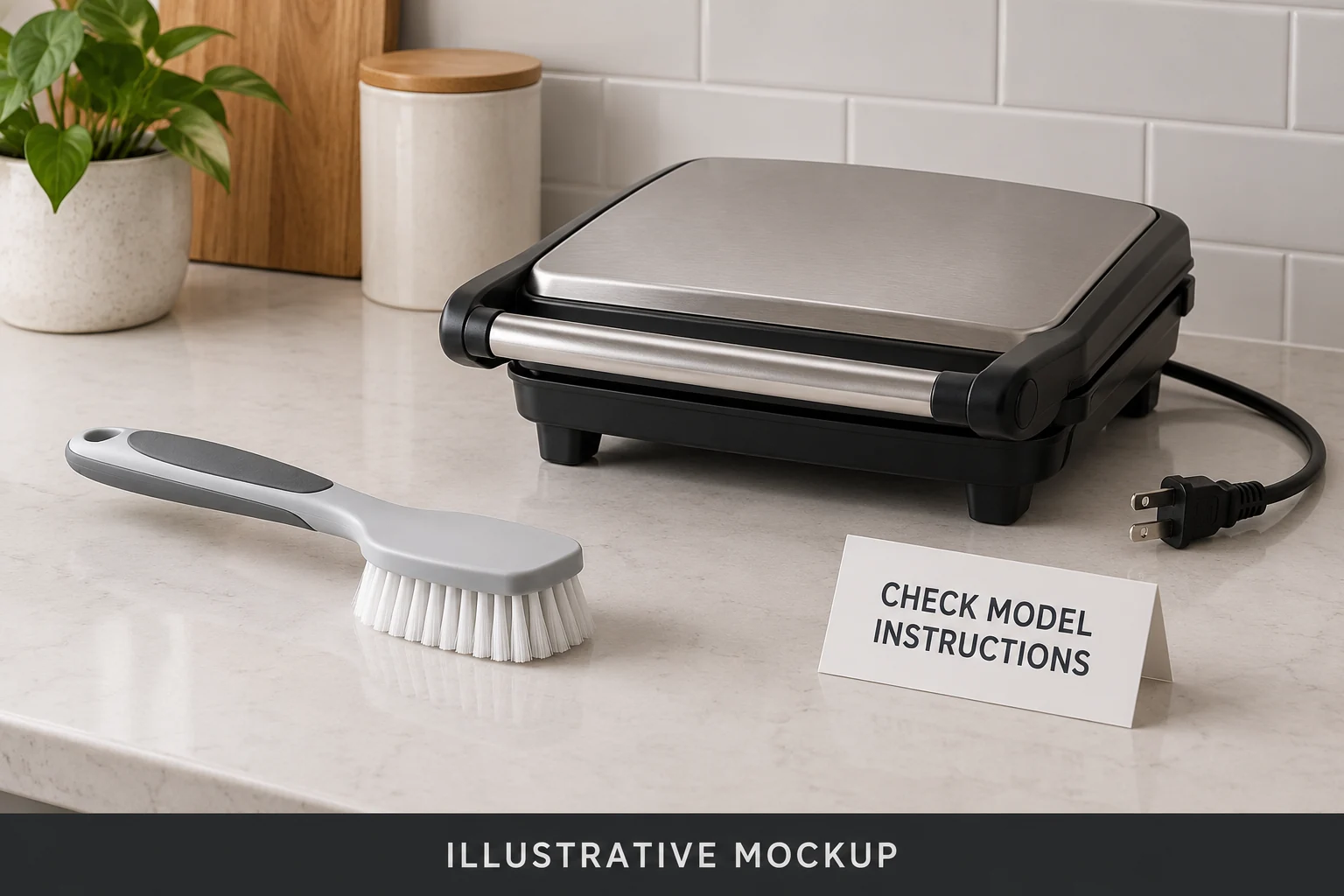
AI-generated illustrative mockup. This is not a compatibility or cleaning test. Tool identity, permitted surfaces, temperature state and care instructions must come from the exact product’s supported guidance.
Keep care instructions separate from surface suitability
A tool's suitability for a surface and the method used to clean the tool afterward are different questions. Do not infer that a brush can go in a dishwasher because the pan it cleans can. Do not infer that a tool's dishwasher-safe claim applies to a different handle, attachment or competing product.
Use the current manufacturer's care instructions for the actual item. If the available page does not establish drying, storage or other details needed for the proposed scene, mark them unresolved. Do not fill the gap with a forum recipe, household chemical mixture or an unverified disinfection claim.
The OXO dish-brush reference photograph clearly shows the handle and head on a plain background. It helps identify the object but does not demonstrate coating compatibility, cleaning effectiveness or care behavior. Keep product identification photographs separate from evidence that an action was performed correctly.
Review what the edit implies
Watch the rough cut once without narration. List every surface or appliance a viewer could reasonably think the tool is intended for. Compare that list with the source-backed scope. Remove unsupported transitions, even when the individual shots look attractive.
Next, compare the caption and thumbnail. “All surfaces,” “scratch-free everywhere” or similar broad claims should not appear merely because one manufacturer's page supports one specific use. A single successful demonstration would not establish every pressure, coating condition or future outcome.
Check that the exact tool remains consistent across shots. A different brush head or another model introduced for a close-up can make the evidence ambiguous. Keep the identifying record with the final export so later revisions do not accidentally reuse a scene outside its original scope.
Make the review useful to the buyer
Ask an unfamiliar reviewer what the tool is shown cleaning, what it is explicitly not for, and where they would find care instructions. If they cannot distinguish an exclusion from an unknown, change the wording or visual hierarchy.
Record the answers as a comprehension check, not a safety certification or proof of reduced returns. Actual product validation, applicable instructions and final-page review remain separate requirements.
The finished creative should help the buyer recognize a bounded use case and avoid an unsupported inference. Until the exact item, scene and final edit have been checked, it remains a draft production plan rather than accepted evidence of product performance.