How-To Guide
Sell a Steam soundtrack as music, not as an unexplained game add-on
Explain the album, delivered formats and listening route without implying a game copy or music reuse license.
By the Superdirector editorial team.
A soundtrack launch should answer a listener's question: what music am I buying, in what form, and how will I get it? Gameplay can explain where a theme came from, but a montage of the game does not establish that the offer delivers downloadable music.
Steam has a dedicated soundtrack application type. Its documentation distinguishes this from older soundtrack DLC and explains that the soundtrack type supports purchase without owning the base game and download without installing it. MP3 files are required; higher-quality formats can be offered through an additional depot. Verify your actual configuration before making any of those promises. Steamworks soundtrack documentation
Two historical listener questions make this distinction concrete. In May 2021, awalton asked what a Steam soundtrack purchase delivers, including formats and whether listening was limited to Steam. In February 2023, instalie asked about buying the Okami soundtrack without rebuying the game, finding the additional-content wording ambiguous. These are separate buyer contexts, not evidence of either product's current configuration or a measured market size.
Decide whether this is a listener campaign or an owner upsell
These audiences can hear the same excerpt but need different context. Someone who already played the game may recognize a location theme. A listener discovering the composer on YouTube may not know the game at all. Do not make that second person decode a gameplay expansion offer to find the album.
Write a listener-facing offer card before editing:
- Release identity: the soundtrack's actual title and credited composer or composers.
- Contents: the verified track list or a clearly stated selection, not an assumed “every sound in the game.”
- Delivered formats: the files actually available in this release.
- Game requirement: the checked ownership and installation requirements for this offer.
- Listening route: the tested way a purchaser locates the downloaded music.
- Rights boundary: what the purchase does and does not say about reuse of the music.
The last field prevents a costly ambiguity. Selling an album is not, by itself, an announcement that purchasers may use it in monetized videos. Do not infer a creator license from the soundtrack's availability. If you want to make a reuse offer, have the rights owner supply its explicit scope and conditions; keep that separate from the listening offer.
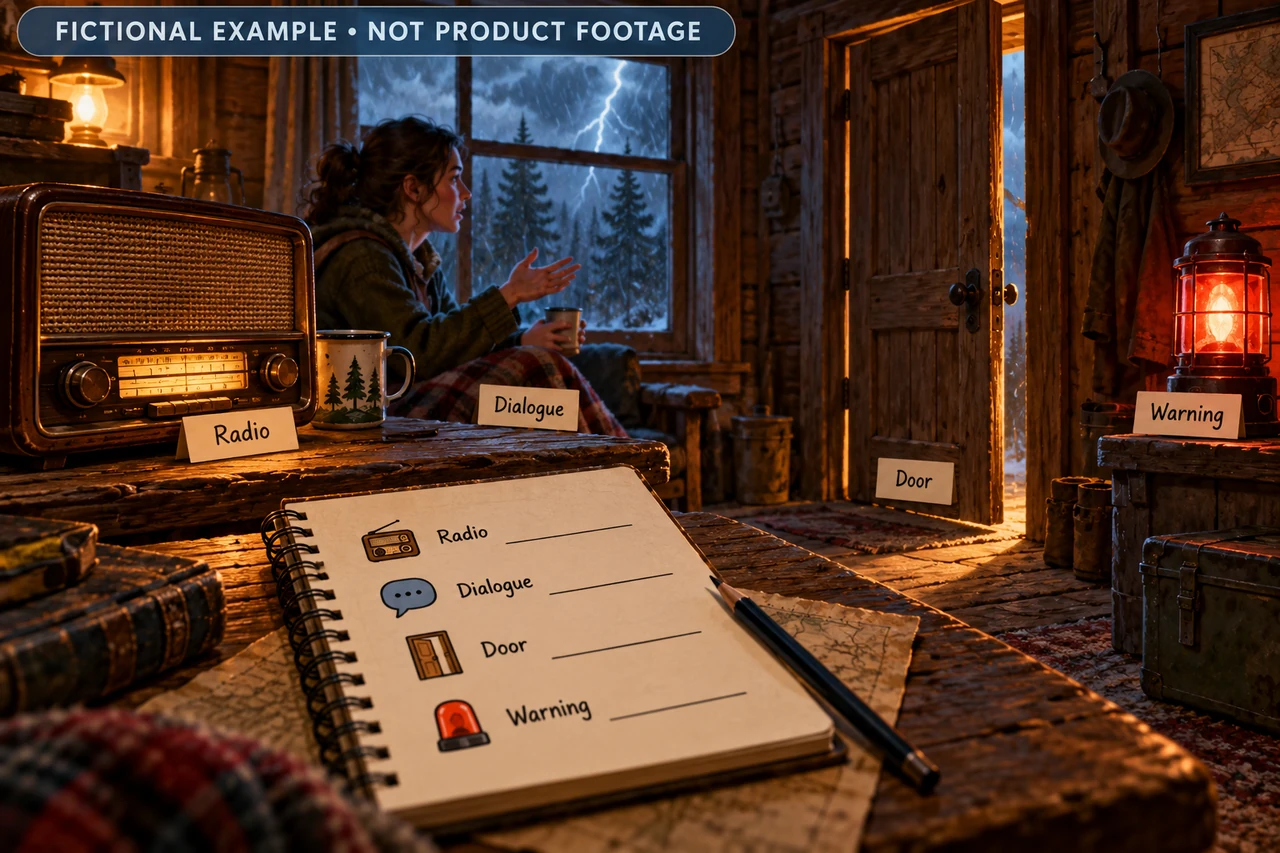
The fictional cabin separates radio music, speech, door effects and a warning. The illustration is an audio-source inventory, not a captured-output test or rights clearance. Original AI-generated editorial illustration. Reused here to illustrate why the album’s music contents must be itemized separately from other game audio.
Original visual by Original editorial illustration generated with OpenAI’s built-in image tool. Created 2026-10-24.
Build a music-first demonstration
For the fictional Lantern Ferry: Original Soundtrack, imagine an album containing the music heard in the harbor and ferry journeys. These are invented product details, not an actual release.
A proposed YouTube segment could begin with the harbor theme playing over accurately credited cover artwork. The narration identifies the instrument or compositional idea listeners can actually hear. A short, clearly contextualized gameplay insert explains the theme's setting. The segment then returns to the album: show the verified track listing, name the delivered formats and demonstrate where the music is found after download.
The game footage is supporting context. It should not make viewers think the soundtrack purchase unlocks a new harbor, a game copy or an interactive music player unless the offer actually includes those things.
For a short Instagram or X edit, choose one audible musical idea rather than compressing the entire album into a rapid medley. Pair it with a readable title and an accurate listening invitation. Keep the full format and retrieval explanation at the checked destination. The proposed edit is a communication choice, not a claim about optimal duration or platform reach.
When enlarged, scroll horizontally to read the diagram.
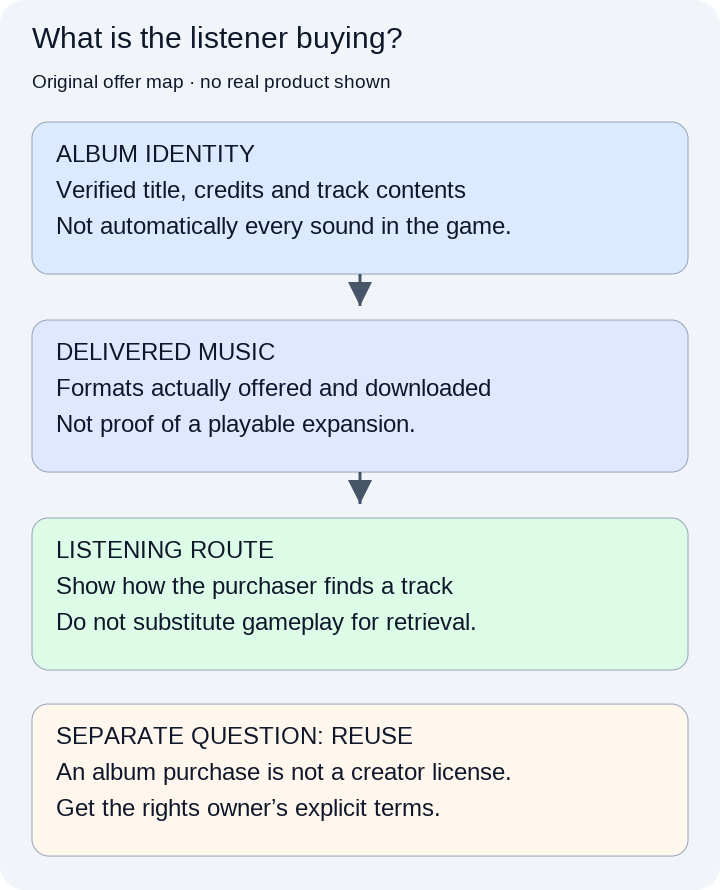
Original offer map. It distinguishes purchasing music from buying playable content or obtaining a reuse license.
Original editorial decision tool, not a product screenshot or measured result.
Original visual by Superdirector editorial team. Creation date not recorded.
Verify the retrieval explanation with the right starting state
Ask the release owner which already-authorized test procedure covers a purchaser who does not own the game. If that state has not been tested, do not stage a clean desktop and label it proof. Record the actual account entitlement, whether the base game is installed, the soundtrack release being inspected and the delivered files. Keep private identifiers out of public footage.
The demonstration should end with an identifiable track playing from the delivered collection, not merely an “installed” status. Compare the track name, credits and format shown in the recording with the offer card. If optional lossless files are advertised, check that specific delivery path rather than inferring it from the MP3 download.
For a project moving from older DLC to the soundtrack application type, treat the migration as a release task, not a copy-editing task. Do not announce the new listening route until the responsible owner confirms the changed offer and delivered build are actually available. A renamed page alone is not proof.
Give collaborators a usable excerpt brief
An excerpt brief should contain the exact approved recording, the permitted segment, the correct music credit, the release identity and the intended destination. Add any written restrictions supplied by the rights owner. “Use anything from the game” is not a substitute for a usable permission record.
Give creators a factual sentence they can adapt: “This is the harbor theme from the soundtrack; the purchase delivers the listed music files.” Keep unverified adjectives such as “complete,” “remastered” and “lossless” out until the release owner confirms their meaning. If the excerpt is a different mix from the sold track, disclose that difference instead of letting the promotional version stand in for the deliverable.
Before approving the campaign, ask an unfamiliar listener what they expect to receive. If they answer “new game levels,” “a Steam game” or “permission to soundtrack my channel,” the offer needs revision. This checks comprehension; it does not predict sales.
Plan the next music-led post
Bring the verified offer card, cleared excerpt and retrieval recording to your content brief. See the planning workflow for turning those references into scripts and shot plans. It does not distribute the soundtrack, clear music rights or test the Steam purchase path.