How-To Guide
Before announcing a Steam Season Pass, map the content you are committing to deliver
Map each Steam Season Pass DLC commitment to available content, release expectations and current roadmap copy.
By the Superdirector editorial team.
A Season Pass announcement is not a mood board for possible future updates. Before a creator describes the offer, identify each included DLC, its promised scope, its delivery window and what the buyer receives now. If those facts are not settled, the content brief should not convert them into a purchase promise.
Valve says Season Pass support is offered only in limited circumstances to partners with an established Steam track record. Its documentation requires a list of included DLC, basic descriptions and expected release dates, and distinguishes these future-content commitments from gameplay-unlocked battle passes. Do not assume a first-time indie project can simply enable the feature. Steamworks Season Pass documentation
Historical buyer questions illustrate the scope problem without establishing any product's current offer. In September 2024, unitedonweb asked whether an Expeditions edition covered future years or only the named year. In November 2024, sirconcept asked whether a Sparking! ZERO edition included all DLC, then specifically asked about future DLC. The replies disagree about some inclusions. A creator brief should therefore use the publisher's verified itemized commitment, not assume that an edition name or 'Season Pass' means everything the game might ever release.
Confirm eligibility before naming the offer
Ask the release owner whether this is an authorized Steam Season Pass, an ordinary bundle of available content or an internal plan for future work. Those are different offers. A promotional label should not decide the underlying purchase structure.
If the project has not established eligibility or the required content commitments, hold Season Pass-specific acquisition copy. You can discuss development plans honestly without implying a saleable entitlement exists. Do not rename an uncertain roadmap “all future DLC” to make it sound more valuable.
This guide concerns the content-to-offer handoff for an eligible product. It does not recommend selling future content, obtain Valve approval or determine financial viability.
When enlarged, scroll horizontally to read the diagram.
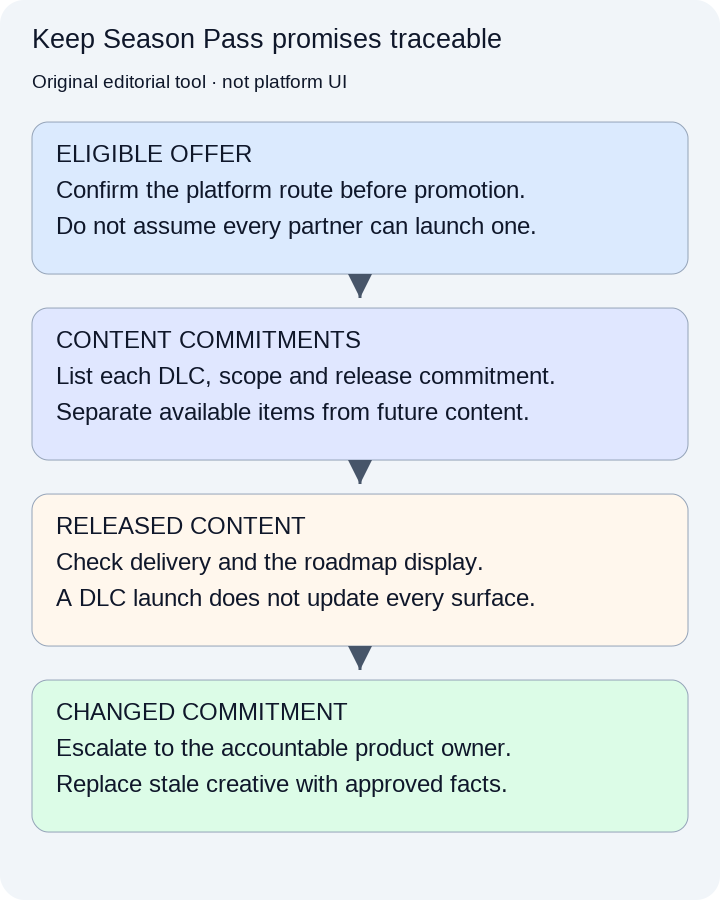
Original editorial decision tool, not platform UI or a measured product result.
Original editorial decision tool, not platform UI or a measured result.
Original visual by Superdirector editorial team. Creation date not recorded.
Make one commitment row per included DLC
For the fictional released game Lantern Ferry, imagine a proposed pass containing additional routes. The teaching example supplies no actual price, delivery date or approved package.
| Commitment field | Question the buyer's explanation must answer |
|---|---|
| Included item | Which named DLC does the pass cover? |
| Basic scope | What kind of playable content is promised? |
| Expected release | What public delivery window has the owner committed to? |
| Current state | Available now, in development or unresolved? |
| Evidence used in the video | Released capture, labeled preview or illustrative concept? |
| Exclusions | Which separately sold or future items are not included? |
Do not use the same footage to imply that every planned route already exists. If a preview is representative of a work-in-progress item, label that limitation beside the relevant material, not only in a closing paragraph.
The purpose of the table is to expose missing commitments. An empty cell is not an invitation for the editor to invent a date or fill the gap with “coming soon.”
Keep available content and future content visibly different
A launch video can have an “available now” segment and a clearly labeled future-content segment. Use the actual state of each item. A rendered title card, a playable internal prototype and a released customer DLC are different evidence.
Valve generally requires at least one released DLC when a Season Pass is offered, with a specific pre-purchase deluxe-edition exception described in its documentation. Have the release owner confirm which arrangement applies; do not extrapolate the exception to any unreleased offer. Steamworks Season Pass documentation
For the fictional route pass, the creator brief should identify the footage's source item and build. If only the base game is captured, say that the video demonstrates the base game while explaining the future offer. Do not let a cinematic montage silently stand in for unreleased gameplay.
Treat the roadmap display as a separate release check
When an included DLC launches, do not assume every surface updates itself. Valve's documentation says the Season Pass roadmap requires an explicit released-state update. It also calls out the need to include the individual DLC in the relevant deluxe package as it releases.
The content team should ask for confirmation of those checks from the authorized owner, then inspect the buyer-facing offer and actual entitlement route. This is not an instruction for an editor to change packages or release content.
Keep three facts separate: the DLC exists for sale, the pass buyer has the intended access, and the roadmap accurately describes availability. A trailer announcement proves none of those configuration outcomes by itself.
Prepare for a changed commitment without inventing reassurance
If a planned delivery window changes, stop reusing the old date until the release owner establishes the allowed next step and approved public wording. Valve describes specific delay and cancellation handling; an editor should not promise a refund amount, automatic eligibility or a new deadline from memory.
Give creators a corrected item-level note: which commitment changed, what is confirmed and where the current official status lives. Do not rewrite the whole offer as though the earlier promise never existed. Keep the previous approved brief in the internal record so the team knows which scheduled assets still contain it.
For YouTube, Instagram and X, separate durable gameplay explanation from date-dependent cards and captions. That makes a correction more precise without implying every repost can be recalled.
Approve the promise, not just the polish
Ask a reviewer to identify what is available today, what is promised later and what is excluded. If they believe the pass includes every future expansion indefinitely, revise the offer before publication unless that is actually the approved commitment.
See the planning workflow to turn verified offer facts into scripts and shot plans. It does not approve Season Pass eligibility, configure entitlements or guarantee delivery of future DLC.