How-To Guide
Is paid Early Access the right next step, or do you need a different kind of feedback?
A playable build creates several possible next steps.
A playable build creates several possible next steps. You might need a small group to test a concept, a representative demo to explain the experience, or paying players who can participate in meaningful ongoing development. Those are different jobs. Choosing a release label before identifying the job can leave both the team and players expecting the wrong thing.
The central Early Access question is not how many months remain. It is whether the current game offers worthwhile usable value, whether community input can influence its development, and whether the team can sustain that work without relying on a hoped-for sales result.
This guide proposes a decision process, not a verdict on a real game or permission to release it. The examples are fictional.
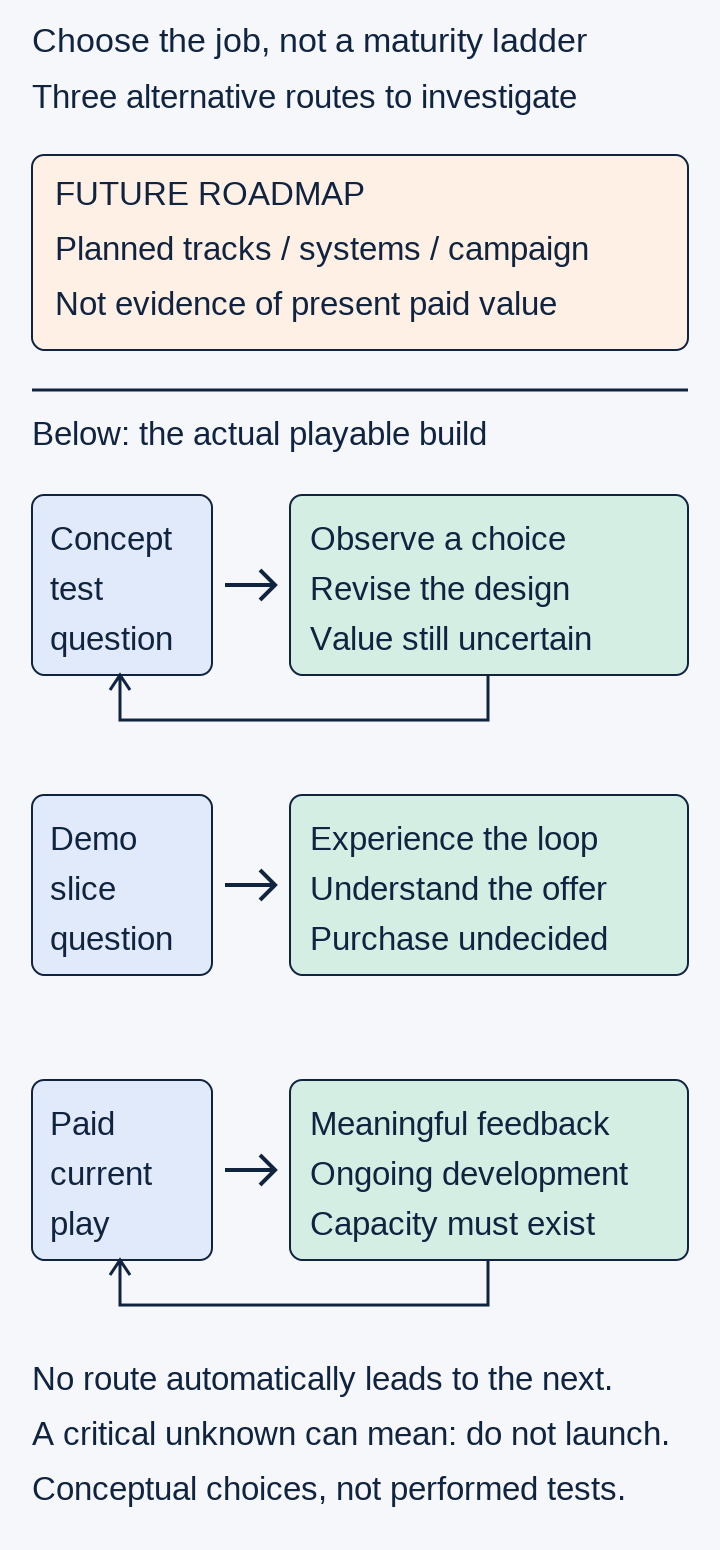
Original decision illustration, not a maturity score or a report of actual player results. No route guarantees demand or sales.
 Superdirector
Have your AI do this for your brand.
7 days free, then $29 a month.
Do not let the calendar substitute for the product
A racing-game developer asked whether to offer a demo or enter Early Access while tracks, cars and interface work remained. In replies, the developer leaned toward a demo and asked about arranging a playtest. That is a reported direction in a discussion, not evidence that any route was released or succeeded. Read the original question and follow-up.
Another developer planning a single-player extraction/survival game asked whether a demo or Early Access would better support feedback. The stated readiness was not independently established, and the replies contain incompatible prescriptions. Read the original developer discussion.
Neither conversation supplies a universal content percentage, minimum playtime or revenue expectation. A team with substantial work remaining could still have a meaningful present game. Another could have polished menus and a trailer but no coherent experience to sell. Inspect the actual build rather than borrowing a stranger's timeline.
Describe the purchase without opening the roadmap
Valve defines Early Access around playable unfinished work whose current value justifies the purchase. It is not a pre-purchase or a way to fund a future-only product. Its rules reject specific guarantees about completion or future additions. Valve also distinguishes a bare concept test from meaningful ongoing development, and says Early Access is not appropriate when development is finished and only final bug testing remains. Read Steam's Early Access guidance.
For the first decision exercise, temporarily set aside planned features. Describe the session someone can have now: the choices available, the consequences they can observe, what brings that session to an endpoint, and the known limitations that affect it. Use the actual build, not a cinematic or a design document.
If that description only becomes appealing after adding promised future systems, you have found a present-value gap. Rewriting the roadmap in a more confident tone does not close it. The next step may be more product work or a narrower research question, not a paid launch.
Consider a fictional racing prototype with one functioning time trial. The designer still does not know which progression structure makes repeated attempts meaningful. The immediate task is to learn about that design choice. Charging for a future collection of tracks would not answer whether the current activity is worth returning to.

A fictional racing prototype keeps the present time-trial activity in view instead of selling imagined future tracks. It does not establish paid-release suitability. Original AI-generated editorial illustration.
Identify a real decision players can influence
Write down one unresolved development decision and explain what observation could change it. “We want feedback” is not specific enough. Would a session reveal whether the resource trade-off makes sense? Whether players can recover from a failed expedition? Whether a new system changes the choices they actually make?
Then identify what is not open for decision. Community input is not a promise to implement every request. A clear boundary helps the team listen without presenting a feature vote as a commitment.
For a fictional survival game, assume the current build already supports a coherent expedition and return loop. The team is still evaluating how resource scarcity changes route choice. That could be a meaningful development question. It does not, by itself, establish that the game is suitable for paid Early Access: present value, support capacity and the actual release requirements still need evidence.
By contrast, if all gameplay decisions are closed and the only remaining task is to find crashes before an otherwise finished release, name that task accurately. Calling it community-shaped development would create a different expectation from the work you intend to do.
Choose the feedback route for its purpose
Steam Playtest provides a separate associated application and control over testing access. It can support a focused investigation without treating that test as the main game's paid release. The platform feature does not choose the research question or verify the build for you. Read the Playtest overview.
A demo serves another purpose: a representative free slice can help a prospective player understand the experience. Valve leaves the decision to offer one to the developer. Do not choose it on the false assumption that demos cannot receive reviews; an optional separate demo store page supports user reviews. Read the demo guidance.
These routes are not mandatory steps on a ladder. A focused test does not automatically graduate into a demo, and a demo does not automatically justify selling unfinished work. Keeping the project unlaunched while resolving a critical unknown is also a legitimate decision.
Test whether the team can support the decision
Valve explicitly asks teams to consider what happens if sales do not meet the number they are relying on to finish development. Treat that as a planning question to answer from real resources, not an invitation to invent a forecast.
List the work created by the proposed route as well as the remaining game work. Someone must inspect reports, decide which findings affect development, communicate material limitations and maintain the playable experience. If the same person performs all of those tasks, they still compete for time.
Keep confirmed capacity separate from a hoped-for publisher, a future hire or anticipated sales. If a necessary resource is unresolved, record the dependency and identify what bounded work can proceed without it. Do not promise an update frequency that the team has not assessed simply because regular updates sound reassuring.
Finish with a route decision and the evidence still missing
Create a short decision record containing the current playable value, the development question, the proposed audience, the team capacity and the critical unknown. Attach the exact build and the observations used, not just a checkbox saying the game is ready.
For the racing example, that record might call for a focused concept test before any paid-release decision. For the survival example, it might identify Early Access as a candidate route while holding release until current-value and support evidence are sufficient. Both are preparation decisions, not launch approvals.
After the next authorized test, separate what players did, what they said, what the team changed and whether anyone paid. A useful design finding is not a purchase commitment. A payment is not proof that every promised future feature can be delivered. Revisit the route when evidence changes rather than using the initial label to justify every later choice.
Frequently asked questions
Is there a universal percentage of finished content that makes paid Early Access appropriate?
SuperdirectorHave your AI do this for your brand.
7 days free, then $29 a month.