How-To Guide
Before crowdfunding your indie game, draw the promise you can actually support
A campaign can make an unfinished game sound like a finished plan.
A campaign can make an unfinished game sound like a finished plan. The trailer shows the exciting part, the reward list expands, and optional features begin to look essential. Before asking anyone to back that plan, separate the creative outcome you are proposing from the work needed to deliver every reward and the audience you hope will appear.
The useful question is not simply “demo first or campaign first?” It is: what exactly would we be asking people to support, and does that proposal still make sense without hoped-for overfunding?
This is a preparation exercise for an unreleased indie game. It does not set a funding amount, assess a real project's finances or authorize a campaign. The examples below are fictional.
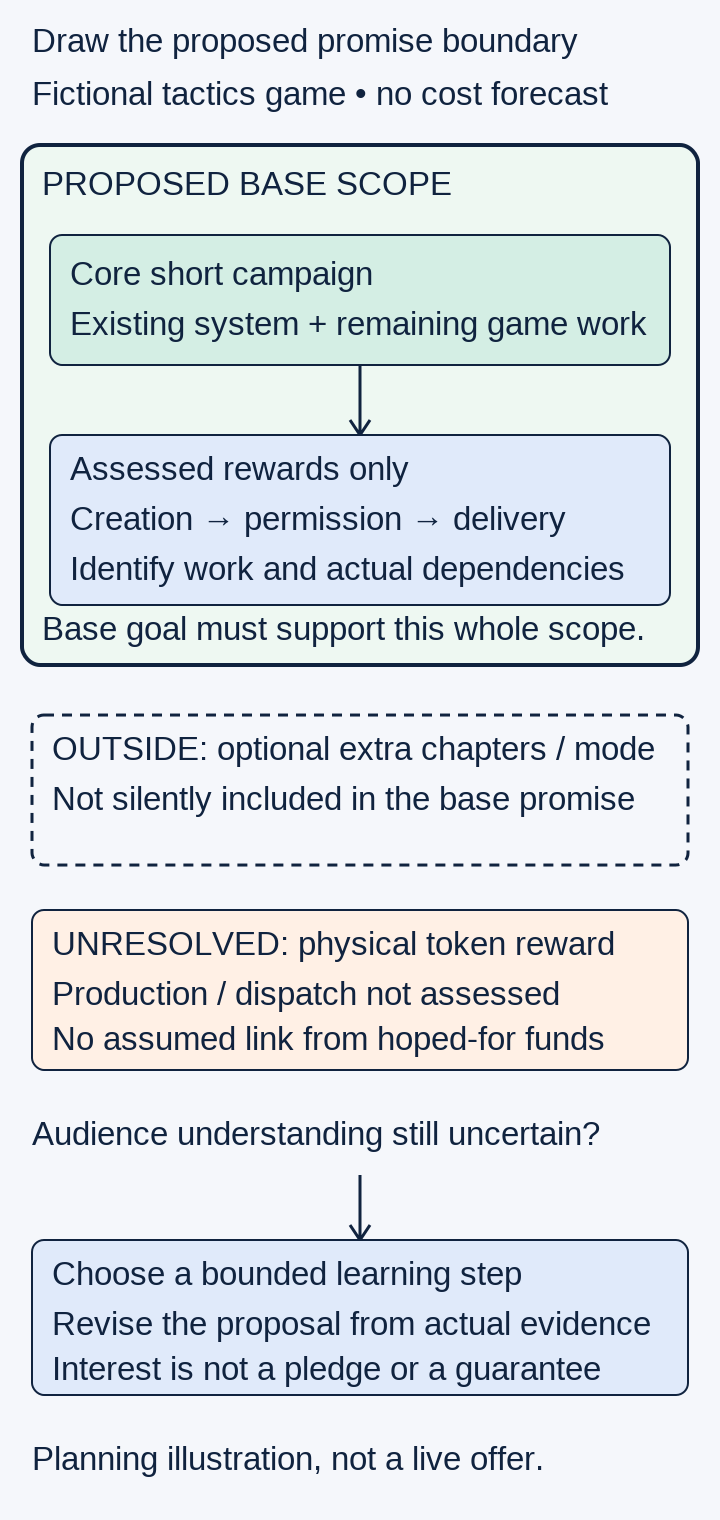
Original planning illustration. The boundary is hypothetical, not a campaign offer, cost estimate or promise of delivery.
 Superdirector
Make it work for your brand
Find it. Remake it. Post it. Superdirector turns the viral formats in your niche into your brand's carousels, X posts and video scripts, and keeps the calendar full.
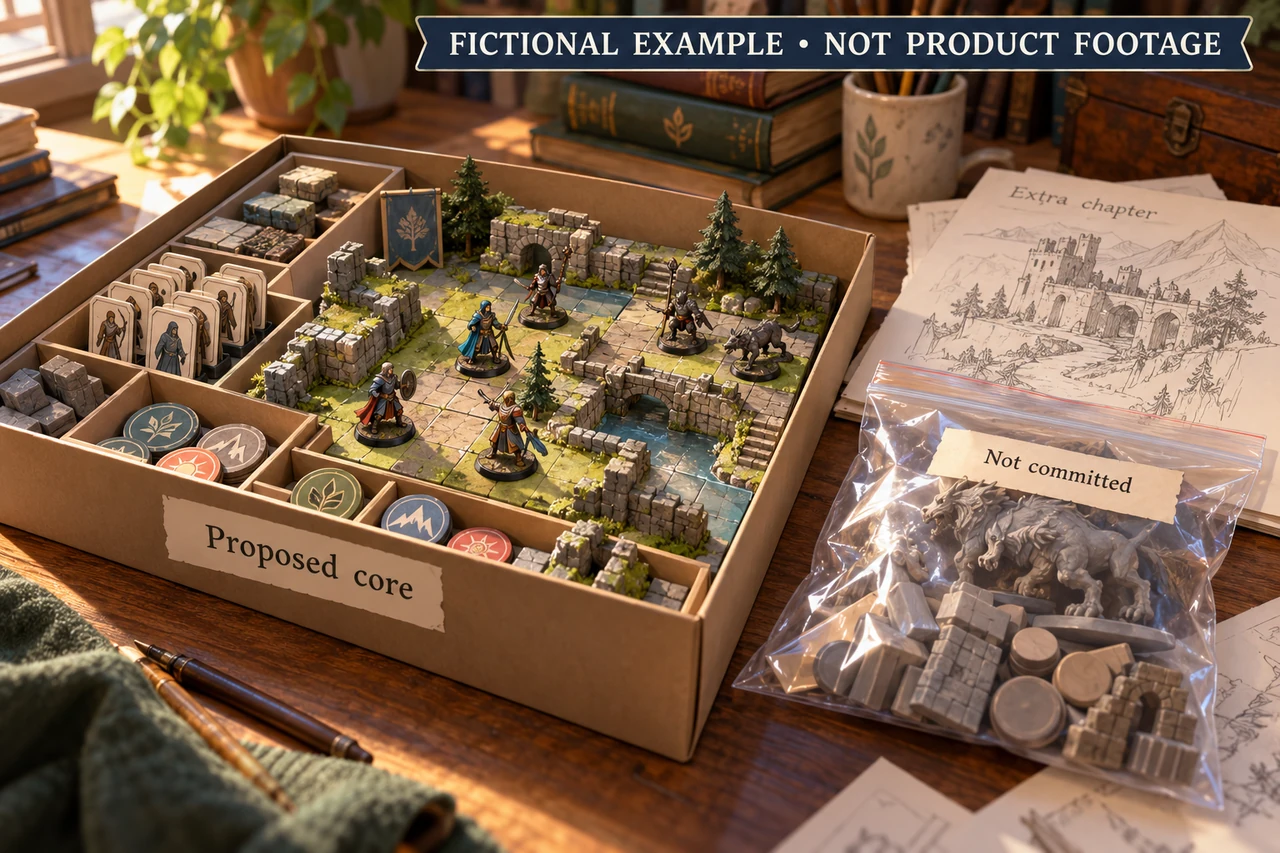
A fictional tactics proposal separates the core campaign from an unassessed physical reward and extra chapter. It is planning artwork, not a launched campaign or commitment. Original AI-generated editorial illustration.
Connect each proposed reward to work someone must do
A reward is not just a label attached to a pledge level. Ask what must exist for the recipient to receive and use it. Who creates it? What approvals or dependencies remain? How will delivery be handled? Which parts are still unknown?
Apply those questions to digital rewards as well as physical ones. A soundtrack needs an actual production and delivery plan; an art book is not complete because concept art exists. Do not assume that a collaborator's enthusiasm establishes permission or a commitment to provide material.
In the fictional tactics project, suppose the team also considers a physical token set. Manufacturing and dispatch have not been investigated. The useful planning change is to remove that unprepared reward from the proposal or resolve its dependencies before making an offer. It is not to draw an arrow from “extra funding” to “everything will work out.” This example concerns an unpublished proposal, not changing promises already made to backers.
Kickstarter's goal guide asks whether the project and all rewards can be fulfilled at the stated goal, without additional funds. It includes production and fulfillment needs and says the goal and deadline cannot be changed after launch. Use the underlying completeness question, not another creator's figures or a deliberately inadequate target chosen for an impressive funded badge. Read the platform's goal guidance.
Give the demo a specific learning job
A representative playable can help people understand the experience. It cannot tell you, by itself, how many of them will back a campaign or whether a reward plan is deliverable.
In one historical developer discussion, Gigaquests asked whether a demo or Kickstarter should come first while describing no existing community and a desire for additional resources. The replies include confident prescriptions, but the conversation does not demonstrate which sequence succeeded. It also contains advice to make the game appear less complete. Reject that approach: show the actual state and describe the real work remaining. Read the original sequencing question.
Consider a second fictional team with a representative playable but no clear account of whom the proposed campaign serves. Before deciding on a campaign, it can choose a bounded learning question: do prospective players understand the central decision, and which missing element prevents them from understanding the proposed experience? That question may inform the product and its explanation. It is not a disguised request to predict pledges.
Record what would change the proposal. If every possible answer leads to the same feature list and launch decision, the activity is not doing much decision work. Conversely, do not require a demo merely to satisfy a universal checklist. Choose evidence that addresses the actual uncertainty and the applicable platform requirements.
Do not confuse visibility with a dependable audience
A separate developer, Entropy_Games, asked about preparation and community building, then described desirable production improvements and acknowledged that long-term marketing results were not yet known. That is useful operator context, not proof of return or a requirement to purchase ads. Its relative date conflicts with the search metadata, so it should not be presented as a precisely dated current trend. Read the developer's discussion and qualifications.
Keep a record of the evidence you actually have: people who saw a demonstration, people who tried it, people who asked about the proposed outcome and people who explicitly expressed interest in a campaign. These are different observations. None is automatically a pledge, and no follower count supplies a guaranteed conversion rate.
For the second fictional team, a useful result might be that people understand the combat but mistake optional chapters for the base game. Correcting that explanation is progress. It does not establish that the audience can fund the proposal. If the team still cannot identify who the offer is for or what the base outcome includes, further learning remains a legitimate route rather than a failed campaign launch.
Make the next decision smaller than launching
Finish the preparation session with one bounded action. Resolve an unassessed reward dependency, revise the base scope, test a confusing demonstration, or document the evidence still missing from the audience assumption. Name an owner and the observation that would let the team reconsider its decision.
Do not treat a live campaign as an informal form whose promises can be rewritten whenever the plan changes. Kickstarter's all-or-nothing explanation distinguishes creative risk from ordinary purchasing and calls for communicating material changes or delays. Its model does not guarantee that a funded project will be delivered. Read the platform's explanation.
Track preparation, an authorized campaign launch, pledges, collected funds, game completion and reward delivery separately. An appealing proposal is not a funded project. Funding is not finished production. The purpose of the scope drawing is to expose those differences before public promises make them harder to correct.