How-To Guide
Show statement-earring weight without promising all-day comfort
Label statement-earring measurements by ear, components and unit without turning a pair total into a comfort guarantee.
By the Superdirector editorial team.
A large earring can look heavy in a close-up. Calling it “lightweight” may not answer the buyer's question, especially when the listing does not say whether its weight refers to one earring or the pair.
For a handmade-jewelry seller, a useful product video makes the measurement interpretable: the exact design, one earring at a time, its wearable components and the unit. It does not turn a scale reading into a promise that every buyer will find the earrings comfortable.
Answer the question buyers actually ask
A public buyer discussion about lightweight chandelier earrings asks for statement designs that do not feel too heavy. Separately, in a maker discussion about resin earrings, a commenter described being asked about the weight of large earrings and weighing pairs.
These are distinct public discussions, not a survey or proof that weight explains a shop's sales. They identify a narrower content opportunity: help a buyer interpret the physical item rather than relying on appearance or an undefined adjective.
Do not reuse the threads' health-related anecdotes as medical guidance or product claims. This guide is about describing a product measurement, not diagnosing discomfort or establishing a safe wearing weight.
Define what goes on the scale
Choose the actual finished variation shown in the campaign. A different charm, backing or material option may be a different item for measurement purposes.
Record the measurement object in plain language:
- One finished earring, including the attached hook or post.
- The separate backing, included or excluded as stated.
- The other earring measured separately where relevant.
- No packaging, display card or shipping box in a wearable-item measurement.
If you also show a pair total, label it explicitly. Do not divide the pair total and present the result as two individually measured earrings. A handmade or intentionally asymmetric pair may not have matching readings. A calculated average is not a measurement of each piece.
A statement such as “3.2 g each” needs evidence for that scope. If only one sample was measured, identify it as the sample shown rather than quietly extending its value to every handmade unit.
Check whether your equipment supports the claim
Follow the scale manufacturer's instructions for setup, checking and use. Do not add decimal places in an overlay that the measurement does not support. If the instrument cannot reliably measure an object this small, obtain a suitable measurement instead of presenting a near-zero display as proof of weightlessness.
The distinction matters: METTLER TOLEDO's precision-balance guidance, checked October 26, 2026, explains that minimum accurately measurable weight is not the same as display readability. That manufacturer guidance is not a certification of your scale or a requirement to buy laboratory equipment. It is a reason not to equate extra displayed digits with a trustworthy measurement.
For your own evidence record, keep the instrument identifier, preparation/check procedure, sample identity, included components, observed reading and date. If repeated readings are inconsistent, resolve the measurement problem before filming a definitive number. Do not select only the lowest reading because it makes a better hook.
Film the unit, not just the number
A simple continuous sequence can answer most of the ambiguity:
- Show the finished earring and identify its variation.
- Show which backing will be included in the measurement.
- Show the prepared scale and place that one wearable set on it.
- Let the reading settle according to the instrument's instructions.
- Frame both the object and display clearly enough to connect them.
- Label the unit and scope: one earring, with or without the specified backing.
Repeat for the second earring if making a claim about both. A cut is not inherently misleading, but do not cut between different variants or swap a lighter component into the measurement shot without saying so.
Keep a measurement shot readable in the final mobile crop. A large overlay can summarize the observed result, but it should not replace the underlying evidence or obscure the object on the pan.
When enlarged, scroll horizontally to read the diagram.
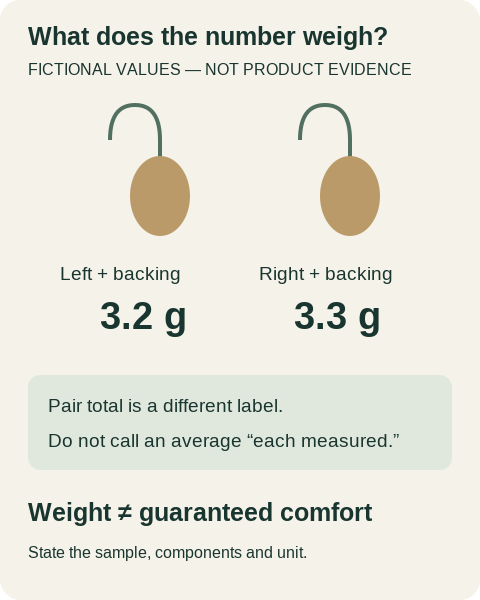
Fictional measurements distinguish individual earrings with their backings from a pair total. No universal comfort or tested production result is claimed.
Original visual by Superdirector editorial team. Creation date not recorded.
Use fictional numbers only to plan the explanation
Here is a fictional example of a clear caption structure—not a measurement of an actual product:
Sample shown: left earring 3.2 g, right earring 3.3 g, each including its supplied backing. These figures describe the measured pair; comfort is personal.
The example tells the reader what was measured and avoids rounding two different pieces into a false identical result. Replace every number and component description with your actual evidence before using the structure in a campaign.
If the shop sells several options, show separate measured examples or clearly scope the campaign to one. Do not place a reading for the smallest design over a montage of larger designs. Likewise, a clip showing a creator wearing the earrings is a demonstration of appearance, not evidence that all customers can wear them for the same duration.
Help buyers compare without prescribing a comfort threshold
A buyer who already knows the weight of a pair they like may find a clearly scoped measurement useful. That does not make equal weight equivalent comfort. The campaign should not claim that grams alone capture fit, shape, movement, backing preference or the person's experience.
Avoid universal statements such as “anything under this number is comfortable,” “safe for sensitive ears,” or “will not stretch your lobes.” A measured product weight does not support those claims. Material composition and any substantiated allergy-related statement are separate evidence questions, not benefits established by the scale footage.
A stronger closing line is factual: “See the weight and dimensions for the exact option shown.” It invites an informed comparison without promising a bodily outcome. Ensure the landing page actually contains those details and distinguishes wearable weight from any packaged shipping weight.
Review the thumbnail, caption and listing together
Use this final check before the Reel or Short goes live:
| Surface | Check |
|---|---|
| Thumbnail | Does “lightweight” have a clear factual explanation nearby rather than a universal comfort promise? |
| Measurement clip | Can the viewer identify one earring versus two and the included backing? |
| Overlay | Does the number match the observed unit, precision and variation? |
| Caption | Is the sample scope clear, with no invented wear-duration claim? |
| Listing | Does the promoted option contain matching information? |
When the hardware or design changes, remeasure the relevant item before reusing the old number. Keep earlier footage attached to its original version so an attractive asset does not become inaccurate through reuse.
The outcome to aim for is a buyer who understands what the measurement means. Do not claim fewer returns or increased sales unless the shop has actually measured those outcomes with an appropriate comparison.
To organize the demonstration, wording and evidence in a creative brief, see the planning workflow. A precise product fact is more useful than a confident comfort promise the footage cannot prove.