How-To Guide
Show natural-material variation without promising the hero piece in every order
A close-up of one beautiful bead can help a maker imagine a project.
By the Superdirector editorial team.
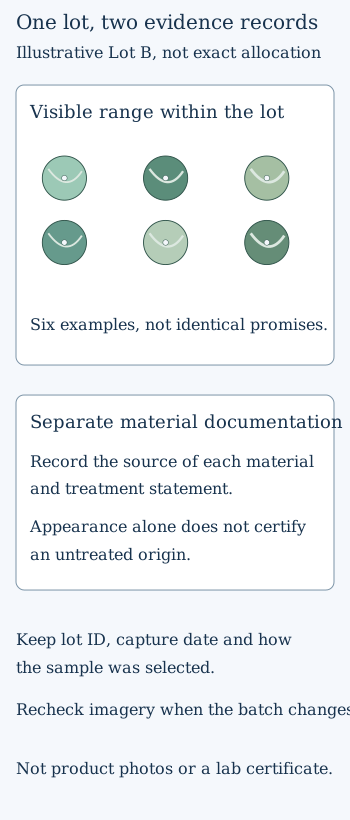
The diagram is a planning model, not a product photograph or material certificate. Actual samples and records must replace the illustrative shapes in customer-facing evidence.
 Superdirector
Make it work for your brand
Find it. Remake it. Post it. Superdirector turns the viral formats in your niche into your brand's carousels, X posts and video scripts, and keeps the calendar full.
A close-up of one beautiful bead can help a maker imagine a project. It can also create a mistaken expectation that every piece in a pack will have the same color and pattern. The solution is not to hide the attractive example. It is to show what that image represents and what the buyer can reasonably expect from the actual lot.
For a natural-material seller, the useful creative asset is a lot-specific range view paired with a clear allocation statement. Keep visible variation separate from claims about material identity, origin or treatment. A camera records appearance; it does not perform gemological testing.
This guide proposes an editorial workflow, not an appraisal, authenticity certificate or tested commercial result. Sources were checked on October 24, 2026.
Separate the questions a buyer is asking
There are at least three questions inside “Will it look like the photo?” First, is the pictured object the exact piece being sold? Second, if it is representative, what visible range does the current lot contain? Third, what evidence supports the stated material and treatment description?
Answering one does not answer the others. A photograph of six different beads may demonstrate differences between those six pieces. It does not establish that the entire shipment has been sampled adequately or that the stones are untreated.
Likewise, a supplier's material statement may be relevant to the description without showing the range a maker will encounter in a particular pack. Preserve both records rather than letting the most attractive image stand in for all the evidence.
Use scientific and merchant references for different purposes
GIA's introduction to gem treatments, by Robert Weldon, explains that treatments can alter appearance and durability and may be difficult to identify visually. This supports a narrow caution: do not infer untreated status from an appealing pattern or irregular color.
JNS Beads' help center provides a merchant example that distinguishes treatment categories and describes its photographs as representative of a batch, with variation between pieces. That is the merchant's own explanation, not independent verification of its inventory or a rule governing all suppliers.
Together, the references suggest two separate fields in the production brief: visible range and documented material information. Neither supplies evidence for the seller's actual lot. Obtain that evidence before making the corresponding claim.
Give the photographed lot an identity
For an illustrative bead lot, label the working record “Lot B” and note its receipt date, supplier reference and product identifier. These are fictional planning labels here, not records of an actual purchase.
Record how examples were chosen. Selecting only the palest or most symmetrical pieces will tell a different story from selecting across the tray. If the purpose is to show a range, include examples that reveal the observed variation rather than only those that suit the brand's color palette.
Do not call a small editorial sample statistically representative unless you have a suitable sampling basis. A practical caption can explain that the image shows selected examples from the identified lot. The internal record should say what was inspected and what remains unknown.
Keep the comparison conditions stable
Photograph the examples together under one setup where possible. Keep background, exposure, scale reference and camera angle consistent enough that differences are not mainly produced by the shoot.
If a piece is turned to show another surface, label that as another view of the same example rather than implying it is an additional item. Avoid using color grading to make separate pieces appear more uniform. If a screen cannot communicate a subtle feature reliably, describe the limitation rather than promising an exact screen-to-object match.
For a wood-slice pack, the same method can show light, dark and strongly patterned examples beside a scale reference. That is an illustrative transfer of the workflow, not a claim that every wood product has a particular range.
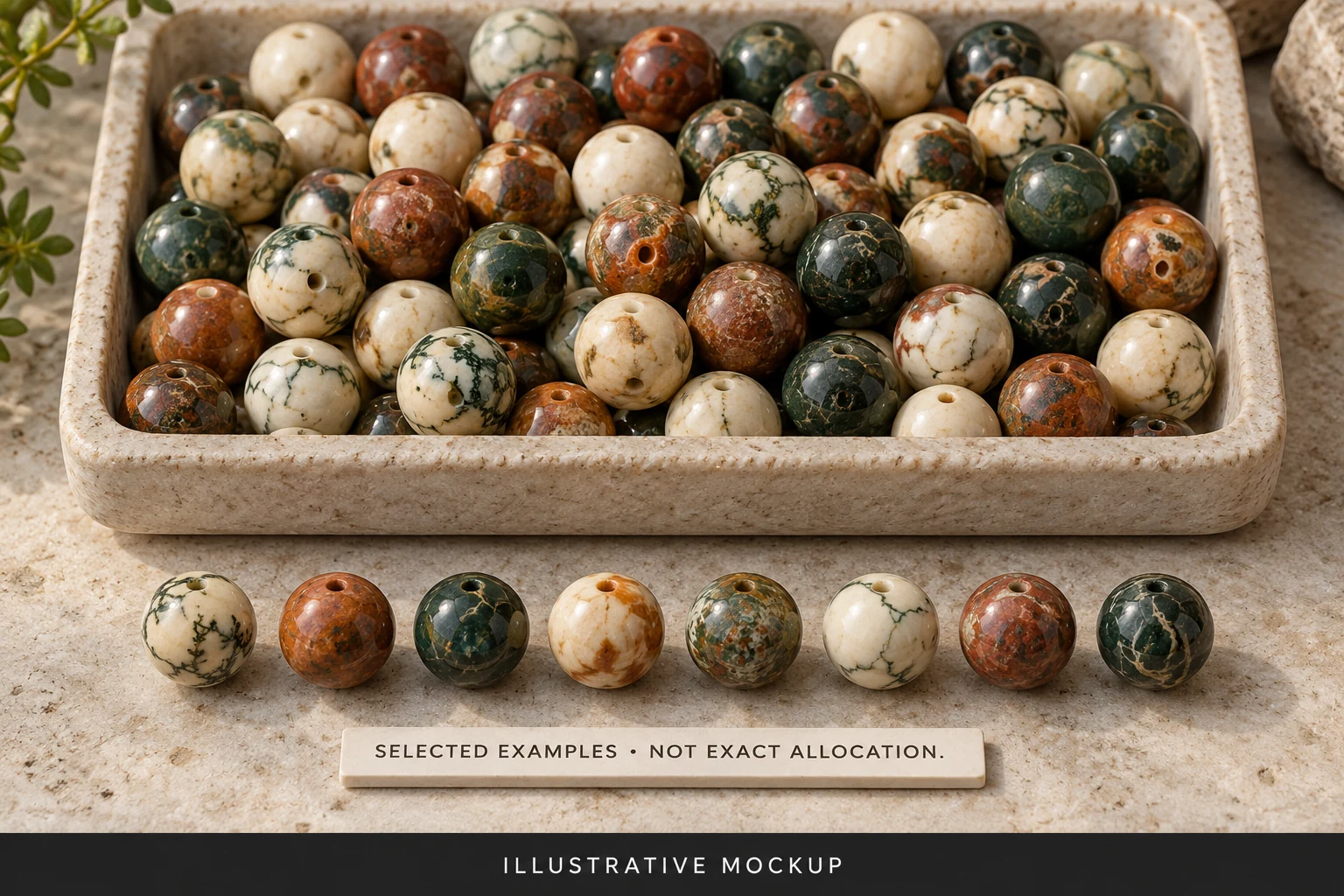
AI-generated illustrative mockup. The generated beads demonstrate how to show visible variation. They are not an inspected material lot, a representative statistical sample, a certificate or an exact order allocation.
Say whether buyers receive the pictured pieces
Use one of two evidence-backed approaches. If the exact piece is sold individually, connect its identifier and photographs to the selectable item. If the image represents a pack or lot, state that it shows examples rather than the exact allocation for every order.
Do not mix the two models in the carousel. A caption saying “examples vary” can be undermined by a selection graphic that appears to let the buyer choose the hero stone. Conversely, do not make an exact-piece listing seem random if the buyer really is choosing the photographed item.
Give the creator a claim boundary
The production brief should include the lot identifier, photo meaning, observed range, permitted material wording and the source of that wording. Mark unsupported phrases explicitly, including “identical,” “untreated” or “exactly as shown” when the necessary evidence is absent.
A useful short video starts with the group view, moves to selected differences and returns to the pack or selection process. A styled project can follow, but it should not imply that every customer receives the same pattern distribution as the demonstration project.
Ask the editor to preserve factual labels across the website, Instagram carousel and tutorial caption. The attractive crop should not become detached from the representative-image explanation when reused in another channel.
Refresh evidence when the lot changes
Compare the next lot with the existing creative before automatically reusing it. If its visible range differs, update the examples and description. Keep prior assets linked to the old lot rather than overwriting the record of what an earlier buyer saw.
A reviewer should be able to explain whether the pictured pieces are exact or representative and identify which material claims come from documentation rather than the photograph. This is a proposed test, not a completed practitioner review.
Build one real lot card and determine which statements its inspected samples and documentation can support. Update the creative when the lot or allocation method changes.