How-To Guide
Sell a replacement bottle cap by complete fit, not by “wide mouth” alone
Help replacement-cap buyers check the exact bottle model, closure evidence and tether fit rather than relying on wide-mouth wording.
By the Superdirector editorial team.
A replacement-cap video often ends when the lid screws onto a bottle. That can leave the most important buying question unanswered: does the exact cap work as the complete closure the buyer expects, including its seal, tether and intended use?
For an accessory seller, a useful compatibility demonstration begins with the bottle model, not the attractive cap color. “Fits wide-mouth bottles” is too broad when products sharing that description use different caps.
Listen for the part the buyer is trying to preserve
In a public older N-Gen bottle discussion, an owner wanted a replacement lid rather than discarding the bottle. Their later account distinguished a cap that appeared to hold water from a retaining ring that did not attach as intended. That is a self-reported adaptation, not manufacturer confirmation of compatibility, and it is not a modification to recommend here.
A separate cap-interchangeability discussion includes a buyer asking about the lid strap on a different bottle. The answer again separates closure fit from tether fit. The thread's photograph and individual claims are not a verified compatibility chart.
These two conversations justify a more useful sales demonstration: distinguish the functions the buyer needs instead of treating the first successful twist as the end of the test. They do not prove demand volume or authorize a universal claim about older bottles.
Use the manufacturer's exact model scope
Current product pages illustrate why naming matters. Nalgene's 16oz Wide Mouth Cap page, checked October 26, 2026, lists a 53mm cap and identifies its fit as 16oz wide-mouth bottles only. Its separate Wide Mouth Cap page lists a 63mm cap and names 32oz and 48oz wide-mouth bottles in the description, with additional models in its specifications.
The useful lesson is not a new cross-brand diameter rule. It is that a shared phrase such as “wide mouth” does not identify one interchangeable part. A nominal diameter is also not, by itself, proof of thread, seal or tether compatibility.
Those are the manufacturer's statements for its named products. They do not establish that an unrelated aftermarket cap, an unidentified old bottle or a modified retaining ring will perform the same way. Where the documented scope ends, mark the answer unknown rather than filling the gap with a forum anecdote.
Build a complete-fit selection record
A cap seller's record should separate these fields:
| Field | Why it changes the purchase decision |
|---|---|
| Bottle brand, exact model and size | Similar-looking bottles can require different parts |
| Cap product identity and revision, if relevant | An old demonstration may show a different assembly |
| Manufacturer-supported bottle list | Defines the documented starting scope |
| Closure and seal arrangement | Screwing on is not the same as establishing the claimed seal |
| Tether or retaining-ring fit | Buyers may expect the lid to remain attached |
| Included components | A cap, gasket, tether or adapter may be a separate item |
| Unsupported or unidentified models | Gives the buyer a reason to ask before ordering |
This is not a certification checklist. Use manufacturer instructions and evidence appropriate to the actual product and claim. Do not improvise pressure, heat or chemical tests. Claims about hot liquids, carbonation, carrying loads or other specialized uses require their own explicit support and are outside this ordinary replacement-cap example.
Film the identification before the installation
A useful short sequence can show the bottle's identifying features, the exact packaged replacement part and the relevant manufacturer-supported model information before the installation. Do not rely on the viewer recognizing a bottle from its color.
If the model cannot be identified, say so. “Looks like the one in the video” is not a good basis for expanding the compatibility claim. A seller can ask for the minimum relevant product information through a private support route, without asking a buyer to expose an address, receipt or unrelated personal details in public comments.
During the demonstration, keep the bottle and cap identifiable across cuts. Show the components included in the offer. If the cap is sold without a gasket or another required part, make that purchasing dependency clear before the call to action—not only in a caption below the fold.
Show the tether as a separate decision
A fictional demonstration plan might have three checkpoints:
- Documented match: identify the exact bottle and replacement part.
- Closure evidence: show installation and only the observations supported by the actual demonstration and instructions.
- Complete assembly: show how the tether attaches, or clearly state that this combination has no supported tether attachment.
No product testing has been performed for this example. The point is to stop one result from silently standing in for another. A cap shown closing should not imply that the retaining ring fits, that the bottle can be carried by that ring or that every orientation and use is covered.
When enlarged, scroll horizontally to read the diagram.
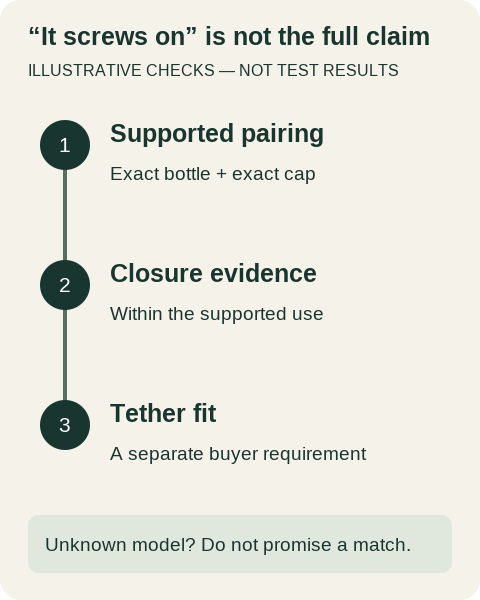
Original planning diagram, not an engineering drawing or a tested compatibility result.
Original visual by Superdirector editorial team. Creation date not recorded.
For a buyer who specifically wants an attached lid, a tether limitation can change the decision even if the closure itself is supported. Put that limitation in the buying explanation, not in a post-purchase troubleshooting reply.
Review the selection outcome
Have someone unfamiliar with the product answer: Which bottle is this for? What is included? Does the tether fit? Which combinations remain unknown? Could an owner of the smaller wide-mouth bottle mistakenly buy the larger cap from this creative?
That review addresses a paid-part selection problem, not merely where to find a manual or how to claim a warranty. See the planning workflow to keep the supported-model record, component footage and approved compatibility wording together before promoting the replacement part.