How-To Guide
Explain a recurring Game Center leaderboard without erasing last week's score
Keep a recurring Game Center competition period, previous score and social invitation distinct.
“New leaderboard” can mean a new competition period, not that a player's old result never existed. Before promoting a recurring Game Center leaderboard, explain which occurrence is active, when a score belongs to it and what the player can still inspect afterward. Keep the social caption and the in-game explanation consistent.
Apple describes recurring leaderboards as successive occurrences with a duration and a restart interval; the interval can leave a gap between occurrences. Its documentation also distinguishes the current occurrence from the most recent previous occurrence in which a player submitted a score. Do not describe every recurring board as a continuous weekly reset unless that is your actual configuration. Apple's recurring-leaderboard guide
The history question has a practical counterpart. A developer asked in January 2022 what a player would see after missing several weekly periods. Separately, a Bullpen player asked about a daily boundary shifting around daylight-saving time. Those questions concern different parts of the same explanation: which period a score belongs to and what previous result remains visible. They do not establish a universal reset time or a permanent history archive.
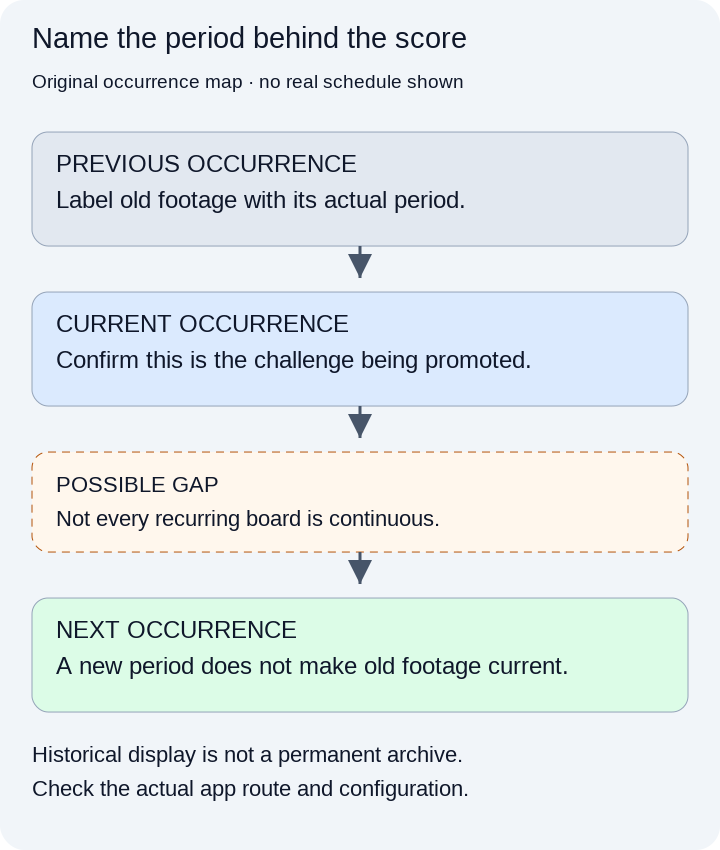
Original editorial decision tool. It is not a platform screenshot or a measured product result.
 Superdirector
Have your AI do this for your brand.
7 days free, then $29 a month.
Name the competition, not just the reset
A creator challenge needs a recognizable unit of comparison. For the fictional iPhone game Cloud Orchard, imagine a recurring orchard run. The campaign invites players to compare scores from the current run period. The example does not specify a real schedule or claim that a Game Center integration has been tested.
Write a period card with the leaderboard's public name, the current occurrence's start and end, the display time zone, the score rule and any gap before the next occurrence. Ask the implementation owner which of those facts the app can show accurately. The content team should not invent a countdown from an editorial calendar.
If the game offers different modes or difficulty settings, identify which one submits to the promoted board. “Beat my score” is misleading when the creator's visible run and the audience's available run are not comparable.
Treat the boundary as a player journey
Inspect three moments: while an occurrence is active, near its end and after it has ended. The purpose is not to manipulate device time or reset production leaderboards. Use the team's authorized development and test procedures, with the implementation owner handling platform-specific controls.
At each moment, ask what a player sees before starting a run and after finishing it. A run that starts near a boundary is an especially useful question to take to engineering: which occurrence receives the score under this implementation, and what does the player learn if submission does not produce the expected result? Do not assume the answer from the time the video was recorded.
Record the observed occurrence and result separately from the intended behavior. If the timing remains unresolved, avoid a campaign that encourages last-second attempts. The missing evidence is a release decision, not a reason to hide the boundary in smaller text.
Keep current rank and previous result distinct
A social post can remain visible after the competition it describes has ended. Label a captured result with its actual period rather than saying “number one” without context. If you have not verified the comparison population and the relevant board, use a plain score description instead of a ranking claim.
In the fictional Cloud Orchard campaign, an older creator clip might say: “My result from the previous orchard run; the current competition is now open.” That is different from presenting the old score as today's target. Use that wording only when the current competition really is available and the game supports the described route.
If players can inspect a previous result, explain that route as observed. Do not promise a permanent archive. A historical score screen is not proof that every past occurrence remains available, and the developer's retained data may differ from what the player-facing interface exposes.
Build two captions before launch
Prepare an active-period caption and an expired-period caption. The active version names the current task and its end condition. The expired version preserves the clip's meaning without inviting a player into a competition that has closed.
| Creative element | During the promoted occurrence | After it ends |
|---|---|---|
| Score label | Name the actual occurrence. | Keep the historical period visible. |
| Invitation | State the available challenge accurately. | Point to the verified current task, or say it ended. |
| Countdown | Use only a checked, maintainable display. | Remove or replace it where you control the asset. |
| Rank claim | Match the observed board and time. | Do not silently carry it into the new period. |
This is an original editorial maintenance plan, not a platform requirement. Some video elements cannot be changed after publication. If a time-bound overlay would rapidly become misleading, choose a more durable explanation before export.
Review the announcement with a newcomer
Ask an unfamiliar reviewer to answer four questions from the proposed post and the actual app: which competition am I joining, what score counts, when does it end, and what happens to the result afterward? Record the exact app version and creative shown. A wrong answer identifies a communication or product-path problem; it does not prove the recurring feature improves retention.
Keep promotional participation separate from platform testing. Apple provides development tools for inspecting recurring behavior, but a simulated reset is not evidence that an actual public competition ran successfully.
See the planning workflow to turn the verified period card and representative play into social scripts. It does not configure Game Center, validate score submission or certify leaderboard fairness.
Frequently asked questions
Can a previous score be promoted as today’s rank?
SuperdirectorHave your AI do this for your brand.
7 days free, then $29 a month.