How-To Guide
Make a daily-puzzle result worth sending to a friend
A good reason to use it comes from the game and the relationship between players.
A share button is a transport option. A good reason to use it comes from the game and the relationship between players. Before adding another prompt to your daily puzzle, ask what a friend could understand, attempt or compare after receiving the result.
The useful design problem is not how to make every player advertise for you. It is how to offer an optional challenge that preserves the interesting part of the puzzle and leads to a real playable task. Some players will prefer to keep their result private. Others may take a screenshot without using your controls. Neither behavior is automatically a defect.
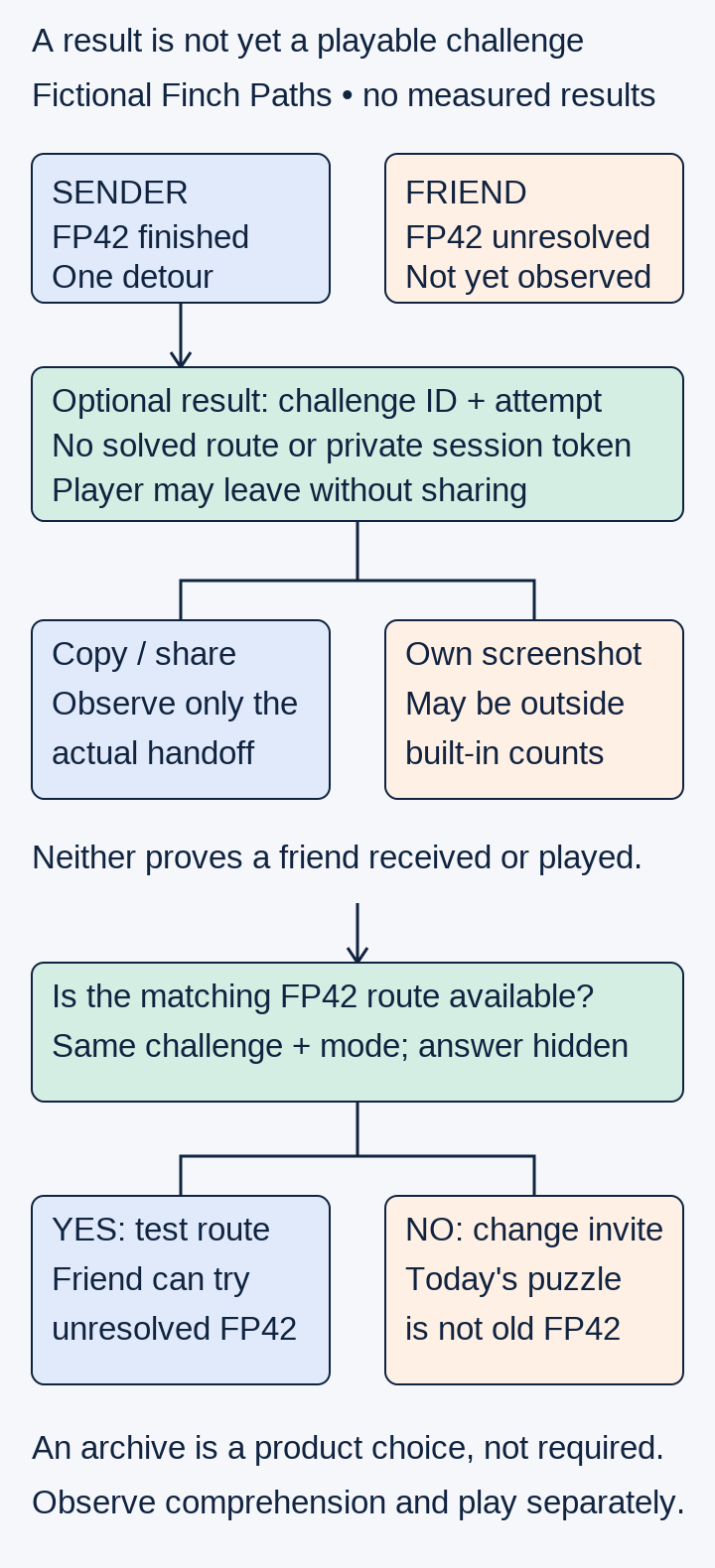
Original challenge-handoff model. The game, identifier and result are illustrative; no message, recipient session or acquisition outcome has been measured.
 Superdirector
Make it work for your brand
Find it. Remake it. Post it. Superdirector turns the viral formats in your niche into your brand's carousels, X posts and video scripts, and keeps the calendar full.
Start with the recipient's next move
Imagine a fictional daily maze game, Finch Paths. One player finishes challenge FP42 with a detour. A result that says only “Great job!” gives their friend little to respond to. A result that identifies FP42 and the attempt's detour count can invite a comparison, provided the friend can actually play that challenge.
This does not require revealing the route through the maze. The shared object can describe the attempt while leaving the solution unresolved. Whether detours are meaningful depends on the actual rules: do not invent a performance dimension merely because it produces an attractive card.
Write the recipient's task in ordinary language: “Try this same maze and compare your route choices.” Then inspect every part of that sentence. Is it the same maze? Are route choices genuinely comparable? Can a new player begin without being shown the answer? If not, change the invitation before polishing the design.
An operator of a daily logic puzzle asked why players were not using the share prompt. Later in the discussion, the author clarified that the shared text intentionally omitted the URL and that their measurement counted button presses, not completed sharing. Those details identify questions worth investigating. They do not prove that one missing link caused the reported behavior, or that changing it would create growth.
Preserve the challenge, not just the score
Daily games have a special handoff problem: the sender and recipient may arrive on different days. A message identifying yesterday's challenge is not a promise that yesterday's challenge remains playable.
For Finch Paths, consider two different product designs. If the game genuinely supports an archive, the result may identify FP42 and offer its tested archive route. If the game only serves the current daily puzzle, the message should lead honestly to that experience. It should not claim the friend will face FP42 after the daily change.
This is a product choice, not a universal argument for building an archive. Keeping only today's puzzle may be intentional. In that case, decide whether the social object is a record of the sender's experience, an invitation to today's game, or a same-puzzle challenge during a limited period. Do not quietly switch among those meanings.
The same check applies to difficulty and assisted modes. A result from a practice mode with hints is not necessarily comparable with an unassisted daily attempt. Name the relevant mode when it matters, without making the card a wall of technical metadata.
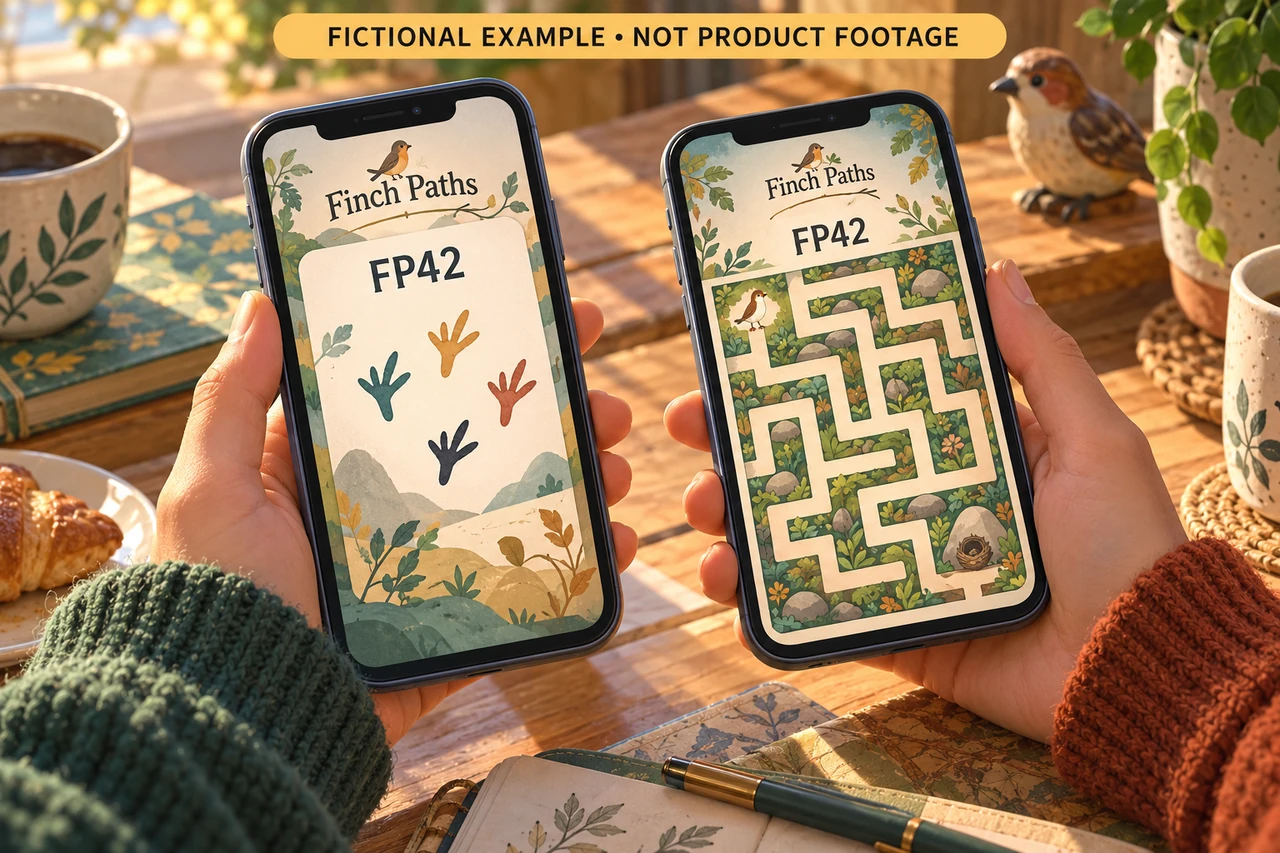
The fictional Finch Paths card preserves challenge identity without displaying the solution. No message delivery, matching archive route or recipient play is verified. Original AI-generated editorial illustration.
Make the attempt recognizable without exposing the answer
A useful result can carry something particular about the player's experience: an attempted path, a sequence of successes and setbacks, or an optional personal comment. The designer must determine what can be shown without reconstructing the solution. A decorative grid is not automatically spoiler-safe.
For the fictional maze, do not export the full solved route and then call it a challenge. A small summary of detours might preserve the task better, but it still needs review against the actual puzzle. For a deduction game, even a list of eliminated possibilities could reveal too much.
Avoid unsupported rank claims such as “top 1%.” A percentile needs a defined comparison population and an appropriate calculation. A descriptive result does not need a fabricated hierarchy to be interesting.
Also inspect the payload for information the player did not intend to share. A public result need not contain an account identifier, private session token or hidden answer. A link that works for the sender may depend on their session; test the recipient's actual route rather than exposing that session to make the link work.
Give players a choice of transport
A player might want to copy text, use the device's share interface, or simply take a screenshot. Offer suitable options without making sharing a gate to the next puzzle or requesting unnecessary access to contacts.
The Web Share API documentation explains that available targets depend on the device. The feature has limited browser availability and requires a secure context. Its completion signal also differs: on Windows the promise resolves when the popup launches, while on Android it resolves after data passes to the chosen target. Neither means a friend read the result or started playing. Cancellation is a legitimate outcome, not a reason to keep reopening the prompt.
A copy option has a different boundary. Clipboard writeText documentation describes success as updating the system clipboard; writing may also be disallowed. “Copied” should therefore mean copied, not sent. If a supported operation fails, explain it without claiming success or instructing players to weaken browser protections.
These implementation details support the invitation. They do not supply its social value.
Keep the claim within the evidence
Separate an observed button press, copied payload, native handoff and recipient play. Leave unobserved steps unknown. A player who screenshots and messages a friend may never appear in your built-in sharing count; do not add invasive tracking merely to force that behavior into a dashboard.
Your first deliverable is one truthful, optional challenge object and a tested recipient task. Later, with suitable measurement and enough context, you can investigate whether it contributes to acquisition or repeat play. A working share route, a compelling example and even a recipient's successful attempt do not establish a viral loop.