How-To Guide
Adding Steam achievements: what should you tell players with existing saves?
“Your save still works” and “your old actions unlock the new achievements” are different promises. Before announcing an achievement update, check each…
By the Superdirector editorial team.
“Your save still works” and “your old actions unlock the new achievements” are different promises. Before announcing an achievement update, check each condition against the history the game actually retains, then test what the new build does with that history.
The answer may differ across achievements. A record of visited locations might support one condition. A challenge requiring a particular sequence, difficulty or absence of an item may need evidence the older build never stored. Neither case justifies telling everyone to reset their progress.
Start with the player's question
A player in the RV There Yet community described earning achievements for later checkpoints while earlier completed checkpoints remained missing. The moderator response visible in that discussion did not confirm a retroactive solution. That is a concrete example of uncertainty the announcement should address, not evidence of the game's current implementation. Player's retroactive-achievement question
A separate developer account describes organizing existing achievements into Steam's newer sets. It is useful adjacent evidence that developers are revisiting achievement presentation, but it does not prove that grouping achievements reconstructs historical gameplay. Do not borrow that author's reported setup time as your own delivery estimate. Developer's achievement-set account
Your release note should answer a narrower question: for this named achievement, this older save and this update, what is supported and what must the player do?
Make one evidence row per condition
Avoid a single checkbox saying “retroactive achievements supported.” Instead record:
- The exact achievement condition in player language.
- What relevant history the older build retained.
- The save/build pair used for the check.
- The event that makes the new build evaluate the condition.
- The observed in-game result and platform result, separately.
- Any limitation, unresolved case or supported next action.
If a condition changed between versions, write down the difference before using an old record as proof. A new label can sound similar while requiring a materially different action.
Example one: history that may support the condition
In a fictional exploration game, a retained save lists the lighthouses the player visited. The team adds a Cartographer achievement for visiting a specific set of those locations.
The stored list is relevant evidence. It is not, by itself, proof that the new build checks the list correctly or successfully updates the platform. Test a preserved copy of the older save with known qualifying locations, observe the evaluation trigger, and inspect the result. Also test a copy missing one required location so the condition is not accidentally awarded too broadly.
An illustrative release-note structure would identify the achievement, the supported older-save range and the verified evaluation trigger. Leave those fields unresolved until the actual build provides evidence; do not substitute the fictional example for testing.
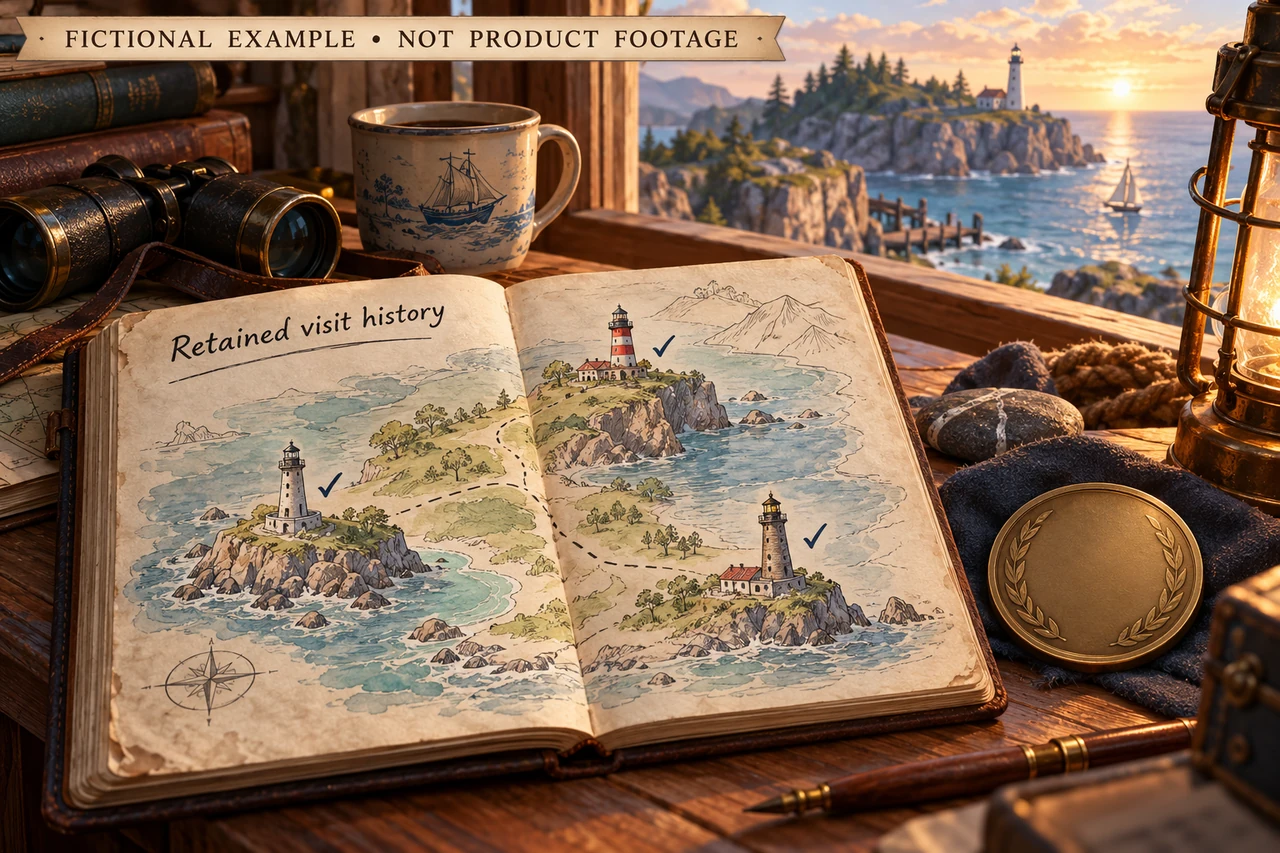
A fictional exploration journal shows the kind of retained location history a new achievement might inspect. No achievement has been awarded or save tested. Original AI-generated editorial illustration.
Original visual by Original editorial illustration generated with OpenAI’s built-in image tool. Created 2026-10-24.
Example two: history that cannot answer the question
Suppose another achievement requires completing a route without using a repair item. The old save records route completion but not repair-item use.
The team cannot infer the missing fact from completion alone. That does not prove the player failed, and it does not prove they qualified. It means the available record cannot answer the condition.
Explain the supported way to earn that achievement after the update. If a repeatable route works in an existing save, say so only after testing it. If a new run is genuinely required, name the affected achievement and the reason rather than presenting a full reset as generic troubleshooting. Keep the player's existing progress intact while investigating.
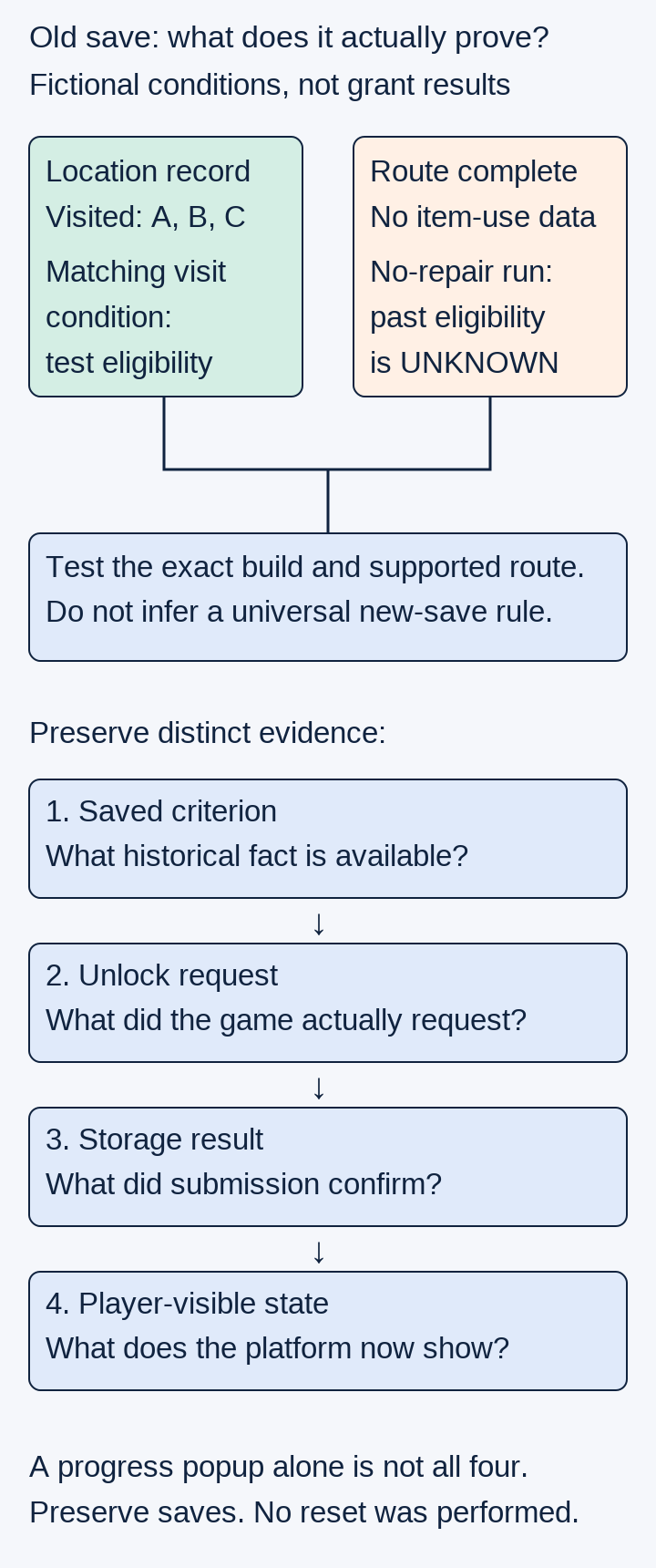
Original fictional evidence map. No save was loaded and no achievement was granted to create this illustration.
Original visual by the Superdirector editorial team. Creation date not recorded.
Separate the indicator from the confirmed result
Valve's documentation distinguishes application-specific achievement definitions, game-side state updates and uploading changes. Its interface reference states that a progress notification does not itself set progress or unlock an achievement. SetAchievement changes in-memory state; StoreStats sends changes for storage, with callbacks carrying results. Steam Stats and Achievements · ISteamUserStats reference
For editorial evidence, preserve four observations: the saved fact that supports eligibility, the game's unlock request, the submission result and the player-visible platform state. A popup or a checked item in a custom menu is not a substitute for all four.
This is not an initialization recipe or a recommendation to reset an account. Use the current integration's supported diagnostics and have the owner interpret failures. Do not copy development reset commands into a public workaround merely because they appear in an API reference.
A historical example of careful boundaries
Satisfactory's 1.0-era official notes in 2024 distinguished continued play with older saves from achievements that were not retroactive. The notes separately describe story/progression caveats and say that some actions may need repeating for achievements. That is a product-and-version-specific example of communicating a limitation, not a statement about Satisfactory today or a universal Steam restriction. Historical official Satisfactory notes
The useful editorial pattern is the separation: save compatibility, achievement eligibility and story/progression experience each receive their own explanation. Do not compress them into “old saves supported” and expect the player to infer the exceptions.
Test the announcement against retained cases
Prepare non-destructive test copies representing a qualifying older save, a non-qualifying older save and a new playthrough. Add relevant connection-state cases only within the team's authorized test setup. Record the exact build and observed outcome rather than assuming that one successful online case covers every circumstance.
If the condition is checked only after a specific supported action, describe that action precisely. If the result is pending or inconsistent, name it as unresolved. Do not promise an exact synchronization time from one observation, and do not claim that reloading always repairs the issue.
Ask a reviewer to read the proposed note and identify which achievements apply to them, what they should do, and whether their existing progress is at risk. Revise unclear wording before publishing the exact tested revision.
What counts as done
The announcement is ready for its next review when each eligibility claim has a matching evidence row, exceptions are named and the support route does not demand destructive experimentation. Keep metadata preparation, implementation testing, public release notes and confirmed player outcomes as separate states.
Track actual support questions after an authorized release. Repeated confusion about a named condition can justify a clearer note or another test, but it does not establish that all achievements or all older saves are broken.
Evidence and limits
The cited developer and player discussions are limited qualitative examples, not a demand survey. Validate each proposed check against the actual game implementation and the retained history in its older saves.