How-To Guide
How long should a UGC video be?
Choose a UGC video length for the exact account, placement and ad format. Separate official duration rules from a fictional production timing plan.
By the Superdirector editorial team.
At a glance
How long should a UGC video be?
Choose duration for the exact account, placement and ad format, then allow enough time to complete the task truthfully. A maximum, an in-feed playback segment and a provider recommendation are different rules. The inspected sources give different limits for organic Shorts, Shorts ads, TikTok auction formats and bumper ads; no single optimal UGC length or performance promise is established.
- Record the actual destination and current source rule before specifying seconds.
- Keep hard limits, playback limits and recommendations separate; unverified organic limits stay unknown.
- The 24-second timeline is a fictional planning allocation, not an optimum or a tested script.
Name the exact destination before choosing seconds
There is no single UGC video length that fits every task or placement. First name the publishing account, organic or paid route, specific ad format where applicable, and where the viewer will actually watch. Then distinguish the allowed asset duration from a platform recommendation and from the time needed to explain your product truthfully.
A file made for a creator’s organic post can later need a different edit for a brand ad. “Vertical video” does not identify the account, campaign or destination. Ask the actual publishing owner which format is being used and keep its current source requirements beside the brief.
| Record | Why it changes the length decision |
|---|---|
| Platform and actual account | Eligibility, available tools and historical upload rules can differ |
| Organic post or named ad format | An organic Shorts rule is not the complete Google Ads specification |
| Full asset and in-feed playback | An admitted video can have only part of its duration played in one surface |
| Sound and other rights | A selected track or claimed material can restrict an otherwise allowed video |
| Communication job | A clear demonstration needs the relevant action and limitations, not merely a short timer |
The UGC format guide helps choose the viewer question. This page starts after that choice and helps turn the actual placement requirements into a duration brief. It does not supply a measured retention optimum or claim that a particular number of seconds produces sales.
Read each duration rule within its own scope
The table records what the retained primary pages stated when read on November 5, 2026, Pacific time. “Maximum,” “playback segment” and “recommendation” are different fields. These readings do not prove that an uninspected account, file or campaign has been admitted.
| Specific destination | What the source states | What to keep separate |
|---|---|---|
| YouTube organic Shorts — standard channels | Square or vertical uploads on or after October 15, 2024, up to 3 minutes are categorized as Shorts | Earlier uploads retain their prior long-form status; this is a classification rule, not an ideal length |
| YouTube organic Shorts — Official Artist Channels | The source gives December 8, 2025 as the corresponding historical upload cutoff for square/vertical videos up to 3 minutes | Account/channel context and music claims remain relevant |
| YouTube Shorts ads | Asset up to 3 minutes; only the first 60 seconds play in the Shorts feed; a 50-second overlay offers the rest on the watch page | The source recommends under 60 seconds, but that recommendation is not its asset maximum |
| TikTok auction Non-Spark in-feed ads | The June 2026 specification says video duration up to 10 minutes | This is that auction-ad specification, not a verified organic recording/upload limit or every reservation format |
| TikTok auction Spark Ads (Pull) | The same page states no video-duration restriction in this specification | It does not establish unlimited organic-post/account capability, permission or availability |
| Google bumper ads | The video-format guide describes a duration between 5 and 6 seconds | A different ad format needs a different deliverable; a skip point is not a maximum length |
| Instagram organic Reels and TikTok organic creation/upload | Current usable duration text was not obtained from the attempted help pages | Confirm the actual route with the publishing owner; do not borrow a YouTube or paid-ad limit |
The organic Shorts rows come from YouTube’s three-minute explanation. It distinguishes standard and Official Artist Channels and the historical upload dates. It also states restrictions for over-one-minute Shorts with active copyright claims and says most available Shorts-library songs can be used for up to 90 seconds, with some limited to 60 or 30. Check the actual track and rights; these statements do not grant a commercial music license for every later ad use.
The Shorts-ad asset page supplies the three-minute asset, 60-second feed-play and 50-second overlay distinctions. Its under-60 recommendation is published guidance, not a universal optimum verified by this article. The same page explains that individual assets cannot be pinned to a single format in every multi-format campaign setup. The ad owner needs the actual campaign route, not just the word “Shorts.”
The TikTok auction specification separates Spark Pull from Non-Spark. “No restrictions” appears under the Spark Pull duration field; it is not a promise that any length can be created or published on every source account. Other specification, authorization, content and account requirements still need their own review.
Google’s format comparison also separates bumper, skippable, in-feed and non-skippable ads. Its non-skippable range depends on campaign subtype. Do not treat the point at which someone can skip an ad as the maximum duration of the uploaded file.
Set an editorial duration that can complete the task
A platform ceiling answers whether a file may fit one requirement. Your brief must also say what the viewer needs to understand. List the required demonstration, factual qualification, relationship disclosure and next action. Plan time for those elements before choosing a shorter version.
- For an unboxing, allow the actual included items to be distinguishable; do not hide an extra prop or a missing item with a fast cut.
- For a demonstration or tutorial, retain the actions needed to understand what happened. Do not shorten the edit by removing a step that changes the apparent result.
- For an experience account, preserve the speaker’s actual basis and limitations. A concise script must not invent a longer history of use.
- For a cutdown, decide which narrower communication job it can honestly perform. It may need a different script instead of a faster version of every original line.
Read the proposed wording aloud in the intended voice and walk through the actual action before finalizing its duration. That is a production task to perform, not a test conducted for this article. If the message or action does not fit, revise the scope or wording; do not turn rapid speech or constant visual changes into an assumed public standard.
FTC staff guidance for relevant U.S. endorsements places disclosure with the endorsement and calls for video disclosure in the video itself. Keep it understandable where the endorsement occurs. A short duration is not a reason to push the only disclosure into the description or reserve it for a final frame that viewers may not see.
The UGC brief guide covers the full assignment. State this particular duration, placement and required content within that brief, alongside what remains unverified.
Use a fictional timeline without calling it an optimum
Original fictional planning exercise — no script was timed, product filmed or campaign tested. Suppose an assignment asks for a 24-second demonstration of a small desk cable divider. The imagined job is to show one arrangement and a visible limitation, then offer a next action. The proposed allocation below is arithmetic for a draft, not a claim about how long the real task or a platform requires.
| Proposed segment | Allocated time | What the draft must preserve |
|---|---|---|
| 00:00 to 00:04 | 4 seconds | Identify the actual task and product; keep any relevant relationship disclosure with the endorsement |
| 00:04 to 00:16 | 12 seconds | Show the necessary action on the actual divider without hiding a material step |
| 00:16 to 00:20 | 4 seconds | State the relevant observed limitation or condition, supported by the real evidence |
| 00:20 to 00:24 | 4 seconds | Give the intended next action without adding a new unsupported claim |
The segments are contiguous, with each end marking the next start: 4+12+4+4=24 seconds. Disclosure is a presentation responsibility across the relevant endorsement, not a new event that is automatically finished after the first segment. The action, words and readability still need to be rehearsed; if they do not fit, the draft allocation changes.
This imagined 24-second plan exceeds a 5–6-second bumper format. A bumper version would need its own appropriate job and script, not the assumption that the whole demonstration can be compressed. Conversely, a three-minute maximum does not require adding material until the file reaches three minutes.
The editable duration brief and blank CSV keep destination rules, recommendations, required content and the actual export duration in separate fields. They are manual teaching aids, without automatic calculation, platform checking or saving.
When enlarged, scroll horizontally to read the diagram.
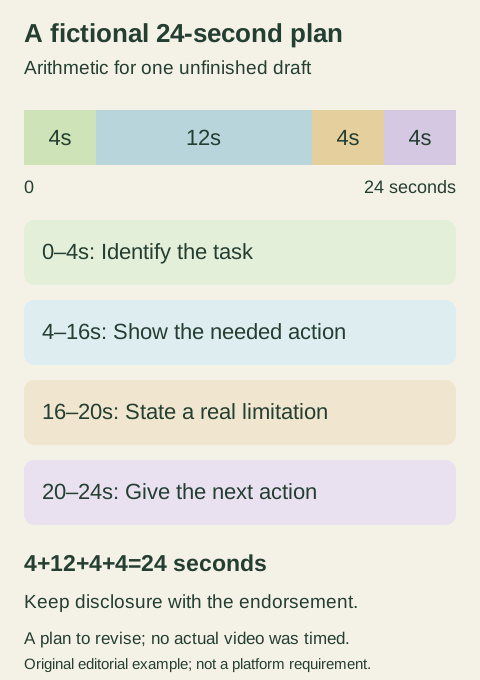
Original fictional timing allocation. The arithmetic is 4+12+4+4=24 seconds; no platform optimum, speech trial or campaign result is implied.
Original visual by Superdirector editorial team. Creation date not recorded.
Review the actual export for the intended placement
Measure and watch the finished file, including the last frame, sound and captions. Compare it with the exact placement and account requirement the owner recorded. Check that a shortened version still communicates the product task and that a crop or overlay has not hidden the evidence, qualification or disclosure.
- Keep the source URL, reading date, named format and the owner who confirmed the actual route.
- Record the final file/version and measured duration separately from the proposed timeline.
- Retain the original full explanation and identify what each shorter version changes. Do not assume that different lengths are interchangeable assets.
- Check any music, platform labels, ad permissions and other conditions through their own current requirements.
- Leave admission or performance unverified until the appropriate actual evidence exists. A file under a numeric limit is not a complete publication proof.
Evaluate the actual published version under its own measurement plan. This article establishes no universal ideal, minimum word rate, cut frequency or expected watch time. Choose an honest, understandable asset for the real destination, then learn from that actual work rather than treating a duration table as a performance forecast.
Sources and limits
Three full primary-page anatomies—YouTube three-minute Shorts, Google Shorts-ad assets and TikTok auction in-feed specs—were read before drafting. The complete Google video-format page and FTC disclosure guidance were also read. TikTok’s ad page is marked June 2026; reading and capture dates are separate from source publication/update dates.
The attempted Instagram Reels and TikTok organic help pages returned error shells, so no organic duration cap or account availability was taken from them. No video, live upload, account, ad setup, speech trial or campaign outcome was tested. The table, timeline, diagram and worksheet are original editorial synthesis; provider recommendations are not our measured optimum.