How-To Guide
Write a handmade holiday cutoff that separates making, dispatch and arrival
Explain handmade holiday ordering deadlines without confusing production time, dispatch dates and buyer-specific estimated arrival.
By the Superdirector editorial team.
For a made-to-order Etsy gift, “order by Friday” is incomplete. The buyer needs to know which product and destination the date covers, whether it is the last date you accept work or an estimated arrival cutoff, and what happens after it passes. Build the announcement from the production schedule and the delivery estimate, not from the date you want a campaign to end.
This guide provides a fictional planning example and copy structure. It does not supply a carrier deadline or guarantee a holiday delivery. Use the current information for your own shop and shipping services.
Put three dates on different lines
Order cutoff: your decision to stop accepting a particular holiday-oriented order or production option.
Dispatch commitment: when you expect to hand the finished order to the carrier, after making and packing it.
Estimated arrival: the delivery window for the buyer's actual destination and service, which is not interchangeable with dispatch.
Etsy's processing-time guidance, checked October 26, 2026, includes making time in custom-order processing. It says processing begins the day after purchase and uses the shop's processing schedule; profiles can differ by variation. The shop's ready-to-ship or made-to-order profile label itself is not visible to buyers. Do not assume that an internal label explains the offer in your Reel.
Work backward from a feasible handoff
First identify the product options you can actually finish. A stocked ornament and a hand-lettered version may share a product page but need different preparation time. Count work already accepted, finishing or drying stages, review steps and the time needed to pack. If a personalization proof must be approved first, identify what happens when approval is late rather than assuming every customer replies immediately.
Next, read the delivery estimate for the intended destination and service. Keep the source and the date checked. A shipping upgrade changes the shipping service, not automatically the time you need to make the item. Avoid promising a rush result until both stages are feasible.
Finally choose a public cutoff you can support. It may be earlier than a carrier's published last-sending date because your product is not sitting in a parcel yet. If you cannot substantiate arrival before the occasion, keep the offer open only with language that does not imply that arrival.
Check the estimate a buyer actually sees
Keep the seller-side processing profile and the buyer-facing estimate as two separate observations. Record the exact variation, quantity, destination context, service and observation time. A default product selection is not evidence for the option shown in your creative. Keep real customer addresses out of the content brief.
Etsy's estimated-delivery guidance says its ranges use processing information, carrier times and historical data. Past shipping behavior can affect the estimate without changing the configured processing time or ship-by date. A disagreement therefore needs investigation; it is not automatically a software defect.
A public October 2026 seller report describes processing-profile and displayed-estimate inconsistencies. Etsy's support-bot reply points to historical shipping behavior; the reporter disputes whether that explains the different editor states. This is an unresolved report, not a verified diagnosis for your shop. Preserve the inputs and visible results before changing settings. Do not repeatedly toggle shop status or shared profiles just to obtain a convenient campaign screenshot.
For a real check, use one compact record: creative version; item and option; processing profile observed; buyer-visible date range; destination/service context; timestamp; mismatch; next correction. If the buyer-visible estimate remains uninspected, an arrival claim remains unsupported even when your production arithmetic is correct.
Fictional example: two ornament options
Imagine a seller with plain ornaments already made and personalized ornaments requiring four processing days. For this example only, the maker works Monday to Friday, has no intervening closure, and has already established enough available capacity. An order placed Monday starts processing Tuesday; four processing days are Tuesday through Friday. Friday is the planned carrier handoff—not the arrival date.
The calculation is useful because it exposes the next missing fact. Without a verified delivery estimate for that buyer's destination and service, the seller still cannot write “arrives by Sunday.” Do not fill the gap with an assumed two-day journey.
| Offer | What the campaign can say once verified | What still needs checking |
|---|---|---|
| Plain ornament, available stock | Preparation and dispatch timing for that stocked option | Destination-specific delivery estimate |
| Personalized ornament | The production cutoff and applicable preparation period | Personalization approval, remaining capacity and delivery estimate |
| Order placed after cutoff | Whether orders remain open for a later arrival | Updated public wording and actual listing settings |
When enlarged, scroll horizontally to read the diagram.
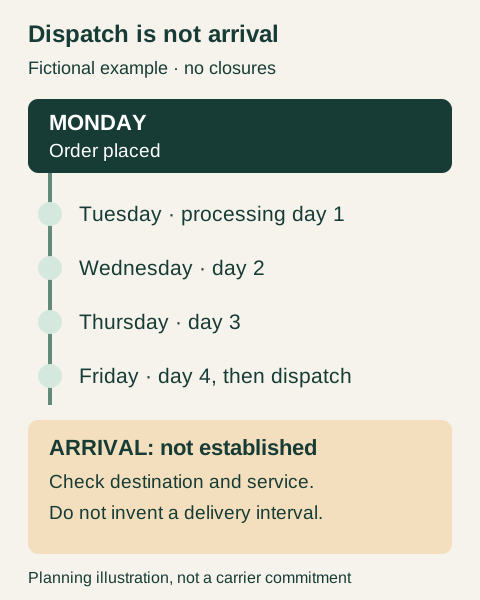
Figure: A fictional Monday order with four weekday processing days reaches Friday dispatch. Delivery remains a separate unknown until checked.
Original visual by Superdirector editorial team. Creation date not recorded.
Write the Instagram announcement as a decision aid
Use the opening frame to name the affected offer, not merely “last chance.” The next frame should show the distinction that changes the buyer's choice: stocked versus personalized, for example. End with the current listing as the source for the delivery estimate.
A fill-in structure is:
For [specific option] orders intended for [occasion], our ordering cutoff is [date, time and timezone]. Preparation takes [verified period]. Check the estimated delivery shown for your destination before ordering. Orders after this cutoff [actual later-order policy].
This is a copy template, not a ready-to-publish promise. Remove a field rather than inventing a deadline. If the shop cannot support an occasion-based claim, use a simpler announcement: “Personalized orders placed now are being made for dispatch in [verified window]. Please do not order expecting arrival before [occasion].”
A YouTube making video can show why the preparation stage exists: lettering, drying, assembly and packing. It should distinguish condensed footage from elapsed production time. A fifteen-second montage does not mean the item can be made in fifteen seconds.
Retire the old promise everywhere it remains visible
A listing edit does not change the spoken line inside yesterday's Reel. Make a small inventory of the active announcement, pinned post, profile link destination, scheduled posts and any creator assets you control. For each one, record the exact promise and its expiry action.
At the cutoff, stop scheduled messages that still invite the old outcome. Where a platform supports a meaningful edit, put the correction where a viewer will see it; do not assume a late comment repairs a misleading opening frame. Remove or replace an asset when its central promise is no longer true. Keep later-order content useful by explaining the next available dispatch window instead of manufacturing another last chance.
Respond to a late-arrival question without silently accepting it
If a buyer writes that the gift must arrive on a particular date, compare that requirement with the actual order. Do not treat silence as agreement to a later arrival. Etsy's current help describes a limited ship-by adjustment process and says to confirm the new date with the buyer before changing it; changing a field is not a substitute for that conversation.
Keep the campaign review separate from individual-order support. For the campaign, success means viewers can tell when they are ordering, when the work can leave, and whether arrival remains an estimate. For orders, track the commitments actually made and the handoffs actually observed. Neither a clear post nor a printed label proves a parcel has arrived.
Start with one offer and one cutoff notice. See Superdirector's planning workflow if you need a place to organize the creative brief; verify capacity, dates and shipping promises against your own operation before publication.