How-To Guide
Preorder launch creative: separate what is charged today from what is due later
A preorder badge tells the buyer that the product is not ready to ship. It does not, by itself, explain when money is collected.
By the Superdirector editorial team.
A preorder badge tells the buyer that the product is not ready to ship. It does not, by itself, explain when money is collected. Before filming a launch demo or writing an offer page, separate the order event, today's charge, the later payment trigger and shipment.
Use the configured purchase option and actual checkout as evidence. Do not create a convincing animation of a payment flow that the store has not implemented.
Choose the payment story before the visual story
Shopify's preorder overview describes full, partial or no payment at order time, depending on the offered option, and requires a preorder app and supported payment setup. Those possibilities are not proof that your chosen app and provider implement your intended flow. Shopify preorder overview.
Make a short internal record before producing creative:
- What exact product and quantity is ordered?
- What amount is collected when the order is placed?
- What remains due, and what event or date triggers it?
- What shipment timing is actually supported by the business?
- Which app, purchase option and checkout revision provide the evidence?
Leave unverified fields marked as unknown, so that a designer never has to invent the missing balance date just to finish a storyboard.

AI-generated illustrative mockup. The amounts are fictional and exclude shipping and tax. Payment timing and fulfillment readiness are separate promises; the mockup is not a live offer or payment test.
Illustrative mockup by OpenAI image generation, editorial direction for this article. Created 2026-10-24.
A worked example: a small-batch desk lamp
The lamp in this example is not yet ready to ship, and its preorder carries a hypothetical $30 deposit and a $70 product balance due later. Shipping and tax are outside these figures. The scenario is for teaching and is neither a live offer nor a payment recommendation.
The first frame identifies the lamp and makes clear it is a preorder. The next frame distinguishes the $30 due now from the $70 due later. The third states the verified collection trigger, once the merchant has established it. Shipment appears as a separate event rather than an animation immediately following the deposit.
If the real offer collects the full amount up front, the storyboard should say that instead. Do not keep a deposit narrative because it sounds less demanding. If it collects nothing now, do not call an order confirmation a paid purchase.
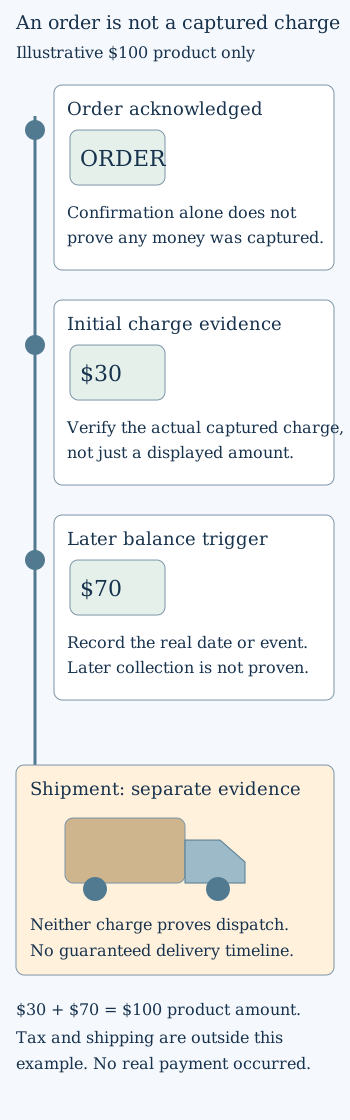
This original timeline is a planning aid, not a checkout screenshot, payment receipt or delivery guarantee.
Original visual by the Superdirector editorial team. Creation date not recorded.
Check the actual checkout before recording a demo
Shopify's setup documentation describes deposit information at checkout and lists restrictions on accelerated checkout methods, including Shop Pay, Apple Pay and Google Pay for preorders. A familiar payment logo should not appear in your demo unless the supported flow actually offers it. Preorder setup and checkout.
Open the exact product and purchase option you intend to promote using an authorized preview or test arrangement. Record the displayed amounts and timing. Do not stitch an ordinary-product checkout onto a preorder page and present it as one continuous real journey.
If your demo is a mockup, label it as one. If it is a real recording, capture the current revision and remove personal or payment information. Keep enough context that a reviewer can identify which product and option were selected.
Do not complete a charge without authorization. A preview can establish what was displayed; it cannot establish that funds were captured or that a later payment will succeed.
Test the mixed-cart case separately
Two products can interact in a way that a single-item screenshot does not show. Shopify documents that multiple preorder dates can consolidate: the earliest dated payment can apply across the products, while due-on-fulfillment takes priority over a specific date. Deposits combine at checkout. Multiple preorder payment terms.
That makes a mixed-cart check necessary when your campaign permits it. Select one realistic cart containing the products you expect customers to combine. Compare the actual displayed terms with the narration and offer record.
Do not promise two independent balance dates by placing two single-product screenshots side by side. If the combined checkout changes the timing, explain the actual combined flow or narrow the creative to the supported case.
Keep payment status and fulfillment status distinct
An order can be confirmed without being fully paid, and a payment event does not show that a product has shipped. Use the exact status evidence available from the authorized store or provider, and do not treat every green checkmark as the same event.
For internal review, keep separate fields for order created, amount captured, remaining balance and shipment evidence. Do not infer captured funds from an authorization or assume a stored payment method guarantees later collection.
Likewise, avoid giving a shipment promise simply because the balance has a due date. The business needs its own support for the production and delivery statement. Applicable consumer obligations require qualified review; this article is a creative-verification guide, not a legal assessment.
Review the buyer's understanding
Give a reviewer the proposed creative and ask what would leave their account today, what might be charged later and when they expect the product to ship. Compare the answers with the verified offer record.
If they confuse a deposit with the full price, revise the visual hierarchy. If they assume payment automatically means immediate dispatch, separate those events more clearly. Keep the final creative tied to the checked purchase-option revision.
After launch, report completed initial payments, collected balances and fulfilled orders as three separate counts. Begin with a truthful preorder explanation that matches the supported checkout, and judge customer understanding apart from commercial outcomes.