How-To Guide
Choose interest collection or conditional preorders around the production decision date
A small-batch launch has at least two clocks. Customers take time to decide, while a supplier may require a commitment on a particular date.
By the Superdirector editorial team.
A small-batch launch has at least two clocks. Customers take time to decide, while a supplier may require a commitment on a particular date. A collection method that looks convincing today may provide the wrong evidence when that production decision arrives.
Start with the decision you need to make, not the app you want to install. Are you learning which design people might want, or deciding whether to commit to a feasible batch under known conditions? Those questions can require different evidence. Neither a signup total nor an order count automatically answers both.
This guide proposes a planning record for a niche physical-product seller. It does not set a minimum viable batch, recommend a payment setting or establish a legally compliant preorder offer. Platform sources were checked on October 24, 2026; actual supplier, account and customer obligations need their own review.
Put the production commitment on the calendar first
Write down what the owner would actually commit to: the product revision, assortment, supplier quote, capacity and decision date. Record which facts are confirmed, which are estimates and which are unknown. Include the consequences of waiting or changing the assortment, using the actual supplier terms rather than an invented standard.
Then identify the missing evidence that could change that decision. Perhaps there is no feasible quote yet. Perhaps the quote exists but the customer collection route cannot support the planned timing. Perhaps the product can be made, but the shipment statement still lacks a reasonable basis.
A useful record ends with a conditional sentence: “At the supplier decision date, the owner will review these specific facts before deciding whether to commit.” Do not finish that sentence with a borrowed order target from another seller. The required quantity and resources depend on this product and this business.
Choose what you are collecting, without renaming it
Nonbinding interest can help investigate preferences without presenting a completed purchase. It should be described as interest, with no unsupported allocation or fulfillment promise. It cannot establish paid demand or available production funds.
A preorder is different even when nothing is collected initially. Shopify's preorder overview describes full, partial or no initial payment, depending on the option. It requires an app and supported setup. Therefore, “no money today” does not automatically make a preorder an ordinary waitlist. Verify what the actual flow and terms create.
Keep the record narrow: what the customer does, what commitment is represented, what evidence results and what remains conditional. A campaign designer should be able to select an accurate call to action from that record. Do not use a purchase-shaped confirmation for an interest-only request simply because it looks more persuasive.
Match the collection mechanism to the decision clock
If the proposed route relies on a card authorization, inspect its actual expiration relative to the supplier decision. Shopify's authorization guidance says capture must occur within the provider's authorization period. Extended availability has conditions; it is not a universal way to hold a commitment indefinitely.
This is not the same as every deferred preorder mechanism. Identify whether the planned route uses an existing authorization, a later billing attempt or another supported arrangement. Do not transfer one mechanism's timing to another because both screens say “preorder.”
The key comparison is temporal: will the evidence still mean what the production plan assumes when the owner needs it? A route that expires before the decision cannot be treated as automatically collectible afterward. A later attempt that needs customer participation remains conditional. Moving a date in a spreadsheet does not change provider behavior.
Do not change capture settings or charge customers to make a planning diagram pass. Have the responsible operator verify the actual arrangement through an authorized test and provider records before using it in a live offer.
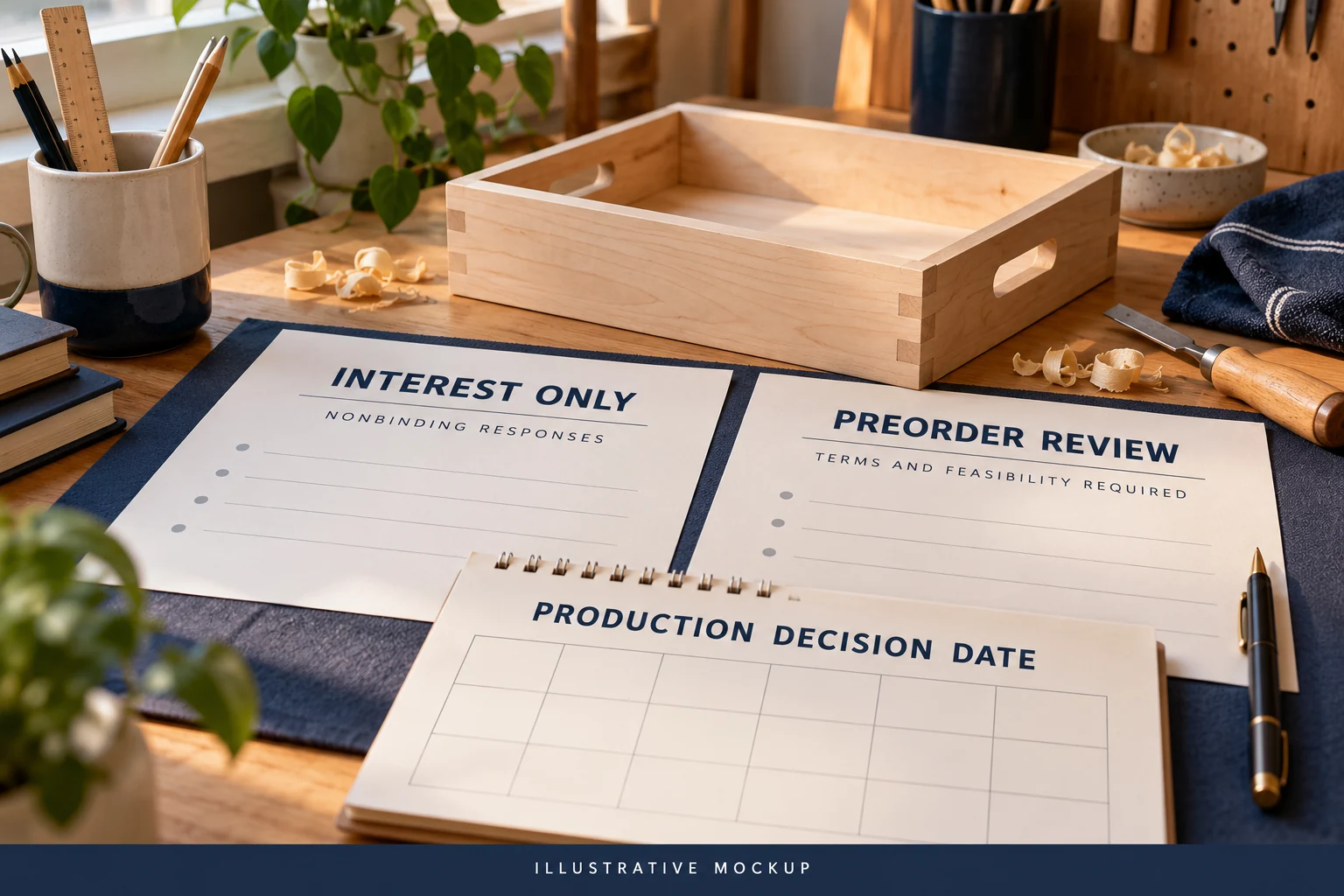
AI-generated illustrative mockup. These are fictional readiness states. Interest is not units sold, and a preorder requires its actual conditions, feasibility and decision timing to be established.
Illustrative mockup by OpenAI image generation, editorial direction for this article. Created 2026-10-24.
A fictional comparison: the same product, two different readiness states
Imagine a maker developing a small-run desk tray. In the first scenario, the supplier has not confirmed a workable quote or production timing. The immediate question is which proposed configuration deserves more investigation. A clearly nonbinding interest exercise can inform that question while the maker resolves feasibility. Calling those responses “units sold” would add certainty that the evidence does not contain.
In the second scenario, a quote and supplier decision date exist. The maker considers conditional preorders. During planning, the operator discovers that the contemplated authorization would expire before the supplier decision. The number of interested customers does not repair that mismatch. The owner must reconsider the proposed route or timetable, with the relevant operational and obligations review, before opening it.
Suppose another supported arrangement instead attempts collection later. That still does not justify entering its unpaid total as available cash. Shopify's preorder management guide describes failed payments, possible additional customer confirmation and unpaid preorder states. The decision record needs those contingencies, not a guaranteed collection assumption.
Both scenarios are invented teaching examples. There is no recommended threshold, actual supplier quote or demonstrated customer outcome here. Their difference is the question the evidence can answer at the required time.
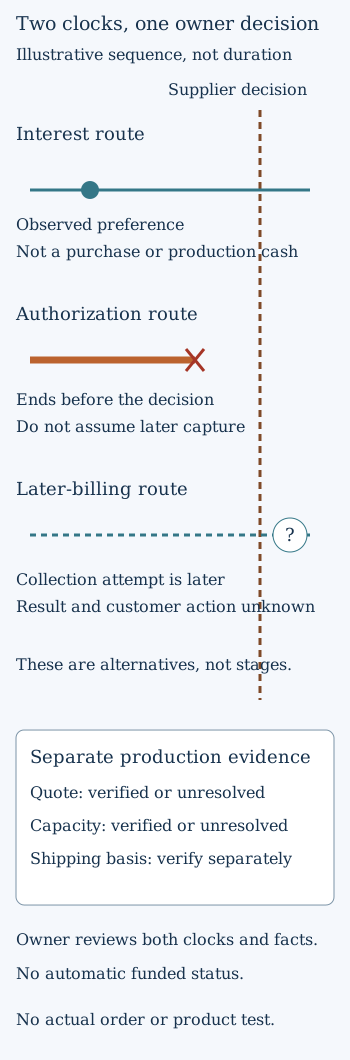
The diagram is an explanatory model. Its spacing is not a provider duration, and its markers are not real transactions.
Original visual by the Superdirector editorial team. Creation date not recorded.
Keep feasibility alongside customer evidence
A response count cannot establish that the product can be produced or shipped as described. Shopify's setup guidance requires a reasonable basis for the shipment timing stated to customers. The actual offer also needs review against applicable obligations; this article does not supply a cancellation or refund procedure.
At the decision date, review production evidence and customer evidence side by side. For each relevant customer record, distinguish the observed action from any future assumption. For the batch, distinguish the quote, capacity and shipment basis from hoped-for improvements.
Possible planning outcomes include retaining the proposed route for owner review, revising the plan or holding the commitment because a necessary fact is missing. Do not turn this into an automatic “funded” badge. Even collected payment does not by itself prove manufacturing readiness, sufficient resources or successful fulfillment.
Give launch creative the same decision boundary
Once the owner has established the supported offer, brief the creative around its actual state. An interest-learning message should explain what people are expressing interest in. A conditional preorder explanation should make the relevant conditions understandable without implying that production is already assured.
For an Instagram sequence or YouTube walkthrough, keep the product's current state and the customer action visible. If the offer changes after the production decision, review the older creative before reusing it. A compelling earlier clip can become inaccurate when it describes a different commitment.
Ask an internal reviewer what they believe will happen after the action. Compare that answer with the actual decision record. This is a comprehension check, not evidence that a customer will buy or that a later payment will succeed.
Close the decision, then observe the outcomes separately
Save the dated decision and the evidence the owner actually used. Later, keep interest responses, orders, collected payments and fulfilled products distinct. Do not retrospectively relabel every early signal as a successful purchase.
Merchant questions about a conditional batch that might not proceed and charging later while avoiding excess inventory illustrate two planning concerns. Their suggested methods still need to be checked against the actual supplier terms and supported payment flow.
Put the supplier decision date and actual collection mechanism into one record. If their timing or meaning does not align, resolve that gap before opening the offer.