How-To Guide
Separate transport packaging from the product a retailer needs to display
A sticker can arrive without a sleeve and already match one store's display rules.
By the Superdirector editorial team.
A print can arrive inside a protective tube and still need work before it can sit in a shop browser. A sticker can arrive without a sleeve and already match one store's display rules. “Well packaged” is therefore not a complete specification for a maker supplying retailers.
The useful question is what remains after the receiver removes the transport layers. Can the store identify, count and display each item in the agreed way, and who supplies any label? Answer that for the exact recipient and order route before purchasing packaging or making a retailer-facing promise.
This guide proposes a receiving-and-display review. Sources were checked on October 24, 2026. No actual order, packaging trial, retailer agreement or damage outcome was verified. The named examples describe particular organizations' published requirements, not universal wholesale or conservation standards.
Identify the destination before designing the package
Record the retailer or gallery, the relevant order or consignment arrangement, the product category and the receiving route. Shipping to a retail store, a distribution center or directly to an online customer can carry different instructions even within the same organization.
Keep the current requirements with the proposed packaging revision. A remembered preference from a previous shop is not evidence that the next one wants the same sleeve, price label or barcode. If the requirement is unclear, leave it unresolved for the responsible owner rather than printing a large batch of labels on an assumption.
Consignment and wholesale are also different commercial arrangements. The examples below use both kinds of destination to demonstrate the need for precise instructions, not to suggest that their agreements, fees or ownership terms are interchangeable. If the proposed deal is still unclear, classify what the shop is actually offering before preparing stock; packaging cannot settle ownership or payment terms.
Give three packaging jobs separate names
First is transport protection: the outer materials and packing arrangement used to move the product. Second is the handling or display layer that stays with the item while a shopper browses. Third is identification: the information the receiver needs to recognize, inventory or sell the item, including any agreed price or barcode.
One component can do more than one job. A backing board may support a print during both handling and display. That does not make every outer mailer part of the retail presentation. Likewise, a shipping label does not automatically identify each individual product after a carton is opened.
Prodigi's shipping guide describes different transport formats by print type, size and fulfillment location, including rolled fine-art prints with specified flat-packed exceptions. This is supplier-specific information, not proof that any shipment is ready for a particular retailer's browser or that transit damage is impossible.

AI-generated illustrative mockup: shipping protection and retail display preparation are separate jobs. The retained materials and identification must match the actual receiver’s requirements; this is not a tested packing design.
Illustrative mockup by OpenAI image generation, directed for this article. Created 2026-10-24.
Use named requirements as contrasts, not a universal recipe
The Artist's Hoard's display guidelines require sleeves and backer boards for art prints, sleeves with optional backers for greeting cards, and do not require packaging for stickers. That store says it creates the barcodes and requires an inventory list with each drop-off. These are its consignment rules, not a mandate to remove packaging from stickers destined elsewhere.
Edinburgh Printmakers' consignment guidance gives a different, specific browser-print preparation: stiff backing, secured wrapping and identification readable without unwrapping. Its illustrated wrapping guide contrasts well-supported, neatly wrapped prints with examples of inadequate backing or loose and damaged wrapping. The guidance belongs to that organization's display context; it does not certify archival suitability or shipping performance for every material.
The lesson is not “buy all these supplies.” It is “match the retained layers to the receiver's actual handling and display task.” A photograph of attractive packaging cannot answer that on its own.
Build a removal map for one proposed delivery
In a fictional art-print example, draw an outer transport carton, then a separately wrapped and backed print inside it. Mark the carton as removed at receiving. Mark the backing and sleeve as retained only because the intended destination's checked instructions require them. Put product identification where the receiver can read it without dismantling the agreed presentation.
Now compare a second fictional route for a sticker supplied to a shop that does not require individual sleeves. Do not add a sleeve merely to make the package resemble the print example. Confirm the actual identification and inventory process instead. A transport container may still be needed; “no individual sleeve required” does not mean “no protection during shipping.”
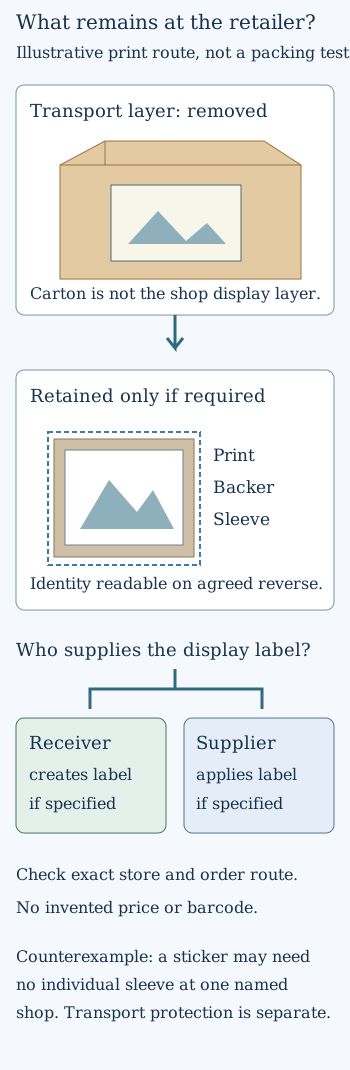
The diagram is not a product photograph, a tested packing design or an instruction for every shop. Its shapes explain which layer remains and which responsibility still needs agreement.
Original visual by the Superdirector editorial team. Creation date not recorded.
Resolve price and barcode responsibility separately
A maker may use a price-and-SKU label at their own market stall and hope to reuse it for every retailer. Before doing that, check whether the receiving organization supplies its own labels, requires a particular supplier-applied label or treats online fulfillment differently.
For example, Indigo's published price-sticker requirements distinguish retail distribution-center and store orders from online distribution-center or dropship orders. The retail route requires price-ticket information based on the purchase order, while the online routes described there should not have price stickers attached. This is a Canadian retailer's route-specific instruction, not a general rule for boutiques. Its guidance also says labels must not cover warnings or care information.
A useful private production plan can therefore keep the base packaging separate from destination-specific finishing. Record who supplies the identifier, who applies it, which value is authoritative and where it belongs. Do not invent a barcode, assume that a printed symbol scans, or cover protected information to make an existing label fit.
Assign the work between supplier, maker and receiver
A supplier may provide transport packing but not the receiver's display preparation. A maker may add the retained sleeve and identification before shipment. A store may create its own barcode after receiving the inventory. Each is a possible allocation of work, not an assumption about a particular agreement.
Write the responsible party beside every necessary step. If a rolled print must become a backed browser print, identify who is responsible for the preparation and whether the actual materials and process are suitable. Do not invent a universal flattening technique or hand that unplanned work to the retailer by calling the shipment “retail ready.”
Include the real labor and materials in the offer's feasibility review. A low-cost shipping format can move work elsewhere rather than eliminate it. No savings or faster receiving time are established until the actual process is observed.
Rehearse receiving before finalizing the promise
Prepare one authorized sample using the intended product and packaging revision. Ask an internal reviewer to follow the receiver's instructions: open the outer packaging, identify the item, count the units and describe how it would enter the agreed display. Record what must be removed, retained, replaced or added.
If identification disappears with the outer carton, revise the item-level handoff. If the display layer must be opened to discover the product identity, compare that with the destination's actual rule. If a barcode is required, a visible printed mark is not a successful scan; that needs its own appropriate check.
This rehearsal is a proposed test, not evidence that it happened here. It also does not replace shipping validation, material-suitability review or the retailer's acceptance process.
The operator evidence is limited to historical questions: an artist asking about wholesale display packaging in the discussion's comments, and a separate maker asking whether wholesale packaging should carry a price. The first comment is not the thread's original author or date. Individual replies describe practice, not standards or measured demand.
The next useful output is one receiver-specific removal map and an assigned label responsibility, with unresolved requirements left visible. Only then can the maker accurately explain what arrives ready for display and what work remains.